Join our newsletters and be the first to receive app updates, exclusive content, and connect with a supportive network of accomplished women. Sign up today to unlock your journey to success with Miranna

Perimenopause Test: How to Know If You're in Perimenopause


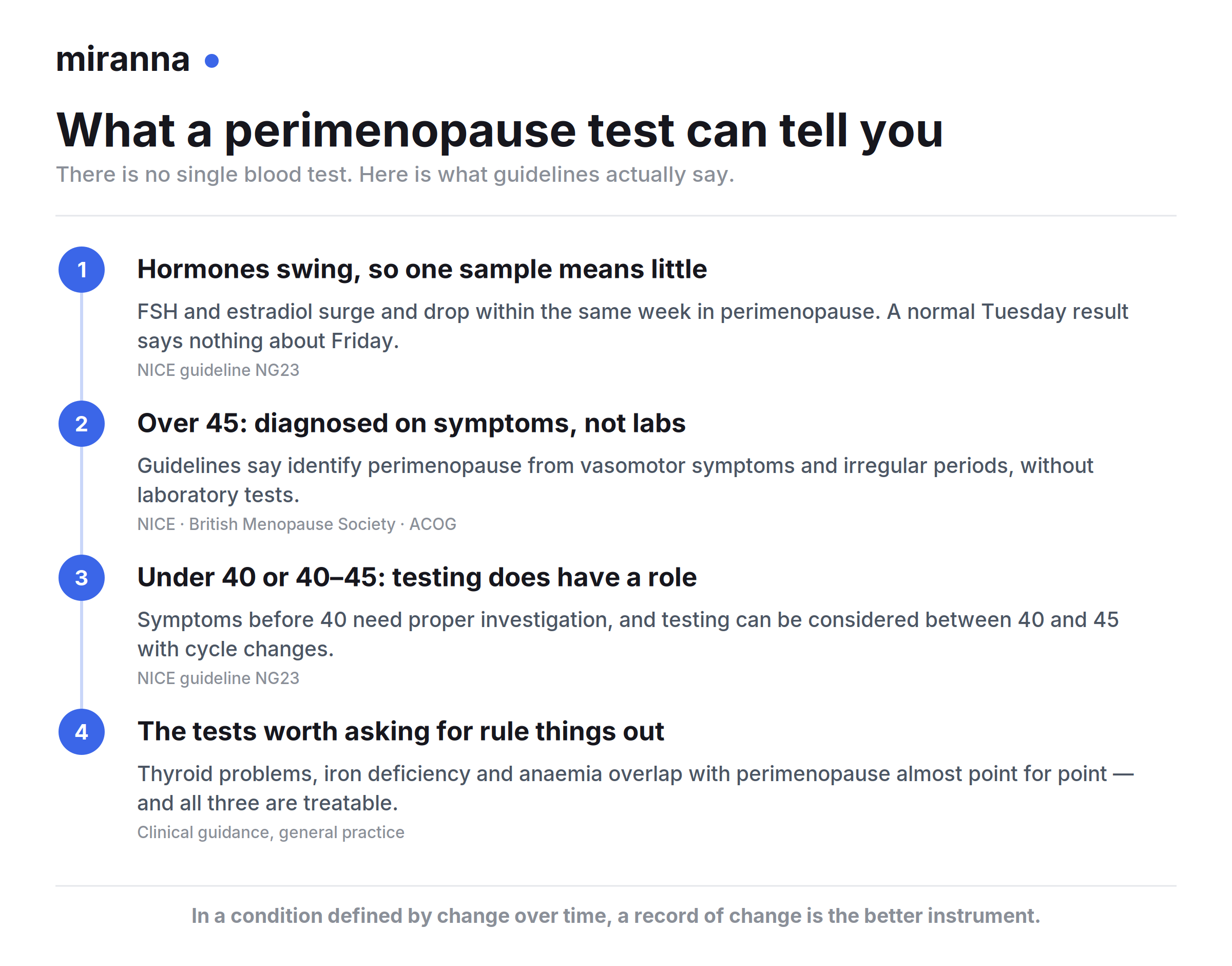
There is no reliable blood test for perimenopause. Hormones fluctuate too much day to day for a single measurement to mean anything, so major guidelines say that in women over 45, perimenopause is identified from symptoms and cycle changes — not lab work. The most useful test is a tracked record of what has changed.
This is not what most women want to hear. When your body has started behaving unpredictably, the promise of a number that settles the question is powerful — and there is an entire market built on exactly that promise.
So here is what is actually true, what a test can and cannot tell you, and what to do instead.
Is there a test for perimenopause?
Not a definitive one, no.
The UK’s NICE guideline is explicit: in otherwise healthy women over 45 with menopausal symptoms, perimenopause should be diagnosed on the basis of vasomotor symptoms and irregular periods, without laboratory tests. The British Menopause Society and the American College of Obstetricians and Gynecologists take the same position — hormone levels are unreliable in perimenopause and should not be used to diagnose it.
That is not gatekeeping or cost-cutting. It is because the test genuinely does not work at this stage.
Why do blood tests not work in perimenopause?
Because perimenopause is defined by fluctuation, and a blood test is a single frame from a very long film.
FSH — the hormone most often measured — rises as ovarian function declines. But during perimenopause it does not rise steadily. It surges and drops, sometimes within the same week. Estradiol does the same, occasionally reaching levels higher than in your thirties before crashing.
Which means a normal FSH result on a Tuesday tells you nothing about Friday, and certainly nothing about the past year. Women are routinely told their bloods are fine while sitting in front of a doctor describing a textbook set of symptoms. The result is not wrong. It is just answering a question nobody asked.
When is testing actually useful?
There are real exceptions, and they matter:
- Under 40 with symptoms. Premature ovarian insufficiency is a genuine diagnosis with real implications, and it needs proper investigation.
- Aged 40 to 45 with symptoms and cycle changes. Guidelines say testing can be considered here.
- Ruling other things out. This is the big one. Thyroid problems, iron deficiency, and anemia produce a symptom list that overlaps with perimenopause almost point for point, and all three are treatable. Asking for thyroid function, ferritin, and a full blood count is a specific, reasonable request.
So the useful version of “get tested” is not a hormone panel. It is ruling out the things that masquerade as perimenopause.
What are the signs of perimenopause?
The stereotype is hot flushes and skipped periods. In practice, the earliest changes are often cognitive and emotional — and because nobody expects those, they get attributed to stress, work, or personality.
In a large cohort of perimenopausal and menopausal women, the five most common symptoms were tiredness (96%), memory problems (93%), difficulty concentrating (91%), irritability (90%), and feeling tense or nervous (90%). Hot flushes ranked 18th.
Which is worth sitting with: the symptom everyone associates with this stage was less commonly reported than five things nobody warns you about. We have covered each of them on its own — the tiredness, the brain fog, the short fuse and the anxiety — along with the broken sleep sitting underneath most of it.
What about the 34 symptoms of perimenopause?
You will see this everywhere, usually as a numbered list with a product at the end of it.
Here is the honest position: the number is not clinical. It circulates because it is memorable and because it is excellent marketing — a list long enough that everyone recognizes something on it. Validated tools do exist, like the Greene Climacteric Scale and the Menopause Rating Scale, and they contain closer to 11 to 21 items, grouped into domains rather than presented as a symptom bingo card.
That does not mean the wider symptom list is fake. Estrogen receptors are distributed throughout the body, so this transition genuinely does touch skin, joints, mood, memory, sleep, and more.
But two things follow. First, breadth cuts both ways: a list broad enough to include almost anything will match almost anyone, which is precisely why it is used to sell things. Second, attributing every symptom to perimenopause is how genuinely treatable conditions get missed for years.
Use the list to recognize a pattern. Do not use it to conclude a diagnosis, and be sceptical of anyone who pairs it with a checkout page.
{{Article Banner}}
What are the earliest signs, and how young is too young?
Perimenopause typically begins in the early-to-mid forties, lasts around four to eight years, and can start in the late thirties. If you are 38 and something has clearly changed, you are not too young to ask.
The earliest signals tend to be subtle:
- A shorter cycle. Often the first measurable change — 26 days where it used to be 29.
- Worse premenstrual weeks. Rougher, longer, harder to ride out than they used to be.
- Sleep going first. Waking at 3 a.m. before anything else looks different.
- Mood and focus. New irritability, new anxiety, or fog, often a year or more before hot flushes.
Hot flushes, when they come, are often a late arrival — not the opening act.
How do you get taken seriously by a doctor?
This is the actual skill, and it makes more difference than any test result.
- Bring specifics, not adjectives. Not “I am exhausted and all over the place,” but “my cycle has shortened from 29 to 25 days over eight months, I have been waking at 3 a.m. most nights since spring, and the two days before my period are unrecognizable.”
- Bring the timeline. When each change started, and whether it tracks your cycle. Three months of notes on your phone is more diagnostically useful than any single blood draw.
- Ask direct questions. Could this be perimenopause? What else should we rule out? Can we check thyroid, ferritin, and full blood count?
- Do not accept “your bloods are normal” as the end of it. In women over 45, normal bloods are entirely compatible with perimenopause. That is the whole point of the guidance.
- Ask for a review, not a verdict. Symptoms shift. A follow-up in three months with tracked notes often gets further than one appointment ever will.
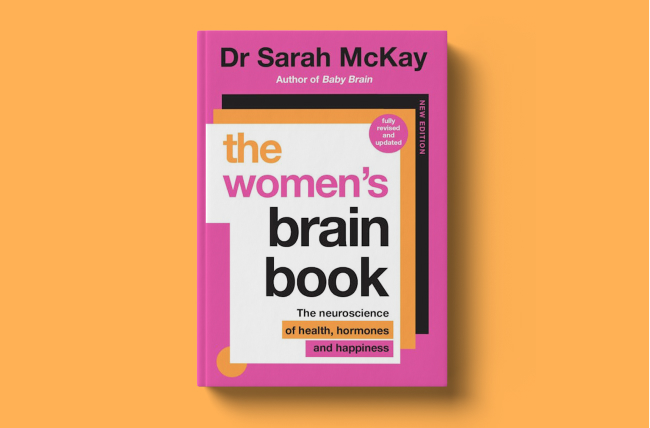
Neuroscientist Dr. Sarah McKay’s argument in The Women’s Brain Book is that women’s brains and bodies change predictably across the lifespan and deserve to be understood, not just managed — the fourteen-minute summary is a good primer before an appointment.
If you would like something more structured than a checklist, Miranna’s assessment walks through your symptoms and builds a personalized plan around what you are actually experiencing.
FAQ
Is there a blood test for perimenopause?
Not a reliable one. Hormone levels fluctuate too much during perimenopause for a single measurement to be meaningful, which is why guidelines advise diagnosing on symptoms in women over 45.
Can a doctor tell if you are in perimenopause?
Yes, usually from your symptom pattern and cycle changes rather than from lab work. The clearer and more specific your account of what has changed, the easier that is.
What is the most accurate perimenopause test?
There is not one. The closest thing is a tracked record of your cycle and symptoms over several months, which is why apps and paper diaries beat one-off hormone panels.
Are at-home perimenopause tests worth it?
They measure real hormones, but the results are hard to interpret because levels swing so much at this stage. A normal result does not rule perimenopause out, and a raised one does not confirm it.
How do I know if it is perimenopause or something else?
You often cannot tell from symptoms alone, which is exactly why ruling out thyroid problems, iron deficiency, and anemia matters. All three overlap heavily with perimenopause and all three are treatable.
Can perimenopause start at 38?
Yes. It commonly begins in the early-to-mid forties but can start in the late thirties. Symptoms before 40 are worth investigating properly rather than dismissing.
The test you actually need is a record
There is a particular frustration in wanting a number and being told to keep a diary instead. It sounds like being fobbed off.
It is not. In a condition defined by change over time, a record of change over time is the better instrument — and it is the one your doctor can actually work with. The women who get useful care at this stage are almost always the ones who walked in with specifics.
Miranna turns the best books on the female body and brain into short audio summaries — so you can walk into that appointment knowing what you are talking about. Try Miranna free.
This article is for information only and is not medical advice. The symptom check above is not a diagnostic tool. If your symptoms are affecting your daily life, please speak with a qualified healthcare professional.

When you're ready to talk to someone
Some questions about perimenopause need more than an article. Miranna's menopause coaches work with women on the hard, specific stuff — wondering whether you are imagining all of this, being told your bloods are fine, working out what to track and what to ask for next time — at your pace, when you're ready. Browse who you'd want to talk to right in the app.
When you're ready to talk to someone
Sometimes the next step is having one good conversation. Miranna's coaches work with women navigating burnout, hormonal shifts, relationships, and the in-between moments — at your pace, when you're ready.
Browse who you'd want to talk to and book a session right in the app.


People ❤️ Miranna