Join our newsletters and be the first to receive app updates, exclusive content, and connect with a supportive network of accomplished women. Sign up today to unlock your journey to success with Miranna

How to Learn Faster: What the Research Actually Shows


Learning faster isn't about reading more or finding your "learning style." It comes down to four things: paying real attention, engaging actively rather than passively, getting fast feedback on your errors, and sleeping. Most study time is wasted on rereading, which feels productive and produces almost nothing.
The uncomfortable part is that the techniques that feel effective are usually the ineffective ones.
Rereading a chapter feels like progress because it gets easier each time — but that ease is familiarity, not knowledge. The methods that actually work feel harder, slower and mildly unpleasant while you're doing them.
Here's what the research supports, and how to fit it into a week that has other things in it.
Why most study advice doesn't work
Three widespread beliefs, all weakly supported:
"Find your learning style." The idea that you're a visual, auditory or kinaesthetic learner is one of the most durable myths in education. A landmark review by Pashler and colleagues found no credible evidence that matching teaching to a preferred style improves outcomes, and the position has held since. What actually helps is matching the format to the material — diagrams for spatial things, sound for pronunciation.
"Reread until it sticks." Rereading produces a strong feeling of knowing and very little retention. It's the single biggest waste of study time.
"Highlight the important parts." Highlighting is a way of postponing the thinking. It marks material as significant without doing anything to encode it.
If a technique feels smooth and pleasant, be suspicious of it.
The four pillars of learning
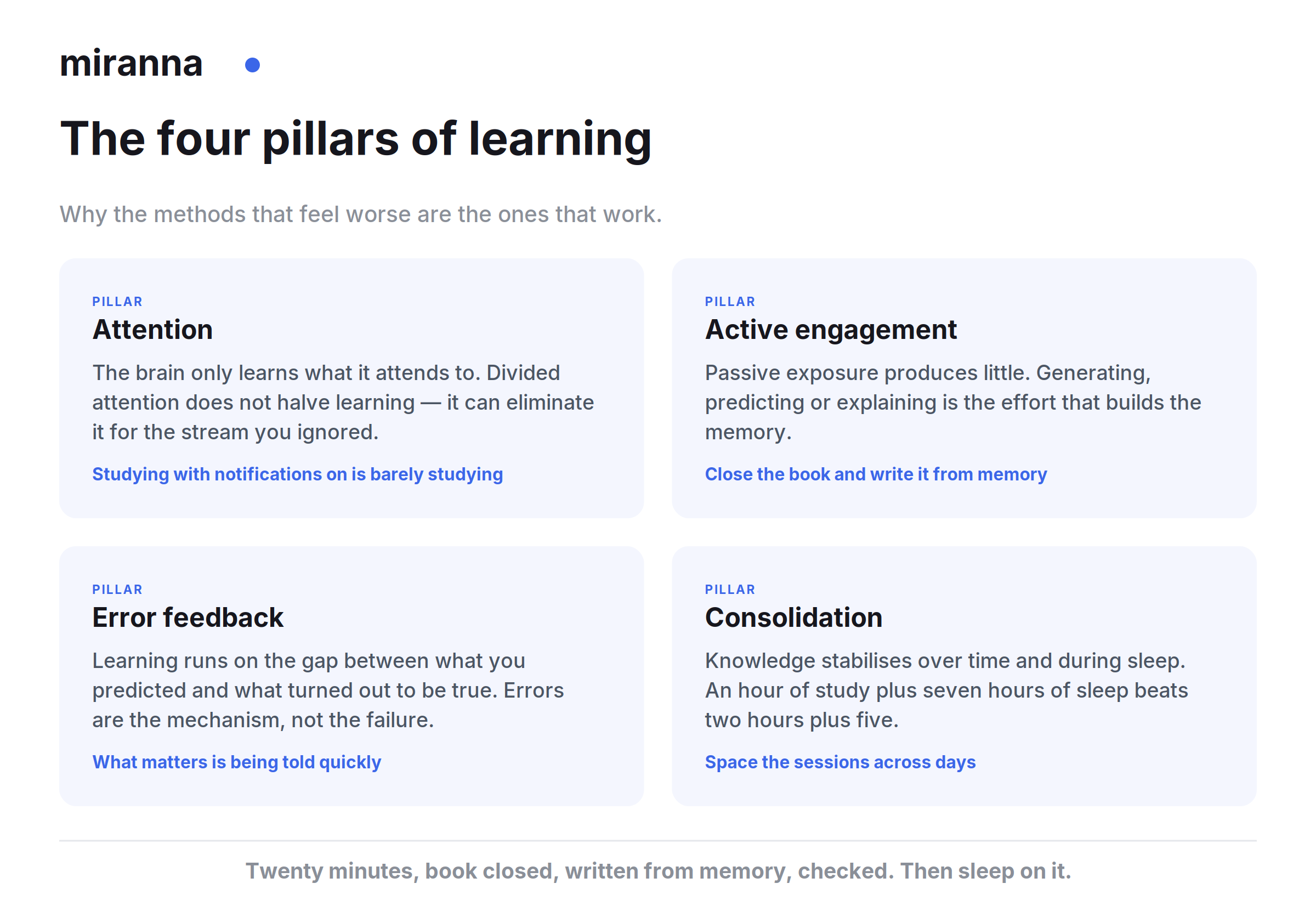
Cognitive neuroscientist Stanislas Dehaene organises what's known about learning into four mechanisms. They're worth knowing because they explain why the effective techniques work.
1. Attention. The brain only learns what it attends to. Divided attention doesn't halve learning; it can eliminate it for the unattended stream. This is why studying with notifications on is close to not studying.
2. Active engagement. Passive exposure produces little. You have to generate, predict, explain, or attempt — the effort of producing the answer is what builds the memory, not the exposure to it.
3. Error feedback. Learning runs on the gap between what you predicted and what turned out to be true. That means errors aren't a sign of failing; they're the mechanism. What matters is getting told quickly that you were wrong.
4. Consolidation. New knowledge stabilises over time and — crucially — during sleep. A skill practised and then slept on is measurably better the next day.
The full argument, including how the brain repurposes older circuits for reading and maths, is summarized in about twelve minutes.
Test yourself instead of rereading
If you change one thing, change this.
Retrieval practice — closing the book and trying to produce the material from memory — outperforms rereading substantially, and the gap widens the longer you wait before testing. In Roediger and Karpicke's experiments, students who practised recall retained 61% of a passage a week later, against 40% for those who reread it. Every act of retrieval strengthens the memory in a way that recognition doesn't.
In practice:
- Read a section, close it, write what you remember. Then check. The checking is the feedback pillar.
- Turn headings into questions and answer them without looking.
- Explain it out loud to someone, or to an empty room. Gaps become obvious immediately.
- Use flashcards for facts, but write the cards yourself — writing them is half the learning.
It will feel worse than rereading. That's the point: the difficulty is the mechanism working.
{{Article Banner}}
Space it out
Cramming works for Friday and fails by the following Tuesday.
The same total study time spread across several sessions produces far more durable learning than one long block — because each time you return, the memory has partially faded, and rebuilding it is what makes it stick.
A workable schedule for something you want to keep: review the day after, then a few days later, then a week later, then a month. You don't need software for this, though it helps for volume.
The counterintuitive part is that some forgetting is desirable. If it feels easy when you come back, you probably left it too soon.
Sleep is part of the method
Not a wellness aside — a step in the process.
Consolidation happens largely during sleep, so a night after learning does real work on the material. Practically, this means an hour of study followed by seven hours of sleep beats two hours of study followed by five.
Which also means the classic all-nighter is close to self-defeating: you gain study hours by removing the process that turns study into memory. If your learning schedule is eating your nights, our night routine guide is the more useful intervention.
Learning in twenty-minute fragments
Most learning advice assumes long, protected study sessions. If you're retraining alongside a job, or studying with a household around you, that isn't the shape of your week.
The good news is that fragments suit the evidence better than blocks do:
- Twenty minutes of focused retrieval beats an hour of distracted reading. Attention is the constraint, not duration.
- Spacing is built in. Several short sessions across a week is exactly the schedule the research recommends.
- Keep a "current question." One thing you're trying to answer, carried around between sessions, so you can pick up without re-orienting.
- Use dead time for review, not new material. Retrieval works on a commute; encoding something new doesn't.
- Write the next step before you stop. The same breadcrumb trick that saves any interrupted work.
Using AI without outsourcing the thinking
AI tools genuinely accelerate learning, and they can also quietly remove the part that does the learning.
The distinction is whether the tool is doing the retrieval or you are. Asking it to summarise a chapter you haven't read produces the feeling of understanding with none of the encoding. Asking it to quiz you, mark your explanation, or find where your reasoning went wrong is retrieval practice with instant error feedback — which is two of the four pillars at once.
Useful prompts, in that spirit: ask me five questions on this and tell me what I got wrong. Here's my explanation — where is it inaccurate? What's the one thing I've misunderstood?
Poppy Crum's take on what changes when AI enters the learning loop is summarized in about five minutes.
Am I too old to learn this?
No, and the belief itself is a bigger obstacle than the biology.
Adult brains form new connections throughout life. What changes with age is mostly speed of processing and the amount of interference from everything you already know — and both are offset by having far more existing knowledge to attach new material to. Adults often learn conceptual material faster than younger people for exactly that reason.
What genuinely gets harder is protected attention, which is a scheduling problem rather than a neurological one.
FAQ
What's the fastest way to learn something new?
Test yourself on it rather than rereading, get feedback quickly on what you got wrong, space the sessions out over days, and sleep between them.
Do learning styles actually exist?
People have preferences, but matching teaching to a preferred style hasn't been shown to improve learning. Matching the format to the material works better.
Is it better to study in long or short sessions?
Short and spread out. Several twenty-minute sessions across a week beat one long block of the same total length.
Why do I forget everything I read?
Because reading is passive. Without retrieval — closing the book and producing the material — very little is encoded, however carefully you read.
Does sleep really affect learning?
Yes. Consolidation happens largely during sleep, so a night after studying does measurable work on the material.
Can AI help me learn faster?
Yes, if it quizzes you and corrects your errors. If it summarises things you never engaged with, it produces the feeling of learning without the substance.
Make it harder on purpose
Almost everything that works here feels worse than the thing that doesn't. Retrieval is uncomfortable, spacing means starting from partial forgetting, and being told you're wrong is not enjoyable.
That's the deal. The smooth methods produce a pleasant sense of competence and very little memory; the awkward ones produce the opposite.
Twenty minutes, book closed, something written down from memory, checked. Then sleep on it.
For the wider picture, our guides to building habits that survive a real week and productivity in a fragmented day go further.
Miranna turns the best books on the brain and learning into short audio summaries — for the fragments of time you actually have. Try Miranna free.

When you're learning on top of everything else
Retraining alongside everything else is its own project. Miranna's coaches work with women on the hard, specific stuff — finding study time in a week that is already full, staying with something past the difficult middle, deciding what to drop while you learn — at your pace, when you're ready. Browse who you'd want to talk to right in the app.
When you're ready to talk to someone
Sometimes the next step is having one good conversation. Miranna's coaches work with women navigating burnout, hormonal shifts, relationships, and the in-between moments — at your pace, when you're ready.
Browse who you'd want to talk to and book a session right in the app.


People ❤️ Miranna