Join our newsletters and be the first to receive app updates, exclusive content, and connect with a supportive network of accomplished women. Sign up today to unlock your journey to success with Miranna

How to Build a Morning Routine You'll Actually Keep


A morning routine works because it's consistent, not because it's early. The three things that matter most are a steady wake time, daylight soon after waking, and one anchor habit you do before the day can make demands. Everything else — the cold plunge, the 5 a.m. start, the twelve-step ritual — is optional.
The morning routine genre has a problem: it was written by people whose mornings belong to them.
Wake at five, meditate for twenty minutes, journal, work out, cold shower, plan the day, all before anyone else is up. Which is achievable if nobody needs breakfast, nobody has to be somewhere at 8:15, and you don't wake at 3 a.m. with your brain already running.
So here's the version built for a morning that has other people in it.
What makes a morning routine work?
Three mechanisms, and none of them require an early start.
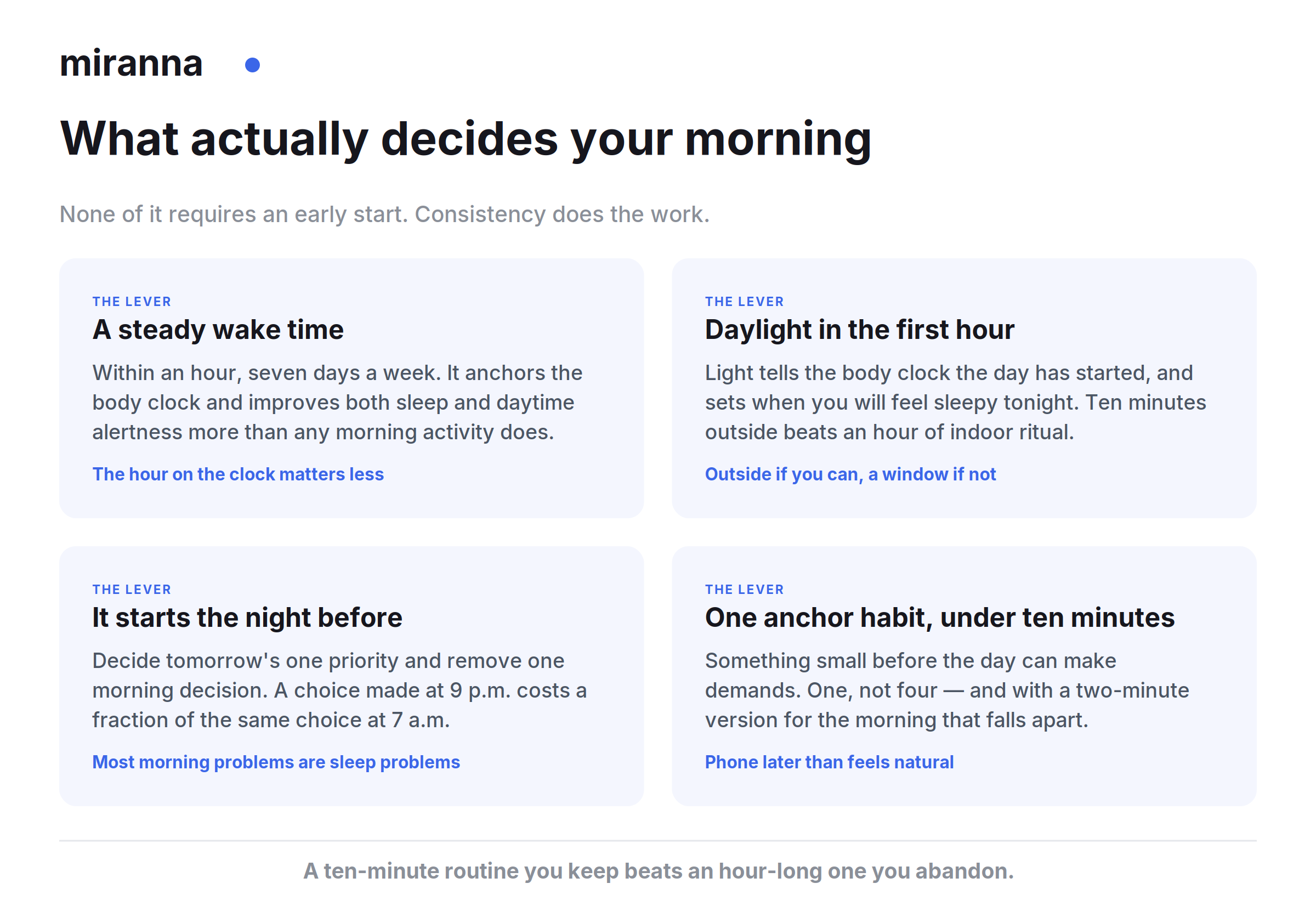
A steady wake time. This is the single most useful thing on the page. Waking at roughly the same time daily — weekends included, within an hour — anchors your body clock, which improves both sleep and daytime alertness more than any morning activity does.
Daylight, early. Light is the main signal that sets your body clock, and morning light in particular shifts it earlier — research on light exposure and circadian timing shows how strongly natural daylight outperforms indoor lighting here. Ten minutes outdoors beats an hour of any indoor ritual.
One anchor habit. Something small you do before the day can start making demands. Not because the activity is magic, but because it establishes that the morning has a shape you decide rather than one that happens to you.
Judge everything else by whether it survives a Wednesday when someone loses a shoe.
Your morning starts the night before
Most failed morning routines are sleep problems in disguise.
If you're getting six broken hours, no amount of ritual design fixes what happens at 6:30. The highest-return morning intervention is almost always something you do at 9 p.m. — which we've covered in the night routine that actually improves your sleep.
Two things carry over particularly well:
- Decide tomorrow's one priority before bed. Five minutes of deciding at night removes the morning's biggest tax: working out where to start while half-awake.
- Remove one morning decision. Clothes out, bag packed, breakfast obvious. Every choice at 7 a.m. costs more than the same choice at 9 p.m.
Do you have to wake up at 5 a.m.?
No. And for a good share of people, trying to is counterproductive.
Sleep specialist Dr. Michael Breus sorts sleepers into four chronotypes — Lion, Bear, Wolf, Dolphin — and they don't share a natural wake time. Lions genuinely wake at five and fade by evening. Wolves are barely functional before mid-morning and sharpest late. Forcing a Wolf into a 5 a.m. start produces a person who is awake early and useless all day.
The early-rising advice is written by Lions, for Lions, and sold to everyone. What actually matters is that your wake time is consistent and that you're getting enough sleep — not what number is on the clock.
Two practical notes from his work:
- Stop hitting snooze. Fragmented extra sleep is worse than none; the fifteen minutes after the first alarm are low quality and leave you groggier.
- Wait about ninety minutes before caffeine. Your own cortisol is doing that job first, and drinking coffee immediately tends to produce an earlier crash.
His full set of rules is summarized in about eight minutes.
A morning routine that fits a real morning
Build it in this order, and stop when it's enough:
1. Fixed wake time. Within an hour, seven days a week. This one is doing most of the work.
2. Light within the first hour. Outside if possible, by a window if not. Ten minutes.
3. Water before coffee. You're mildly dehydrated after seven hours without fluid, and some of that morning fog is that.
4. One anchor habit, under ten minutes. Stretching, a page of writing, a short walk, coffee somewhere other than in front of a screen. One. Not four.
5. The priority you chose last night. Before email, before messages, before the day fills up.
6. Phone later than feels natural. Every minute before the first scroll is a minute the day is still yours.
That's it. It takes twenty minutes and works at 6 a.m. or 8:30.
{{Article Banner}}
When the morning isn't yours
Plenty of women's mornings are fully spoken for — small children, care responsibilities, an early shift, a commute that starts in the dark.
The standard advice — wake earlier to carve out time — has a real cost, and it's usually sleep you can't spare. Some alternatives that work better:
- Attach the routine to an existing anchor. After the school gate. After the door closes. On the train. The routine doesn't have to happen at home.
- Take the two-minute version. Water, daylight through a window, one deep breath before opening the door. That's a routine, and it's the one that survives.
- Move it to the first genuine gap. A "morning routine" at 10:15 still works. The label matters less than the pattern.
- Negotiate one morning a week. A single protected morning is more sustainable than a daily one that requires everyone else to change.
- Don't trade sleep for virtue. If waking at five means six hours of sleep, that's a bad exchange and the research is unambiguous about it.
What to skip
The five-step aesthetic morning. It photographs beautifully and lasts about nine days.
Cold plunges as a requirement. Fine if you like them. Not load-bearing.
Waking up earlier to fit more in. Unless you also go to bed earlier, this is a sleep-debt strategy in a productivity costume.
Elaborate journaling as a barrier to entry. Three lines counts. A structured system you dread doesn't.
Copying someone else's routine wholesale. Their chronotype, their household and their commute aren't yours.
How to make it stick
Morning routines fail for the same reasons every other habit does, so the same fixes apply — we've covered them in detail, but briefly:
- Start with one thing, not six. Add the second only when the first is automatic.
- Attach it to something already fixed. After the kettle goes on, after the shower, after the door closes.
- Have a minimum version. Two minutes on the bad day, and it still counts.
- Never miss twice. One skipped morning is nothing; the story you tell yourself after the second one is what ends it.
And if a rigid daily routine keeps failing, try running it as an experiment for two weeks instead of committing to it forever — Anne-Laure Le Cunff's case for that approach is summarized in seven minutes.
FAQ
What should a morning routine include?
A consistent wake time, daylight within the first hour, water before caffeine, and one small anchor habit before the day makes demands. Twenty minutes is enough.
How do I wake up early?
Move your bedtime first, get light immediately on waking, and stop using snooze. Waking earlier without sleeping earlier just creates sleep debt.
Do I have to wake up at 5 a.m.?
No. Chronotypes differ, and consistency matters far more than the hour. Early rising suits some people naturally and makes others worse at everything.
How long should a morning routine be?
Twenty minutes is plenty. A ten-minute routine you keep beats an hour-long one you abandon in a fortnight.
How do I build a morning routine with kids?
Anchor it to an existing event rather than a clock, keep a two-minute version for the days that fall apart, and consider protecting one morning a week rather than all of them.
Is it bad to check your phone first thing?
It isn't a moral failure, but it hands the first decisions of your day to other people. Delaying it even fifteen minutes changes how the morning feels.
Consistent beats early
The productive morning isn't the one that started at five. It's the one where you woke at the same time you always do, got some light, did one small thing you chose, and touched the day's priority before the day touched you.
That version works in a house full of people. The other one mostly works in photographs.
For the wider picture, our productivity tips for a fragmented day and summary of Atomic Habits go further.
Miranna turns the best books on habits, sleep and focus into short audio summaries — the right length for a walk before the day starts. Try Miranna free.

When the morning isn't yours to plan
Some mornings are not yours to redesign. Miranna's coaches work with women on the hard, specific stuff — a morning that belongs to everyone else, the routine that lasted nine days, protecting one hour a week without a fight — at your pace, when you're ready. Browse who you'd want to talk to right in the app.
When you're ready to talk to someone
Sometimes the next step is having one good conversation. Miranna's coaches work with women navigating burnout, hormonal shifts, relationships, and the in-between moments — at your pace, when you're ready.
Browse who you'd want to talk to and book a session right in the app.



People ❤️ Miranna