Join our newsletters and be the first to receive app updates, exclusive content, and connect with a supportive network of accomplished women. Sign up today to unlock your journey to success with Miranna

Menopause Fatigue: Why You're So Tired and What Helps


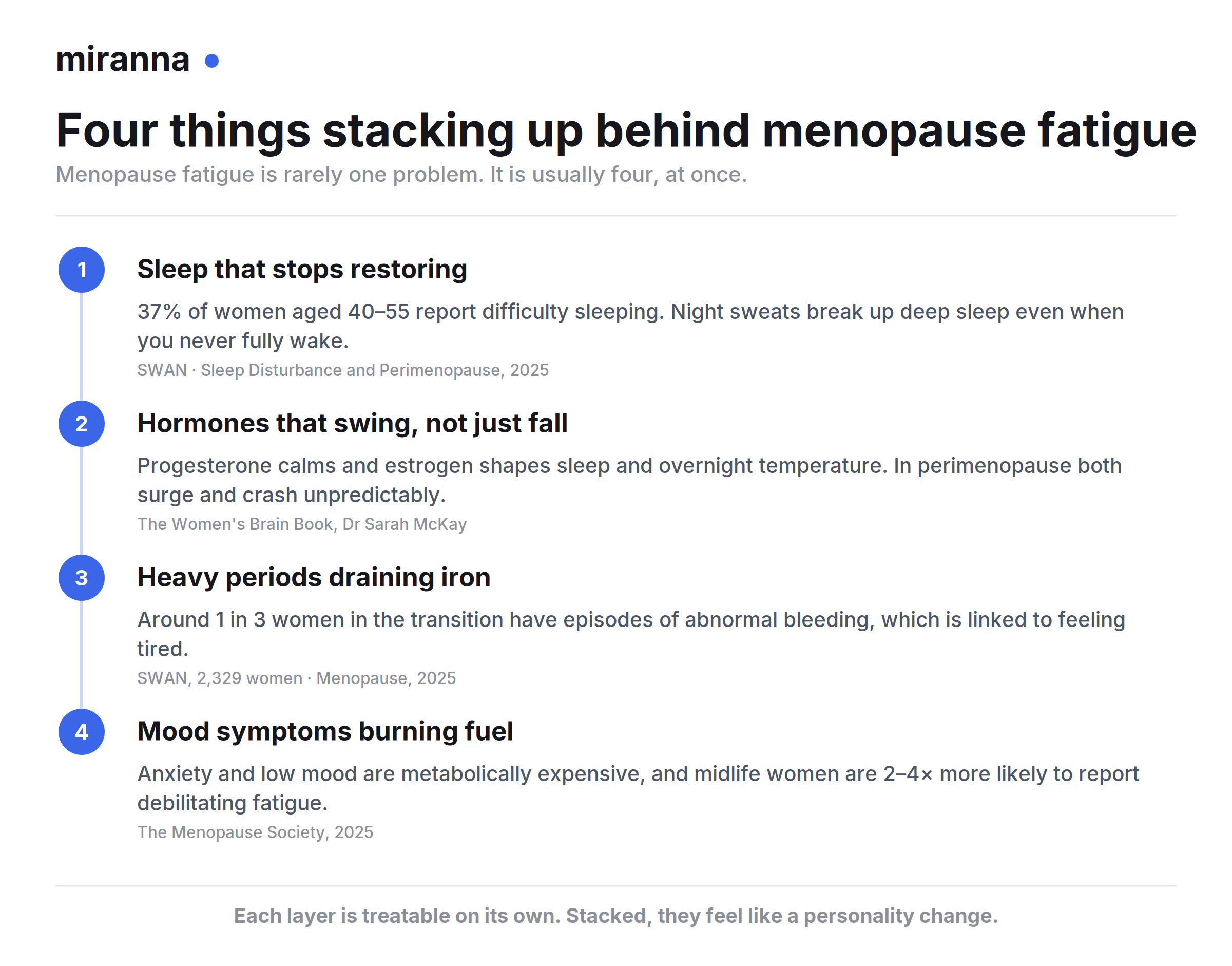
Menopause fatigue is a deep, unrefreshed tiredness that sleep does not fix. It is driven by fragmented sleep, fluctuating estrogen and progesterone, heavy periods that drain iron, and the mood symptoms riding alongside them. It is real and it is common — midlife women are two to four times more likely than others to report debilitating fatigue.
This is not the tiredness of a bad night. It is the tiredness where you sleep eight hours and wake up feeling like you were awake for all of them. Where you look at the stairs and calculate. Where you cancel the thing you were actually looking forward to, because the thought of putting on real clothes is more than you have.
And the worst part is usually not the exhaustion. It is the private suspicion that you have become lazy.
What does menopause fatigue actually feel like?
Women describe it in a way that is remarkably consistent, and almost none of them say “fatigue.”
- Waking unrefreshed. You slept. Your body did not appear to notice.
- The 3 p.m. floor drop. Not sleepy — flattened, as if someone unplugged you.
- Effort inflation. Ordinary tasks — a call, the supermarket, a reply — cost three times what they used to.
- Crashing after normal things. One busy day now needs two days of recovery.
- Wired and exhausted at once. Too tired to function, too switched-on to sleep.
- Zero reserve. You can still do what you must. There is nothing left for what you want.
That last one is the tell. Menopause fatigue rarely stops you working. It quietly eats everything around the work — the friends, the exercise, the sex, the hobbies — and leaves a life that functions but does not feel like yours.
Does menopause make you tired?
Yes, and through more than one route at once. That is precisely why it is so hard to fix with any single change.
Estrogen and progesterone are sleep hormones as well as reproductive ones. Progesterone has a calming, sleep-promoting effect; estrogen influences sleep architecture and body-temperature regulation overnight. When both start swinging unpredictably, sleep gets lighter and more broken even on nights with no night sweats at all.
Night sweats fragment sleep you do not remember losing. You may not wake fully. The deep, restorative stages still get interrupted, and deep sleep is where physical recovery actually happens.
Heavy periods drain your iron. This one is badly underdiscussed. Around a third of women in the transition have episodes of abnormal uterine bleeding, and a 2025 study of over 2,300 women in SWAN found repeated heavy bleeding was linked to feeling tired. The same report notes midlife women are two to four times more likely to experience debilitating forms of fatigue. If your periods have become floods, that is a conversation to have with a doctor, not something to push through.
Mood symptoms are metabolically expensive. Anxiety and low mood consume energy at a startling rate, and they are more common during the transition.
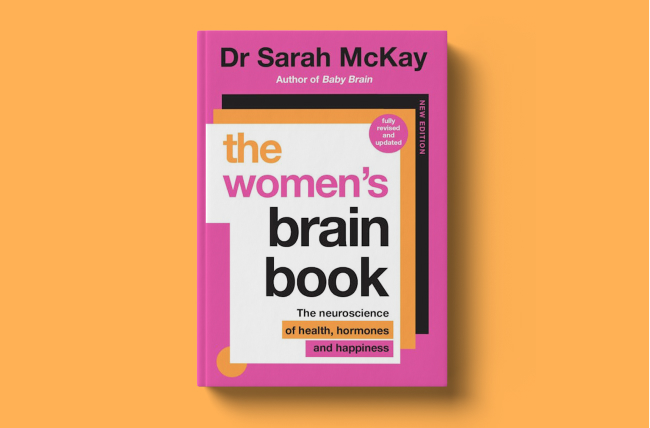
Neuroscientist Dr. Sarah McKay’s core argument is that the brain is not a passive victim of hormones — it is a system adapting to a changing environment, and it can be supported. If you want the whole arc of how hormones shape the female brain across the lifespan, her summary of The Women’s Brain Book runs about fourteen minutes in the app.
Why is perimenopause fatigue often worse than fatigue after menopause?
This surprises people who assume things get steadily worse until the periods stop.
Perimenopause is the volatile stretch. Hormones are not low yet — they are erratic, sometimes swinging higher than they ever did in your thirties, then crashing. Your body is trying to run on a power supply that surges and dips without warning. That instability is harder to adapt to than a lower, steadier baseline.
It is also the stage where you are least likely to be believed. Periods are still arriving, blood tests look unremarkable, and the obvious menopause markers have not shown up yet — so “I am exhausted” gets filed under stress, work, or being 45. Meanwhile the heavy bleeding that often defines this phase is quietly taking your iron with it.
Sleep problems do tend to settle after the transition. That is genuinely worth knowing when you are in the middle of it.
Is it the sleep, or is it the hormones?
Both, and untangling which one is louder for you changes what you should do first.
In SWAN, 37% of women aged 40 to 55 reported difficulty sleeping, and the same review found sleep disorders affect between 16% and 47% of perimenopausal women, rising further after menopause. That is an enormous slice of midlife tiredness that is, at root, a sleep problem wearing a hormone costume — and we have covered why sleep breaks in perimenopause and what actually fixes it separately.
A rough sorting question: does a genuinely good night make a difference? If two solid nights restore you, sleep is your lead problem, and that is the more tractable one. If you sleep well and still wake flattened, the fatigue is being driven by something else — hormones, iron, mood, thyroid, or several at once.
If sleep is the culprit, sleep specialist Dr. Michael Breus’s practical rules — the wind-down routine, the three-hour rule, what to do with 3 a.m. wake-ups — are distilled into an eight-minute summary worth listening to before you buy anything.
When is exhaustion not menopause?
This matters, because “it is just menopause” is the most common reason treatable things go untreated for years.
Ask a doctor to look further if:
- Your periods are heavy or prolonged — iron deficiency is common, and fixable
- The fatigue arrived suddenly rather than creeping in
- You are cold, gaining weight, and losing hair alongside it — thyroid problems are common in midlife women and share a symptom list with menopause almost point for point
- You are breathless or your heart races on stairs you used to manage
- You have stopped wanting things, not just lacking the energy for them — that is a mood question, and it deserves a real answer
None of this is medical advice, and no article can run your bloods. But going in with “I would like to check iron, ferritin, and thyroid” is a specific request, and specific requests get taken more seriously than “I am tired.” More on that in what a perimenopause test can and cannot tell you.
What actually helps menopause fatigue?
There is no supplement that fixes this. What follows is unglamorous, and it works in aggregate rather than individually.
- Get the bloods done first. Everything below is harder if you are running on low iron or an underactive thyroid.
- Defend the first half of the night. That is where deep sleep lives. A cool bedroom, a consistent wind-down, and a hard boundary on late-evening alcohol do more for restoration than an extra hour of lie-in.
- Lift things. The counterintuitive one. Strength training is one of the few interventions that reliably raises energy in midlife rather than spending it — muscle is metabolically active tissue, and it protects sleep quality too.
- Eat enough, and eat protein early. Under-eating is a common and invisible contributor. So is a breakfast that is mostly coffee.
- Get morning light. Ten minutes outside early anchors the body clock that is driving your sleep timing. It costs nothing and it is one of the few things with a fast payoff.
- Treat the anxiety, not just the tiredness. If you are wired-and-exhausted, the wired part is doing real damage to the exhausted part.
- Stop auditing your own laziness. The self-criticism is not free. It burns energy you do not have, and it is aimed at a physiological process.
On the training point, Dr. Stacy Sims’s whole argument in Next Level is that midlife women need to train differently, not less, and it is summarized in about twelve minutes if the gym feels like the last thing you have energy for.
{{Article Banner}}
How do you get through a day when there is nothing left?
Some weeks you are not optimizing. You are just getting through. Two things help more than any productivity system:
Budget energy like money. You have a finite amount today. Decide in the morning what it is being spent on, and let the rest actually go — not “I will do it later if I can,” but genuinely go. The mental cost of a long list of undone things is real.
Front-load the day. Most women in the transition have more in the tank before noon. Move the thing that matters most into that window and stop scheduling anything demanding at 4 p.m.
And tell one person the truth about your energy. Half the exhaustion of this stage is performing normal capacity while running on a third of it.
If the bigger question underneath all this is what you want the next decade to look like, we have written separately about what a midlife crisis actually looks like for women.
FAQ
Does menopause make you tired all the time?
It can. The tiredness usually comes from several sources at once — fragmented sleep, fluctuating estrogen and progesterone, low iron from heavy periods, and mood symptoms — which is why it feels more constant than ordinary tiredness.
Does perimenopause cause fatigue even with normal periods?
Yes. Hormones fluctuate for years before cycles become obviously irregular, and fatigue and sleep disruption are often among the earliest changes women notice.
How long does menopause fatigue last?
There is no fixed timeline, but sleep problems tend to settle after the transition, and energy for most women improves on the other side rather than continuing to decline.
Why am I exhausted but can't sleep?
Falling progesterone removes a natural calming influence, and anxiety and night-time temperature swings keep the nervous system switched on. Wired-and-tired is one of the most commonly reported patterns of this stage.
What vitamins help menopause fatigue?
No supplement has strong evidence for treating menopause fatigue, despite heavy marketing. Genuine deficiencies — iron in particular, given heavy bleeding is common — are worth testing for with a doctor rather than guessing at.
Is crashing fatigue a sign of something serious?
Usually not, but sudden onset, breathlessness, very heavy periods, or fatigue with weight and hair changes are reasons to get checked rather than assume it is the transition.
You are not lazy. You are under-resourced.
There is a difference, and it is not semantic. Lazy is a character verdict. Under-resourced is a solvable situation — one with causes you can name, test for, and chip away at.
Most women in this stage are not failing to try hard enough. They are running a full life on a body that is renegotiating its energy supply, and doing it while apologizing for the shortfall.
Miranna turns the best books on the female body and brain into short audio summaries — McKay, Sims, Breus, and more — so you can figure out what is happening to your energy without spending energy you do not have. Try Miranna free.
This article is for information only and is not medical advice. Persistent fatigue has many causes worth ruling out, so please speak with a qualified healthcare professional about yours.

When you're ready to stop pushing through
Some stretches of perimenopause need more than an article. Miranna's menopause coaches work with women on the hard, specific stuff — cancelling on people again, having nothing left for anyone after the workday, building a week you can actually live in — at your pace, when you're ready. Browse who you'd want to talk to right in the app.
When you're ready to talk to someone
Sometimes the next step is having one good conversation. Miranna's coaches work with women navigating burnout, hormonal shifts, relationships, and the in-between moments — at your pace, when you're ready.
Browse who you'd want to talk to and book a session right in the app.


People ❤️ Miranna