Join our newsletters and be the first to receive app updates, exclusive content, and connect with a supportive network of accomplished women. Sign up today to unlock your journey to success with Miranna

Menopause Brain Fog: Why It Happens and What Helps


Menopause brain fog is real, extremely common, and for most women it is temporary. It shows up as forgetting names, losing your train of thought mid-sentence, and needing three tries to finish one email. It is driven by fluctuating estrogen in brain regions that handle memory and focus — not by early dementia. Most women find their sharpness returns after the transition.
You know the moment. You walk into the kitchen and stand there, waiting for your own brain to tell you why. You are in a meeting, you have the word, it is right there — and then it is not. You reread the same paragraph four times and absorb none of it.
If you have been quietly wondering whether something is wrong with you, here is the short version: something is happening, it has a name, and it is not your character falling apart.
What does menopause brain fog actually feel like?
Brain fog is not one symptom. It is a cluster, and the specific shape of it is remarkably consistent from woman to woman:
- Word-finding trouble. The noun disappears. You describe it instead: the thing, the round thing, for the pasta.
- Slower processing. You still get there. It just takes longer, and you feel the lag.
- Leaky working memory. You hold a phone number for four seconds instead of forty.
- Attention that slides. You start three tasks and finish none, then feel terrible about it.
- Names, appointments, and why you opened this tab.
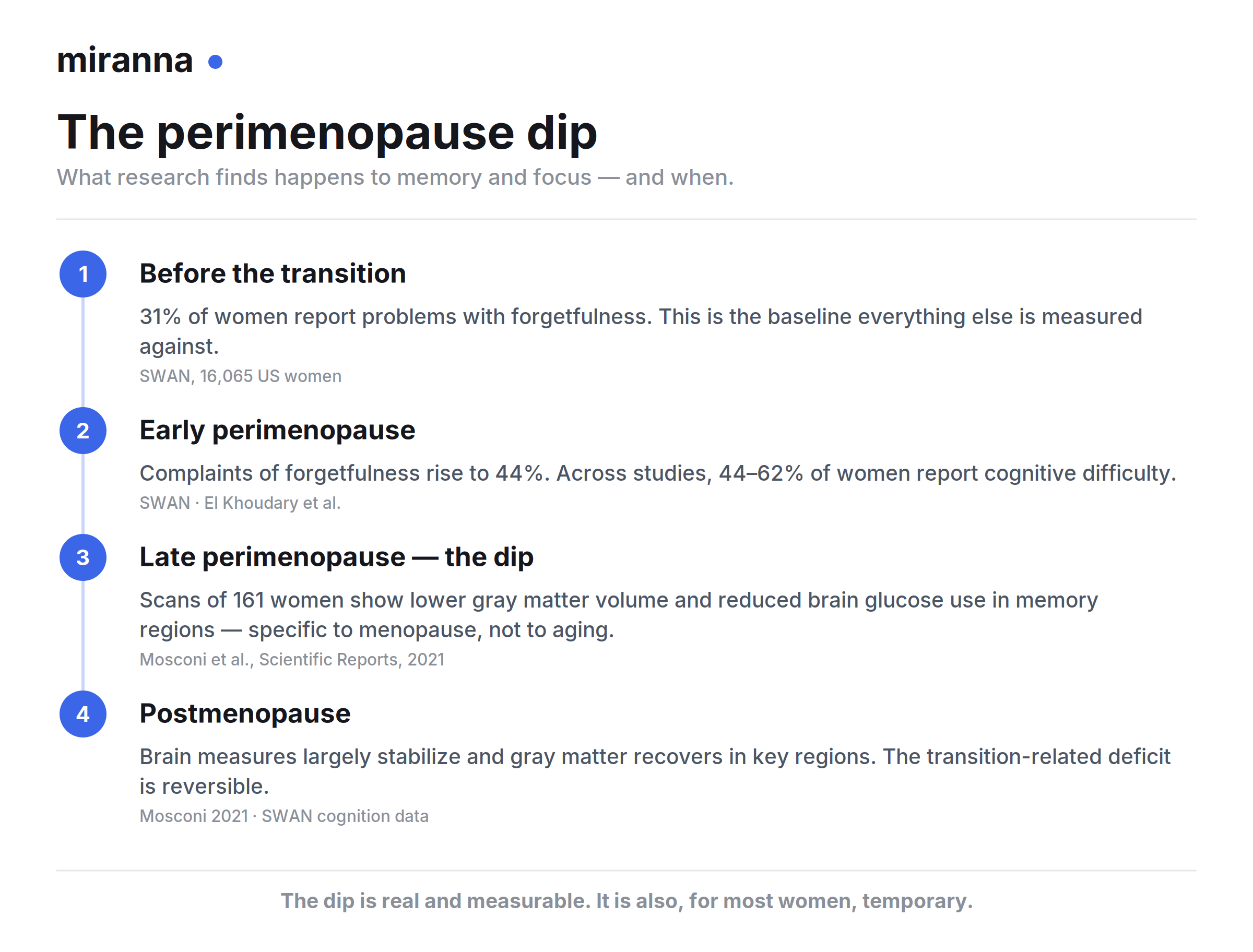
Between 44% and 62% of women report cognitive difficulties during the menopause transition, depending on how the question is asked. In SWAN, the long-running US study of over 16,000 midlife women, complaints of forgetfulness rose from 31% before the transition to 44% in early perimenopause. A 2026 review in The Lancet found that around two-thirds of women report cognitive concerns — memory or concentration — during the transition.
So when you feel like the only person in the room whose brain has gone soft: statistically, you are almost certainly not.
Why does menopause cause brain fog and memory lapses?
Because estrogen is not only a reproductive hormone. It is a brain hormone.
The hippocampus and prefrontal cortex — the regions that run memory, language retrieval, and executive function — are dense with estrogen receptors. Estrogen helps regulate how brain cells take up and use glucose, which is the brain’s fuel. So when estradiol starts fluctuating wildly in perimenopause, and it fluctuates before it falls, those regions are working with an unstable energy supply.
This is measurable. Neuroscientist Dr. Lisa Mosconi and her team at Weill Cornell scanned 161 women aged 40 to 65 across all three stages of the transition, using MRI and PET together. They found lower gray matter volume and reduced brain glucose metabolism in the temporal regions from pre- to post-menopause — changes that were specific to menopause, not to chronological aging, because age-matched men did not show them.
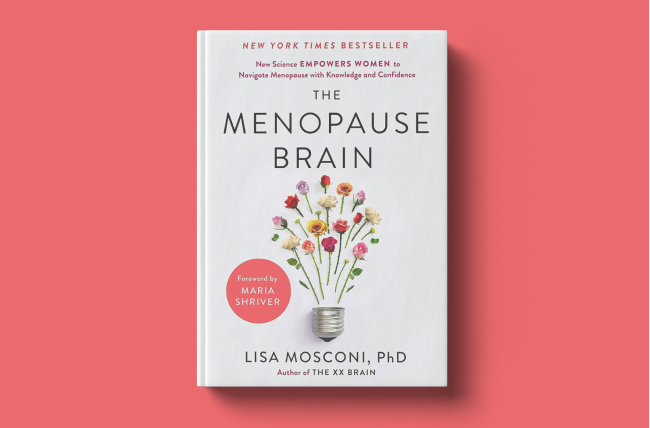
Here is the part that matters more than the scary part: in the same study, those brain measures largely stabilized after menopause, and gray matter volume recovered in key regions. Mosconi’s own framing is that the brain finds a new normal. If you want the full argument — the PET scans, the estrogen-receptor findings, the Alzheimer’s-risk context — Mosconi walks through it in her 10-minute summary of The Menopause Brain in the app.
There is also a second layer, and it is less glamorous than neuroscience: you are probably not sleeping. Night sweats fragment sleep, fragmented sleep wrecks attention and memory consolidation, and anxiety eats working memory on its own. SWAN found that depressive and anxiety symptoms measurably slowed processing speed in midlife women. Fog is rarely one thing stacked on nothing — which is why the broken sleep of this stage is worth treating as its own problem.
Is menopause memory loss a sign of early dementia?
This is the question underneath the question, and it deserves a direct answer: for most women, no.
The pattern researchers see in perimenopause is a dip, not a slope. In SWAN, women showed a temporary loss of the normal learning gain you would expect from repeat testing during late perimenopause — and that deficit was reversible, with persistent decline only appearing well after menopause as ordinary cognitive aging. Perimenopausal fog also fluctuates: brutal weeks, then clear ones. Neurodegenerative decline does not hand you a good week.
The International Menopause Society’s white paper on cognition exists largely because women arrive at appointments convinced they are watching the first act of Alzheimer’s, and clinicians need to normalize the experience rather than dismiss it.
That said, some things do warrant a conversation with a doctor rather than a coping strategy:
- Memory changes that came on suddenly rather than creeping in
- Getting lost somewhere familiar, or trouble with routine sequences you have done for years
- Other people noticing before you do
- Fog that keeps deepening steadily instead of fluctuating
None of this is medical advice, and no article can assess your brain. If any of the above sounds like you, take it to a clinician.
When does menopause brain fog end?
The honest answer is that it varies, and anyone giving you a precise number is guessing. What the research supports: the cognitive dip is concentrated in perimenopause and the first stretch after your final period, and performance tends to recover on the other side. Mosconi’s imaging work found biomarkers stabilizing in postmenopause. SWAN found the transition-related deficits reversible.
Most women describe a foggy stretch measured in a couple of years, not decades. It does not feel that way while you are in it. It is still true.
Why does ADHD show up, or get louder, in perimenopause?
This is one of the most underdiscussed collisions in women’s health, and it explains a lot of late diagnoses.
Estrogen modulates dopamine, and dopamine runs the attention and executive-function circuits in the prefrontal cortex. If you have ADHD and have spent thirty years compensating — lists, systems, sheer effort — falling estrogen can pull the floor out from under those compensations. Strategies that worked stop working. A 2026 review in Drugs & Aging describes exactly this: ADHD in midlife women is frequently underdiagnosed, and the hormonal transition can exacerbate or unmask symptoms that were previously manageable. A population-based cohort study found women with ADHD reported more severe perimenopausal symptoms than women without.
The overlap is genuinely hard to untangle: inattention, disorganization, emotional flooding and word-finding trouble belong to both lists. One useful distinction is history. Perimenopausal fog is new and fluctuates with your cycle. ADHD is lifelong, even if it went unnamed — the childhood version of you was probably called scattered, dreamy, or so bright but does not apply herself.
If that landed, our guide to everyday strategies for adults with ADHD is a reasonable next stop, and a proper assessment is worth asking for.
What actually helps with menopause brain fog?
Nothing here is a cure, because fog is not a disease. These are the levers that consistently show up in the research and in clinical guidance, and they are unglamorous:
- Protect sleep like it is a work deadline. It is the single biggest lever you have. Fragmented sleep alone produces most of the symptoms women attribute to fog.
- Move your body, ideally hard enough to breathe. Exercise is the most reliably supported non-drug intervention for midlife cognition. You do not need a program. You need most days.
- Offload aggressively. Write it down. Every time. Externalizing memory is not a failure — it is what competent people with finite working memory do.
- Single-task on purpose. Fog makes task-switching disproportionately expensive. Batch things. Close the tabs.
- Treat the mood and the anxiety, not just the fog. They are doing measurable damage to your processing speed, and they are treatable.
- Be a hard skeptic about supplements. The brain-fog corner of the wellness market is enormous and evidence-light. Any product promising to restore your memory is selling you a story. Discuss medical options, including hormone therapy, with a clinician who knows your history, not with an ad.
{{Article Banner}}
How do you advocate for yourself at work?
Half the damage of brain fog is not cognitive. It is the story you tell yourself about it: that you are slipping, that you will be found out, that this is who you are now. Women in midlife are often at their most senior and most visible, which makes a bad word-finding day feel like a professional emergency.
A few things that help:
- Name it to yourself accurately. My brain is running on unstable fuel this month is truer than I am losing it.
- Build in structural buffers. Agendas before meetings, notes after, deadlines with slack.
- Choose one person to tell. Not the whole company. One ally changes the isolation math.
- Come to your doctor with specifics. Not I am foggy but I have been losing words mid-sentence for six months, it is worse the week before my period, and I am waking at 3 a.m. Specifics get taken seriously, and there is no blood test that does this job for you.
If the midlife reckoning underneath all this feels bigger than symptoms, we have written separately about what a midlife crisis actually looks like for women.
FAQ
Does menopause cause memory loss?
It causes measurable, usually temporary changes in memory and processing speed — not the progressive memory loss of dementia. SWAN data show the transition-related dip is largely reversible, with women recovering after menopause.
How long does menopause brain fog last?
There is no fixed timeline. Research points to the dip concentrating in perimenopause and early postmenopause, with cognitive performance and brain biomarkers stabilizing afterward. Most women describe it in terms of a couple of years.
Can perimenopause brain fog start in your 30s?
Yes. Perimenopause commonly begins in the early-to-mid forties but can start in the late thirties, and cognitive symptoms often arrive before cycle changes become obvious.
Is brain fog the same as early dementia?
No. Perimenopausal fog fluctuates, is tied to hormonal shifts and sleep, and improves. Sudden onset, disorientation in familiar places, or steadily worsening symptoms are reasons to see a doctor.
What can I take for menopause brain fog?
There is no supplement with strong evidence behind it, despite aggressive marketing. Sleep, exercise, and treating mood symptoms have better support. Medical options, including hormone therapy, are a conversation for a qualified clinician — this article is not medical advice.
Can menopause brain fog be mistaken for ADHD?
Frequently, in both directions. Falling estrogen affects dopamine, which can unmask lifelong ADHD in midlife. The distinguishing question is usually whether the pattern is new or whether it has been there since childhood.
Your brain is not broken
It is renovating. Loudly, inconveniently, and without asking your permission first — but renovating, not collapsing.
The women who come out of this stretch feeling most like themselves are not the ones who found a magic supplement. They are the ones who understood what was happening, stopped treating it as a personal failing, and got specific with the people who could help.
Miranna turns the best books on the female brain into short audio summaries — Mosconi, McKay, and more — so you can understand your own biology on a school run, not on a reading retreat you will never take. Try Miranna free.
This article is for information only and is not medical advice. If your symptoms are affecting your daily life, or you are worried about your memory, speak with a qualified healthcare professional.

When you're ready to talk to someone
Some months of menopause need more than an article. Miranna's menopause coaches work with women on the hard, specific stuff — losing the word in front of your team, the quiet fear that this is just how you are now, asking for what you need at work without apologising for it — at your pace, when you're ready. Browse who you'd want to talk to right in the app.
When you're ready to talk to someone
Sometimes the next step is having one good conversation. Miranna's coaches work with women navigating burnout, hormonal shifts, relationships, and the in-between moments — at your pace, when you're ready.
Browse who you'd want to talk to and book a session right in the app.


People ❤️ Miranna