Join our newsletters and be the first to receive app updates, exclusive content, and connect with a supportive network of accomplished women. Sign up today to unlock your journey to success with Miranna

Perimenopause Insomnia: Why Sleep Breaks and What Fixes It

Perimenopause insomnia is difficulty falling or staying asleep during the menopause transition, affecting an estimated 20–60% of women. Falling progesterone removes a natural sedative, unstable estrogen disrupts overnight temperature control, and a more reactive stress system wakes you early. The best-evidenced treatment is not a supplement — it is CBT-I.
You fall asleep fine. That is what makes it confusing.
Then you are awake at 3:14, fully alert, and the night divides into two halves: the one you slept and the one you spent doing arithmetic about how many hours are left. By 5 a.m. you have solved a work problem, revisited a conversation from 2011, and decided you will just get up.
What does perimenopause insomnia actually look like?
It is rarely the classic version where you lie awake for hours at bedtime. The menopausal pattern has its own shape:
- Early-hours waking. Asleep by eleven, awake at three, and unable to get back.
- Waking hot. Sometimes a full night sweat, often just a rising heat that surfaces you without you knowing why.
- Light, unrefreshing sleep. Seven hours logged, none of them apparently useful.
- Wired at bedtime. Exhausted all evening, then suddenly alert the moment you lie down.
- Dread about the night itself. The bed becomes a place you approach with anxiety, which reliably makes sleep worse.
This is one of the most common experiences of the transition. In SWAN, 37% of women aged 40 to 55 reported difficulty sleeping, and the same review found sleep disorders affecting 16–47% of perimenopausal women and rising further after menopause. The Menopause Society puts insomnia at 20% to 60% of perimenopausal and postmenopausal women in the US.
Why does perimenopause cause insomnia?
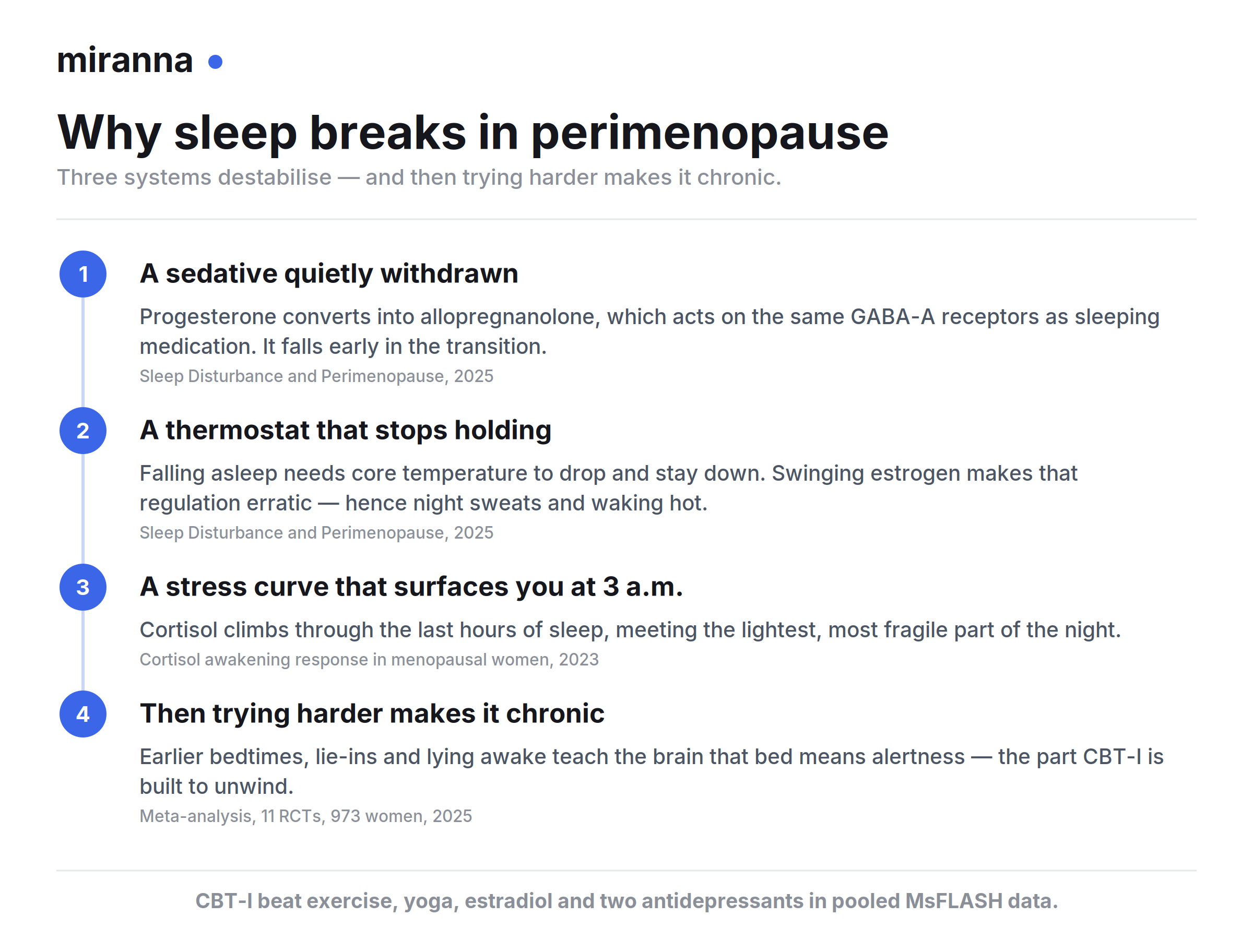
Three separate systems that keep you asleep get destabilized in the same few years.
You lose a sedative you did not know you had. Progesterone converts in the brain to allopregnanolone, which acts on GABA-A receptors — the same system targeted by sleeping medication. Progesterone tends to fall early in perimenopause, and with it goes a natural sedating effect that was quietly working for decades.
Temperature control gets unreliable. Falling asleep requires your core temperature to drop, and staying asleep requires it to stay down. Estrogen is involved in that regulation, so as it swings, the thermostat becomes erratic — hence night sweats, and hence waking hot without a full flush.
The stress system wakes you early. Cortisol climbs in the last hours of sleep. If that curve is running high and your sleep is already light by 3 a.m., the two meet and you surface.
Then a fourth thing arrives, and it is the one that turns a hormonal problem into chronic insomnia: you start trying. Going to bed earlier to catch up. Lying there willing it. Checking the clock. Sleep is one of the few functions that gets worse the harder you work at it, and the anxiety about not sleeping outlives the hormonal cause that started it.
Why do I wake at 3 a.m. and cannot get back to sleep?
Because the second half of the night is structurally more fragile. Deep sleep is concentrated early; the later hours are lighter and easier to interrupt. Add a temperature spike, a low point in blood sugar, and a rising cortisol curve, and 3 a.m. is exactly where a night breaks.
What happens next is what decides the following six months. Lying in the dark, awake and frustrated, teaches your brain that bed is a place of alertness. Do it for enough weeks and the association becomes the problem in its own right.
If the waking comes with a pounding heart and dread rather than simple frustration, that is a related but distinct pattern — we have written separately about perimenopause anxiety and 3 a.m. waking.
Is it the hot flushes, or is it insomnia?
Both, and they are less connected than everyone assumes.
The MsFLASH trials pooled data from around a thousand women to test seven interventions head to head. The striking finding: CBT-I produced the greatest reduction in insomnia symptoms while doing nothing for hot flush frequency — and low-dose estradiol helped flushes far more than it helped sleep.
Which means treating the flushes may not fix your sleep, and fixing your sleep may not require eliminating the flushes. They are related problems, not one problem.
What actually works for menopause insomnia?
This is the part almost nobody is told, and it is the most useful thing in this article.
The best-evidenced treatment for menopausal insomnia is CBT-I — cognitive behavioral therapy for insomnia. A structured, short, non-drug program, usually four to eight sessions, delivered in person, online, or even by phone.
The evidence is unusually clear:
- In the MsFLASH pooled analysis, CBT-I outperformed exercise, yoga, low-dose estradiol, two antidepressants, and omega-3 supplements. Omega-3 did nothing at all.
- A 2025 meta-analysis of 11 randomized trials in 973 menopausal women found CBT-I significantly improved sleep quality and reduced insomnia severity, regardless of how it was delivered.
- In a MsFLASH randomized trial, telephone-delivered CBT-I improved sleep in perimenopausal and postmenopausal women with insomnia and hot flashes.
Six phone calls beat hormone therapy for this particular symptom. That is not the sentence most women expect, and it is worth taking to your doctor.
{{Article Banner}}
What does CBT-I actually ask you to do?
It is not sleep hygiene with a new name. Two components do most of the work, and both are counterintuitive:
Stimulus control. The bed is for sleep only. If you are awake more than about twenty minutes, you get up, sit somewhere dim and dull, and return when sleepy. Unpleasant for a week. It systematically breaks the bed-equals-alertness association.
Sleep restriction. You temporarily shorten your time in bed to roughly the hours you are actually sleeping, then extend as sleep consolidates. Counterintuitive, mildly brutal, and the single most effective element.
Around that: consistent wake time seven days a week, no clock-watching, and working on the beliefs that keep the system spinning — if I do not sleep I cannot function tomorrow is a thought that reliably prevents sleep.
Doing this properly with a therapist or a structured program works better than assembling it from articles. But the direction of travel is useful even on your own: less time in bed, not more.
Sleep specialist Dr. Michael Breus’s practical version — the wind-down, the three-hour rule, what to do with a 3 a.m. wake-up — is summarized in about eight minutes.
What about the bedroom, alcohol, and magnesium?
Worth doing, but they are the supporting cast, not the treatment:
- Cool the room, seriously cool. Temperature is doing real work here. Layers you can throw off, breathable bedding, a fan.
- Move the alcohol. A glass of wine gets you to sleep and then fragments the second half of the night — precisely the half that is already fragile.
- Fix your wake time, not your bedtime. A consistent morning anchor stabilizes the whole system. Sleeping in after a bad night feels humane and reliably makes the next night worse.
- Get morning light. Ten minutes early does more for the body clock than an hour of screens off at night.
- Be honest about supplements. Magnesium is popular and mostly benign. Omega-3 was directly tested for menopausal insomnia and did nothing. If a product promises to fix this, be skeptical.
Neuroscientist Dr. Sarah McKay’s summary of The Women’s Brain Book covers how hormones shape sleep and the brain across the whole lifespan, which helps make sense of why this stage in particular is so disruptive.
When should you see a doctor?
Not everything that wakes you is hormonal. This is not medical advice and no article can assess you, but it is worth a professional conversation if:
- You snore, gasp, or your partner has noticed you stop breathing — sleep apnea rises sharply in women after menopause and is badly underdiagnosed
- You have crawling or restless sensations in your legs at night
- You are exhausted despite apparently adequate sleep — thyroid and iron are worth checking, and menopause fatigue has causes beyond the nights
- Sleep problems come with persistent low mood or hopelessness
- You have been relying on alcohol or over-the-counter sleep aids to get through
Ask specifically about CBT-I, and about medical options if flushes are the main driver. Both are legitimate conversations.
FAQ
How long does perimenopause insomnia last?
It typically tracks the transition, and sleep symptoms tend to settle afterwards. The insomnia that persists is usually the learned kind, which is exactly what CBT-I is designed to unwind.
Why do I wake up at 3 a.m. every night in perimenopause?
The later hours of sleep are lighter, cortisol is rising, blood sugar is low, and temperature regulation is unstable. Any of those can surface you, and frustration then keeps you awake.
Does menopause insomnia go away on its own?
Often it improves as hormones stabilize. But when the pattern has been running for months, the habit of not sleeping tends to outlast the hormonal cause and benefits from being treated directly.
What is the best treatment for menopause insomnia?
CBT-I has the strongest evidence — it outperformed exercise, yoga, low-dose estradiol, and two antidepressants in pooled MsFLASH data. Medical options are a conversation for a qualified clinician.
Do supplements help perimenopause insomnia?
Omega-3 supplements were tested directly and showed no benefit for insomnia symptoms. No supplement has strong evidence here, despite an enormous market.
Can perimenopause insomnia start before periods change?
Yes. Progesterone falls early in the transition, so sleep is often disrupted well before cycles become obviously irregular.
Less time in bed, not more
The instinct when sleep breaks is to give it more room — earlier bedtimes, weekend lie-ins, lying there hoping. It is the most natural response available and it is the one that keeps the problem alive.
The unglamorous truth is that sleep responds to consistency and to being left alone, and that the best-supported treatment for this stage is a short, structured, unsexy behavioral program that most women have never been offered.
Ask for it by name.
Miranna turns the best books and podcasts on sleep and the female brain into short audio summaries — Breus, McKay, and more — for the nights when reading a whole book is not happening. Try Miranna free.
This article is for information only and is not medical advice. If sleep problems are affecting your daily life, or you have symptoms like snoring or interrupted breathing at night, please speak with a qualified healthcare professional.

When you're ready to talk about the nights
Some nights in perimenopause need more than an article. Miranna's menopause coaches work with women on the hard, specific stuff — the 3 a.m. arithmetic, dreading bedtime before it arrives, building an evening that does not revolve around not sleeping — at your pace, when you're ready. Browse who you'd want to talk to right in the app.
When you're ready to talk to someone
Sometimes the next step is having one good conversation. Miranna's coaches work with women navigating burnout, hormonal shifts, relationships, and the in-between moments — at your pace, when you're ready.
Browse who you'd want to talk to and book a session right in the app.


People ❤️ Miranna