Join our newsletters and be the first to receive app updates, exclusive content, and connect with a supportive network of accomplished women. Sign up today to unlock your journey to success with Miranna

Perimenopause Anxiety: Why It Starts and What Helps


Perimenopause anxiety is a new or intensified anxiety that appears during the menopause transition, often in women who were never anxious before. Falling progesterone weakens the brain’s calming GABA system while a more reactive stress axis raises cortisol — so the alarm fires faster and takes longer to switch off. It usually eases after the transition.
It arrives without a subject. That is the part that confuses everyone.
Ordinary anxiety has a plot: the presentation, the scan result, the argument. This has none. You wake up at 4 a.m. with your heart going and nothing in particular to be afraid of. You feel dread standing in your own kitchen. Your body is behaving as though something terrible is happening, and your mind — reasonably — starts hunting for what it must be.
What does perimenopause anxiety feel like?
Women describe a set of experiences that do not match the anxiety they had read about:
- Dread with no content. A sense that something is badly wrong, attached to nothing.
- Body first, thoughts second. Racing heart, tight chest, jittery hands — and only afterwards a mind scrambling to explain them.
- Morning dread. The worst hour is often the first one.
- 3 a.m. waking with your heart pounding. Alert, frightened, and nowhere to put it.
- Shrinking tolerance. Crowds, noise, plans, phone calls, small talk — all more expensive than they used to be.
- Health anxiety. New physical symptoms plus a body in alarm mode is a reliable recipe for late-night searching.
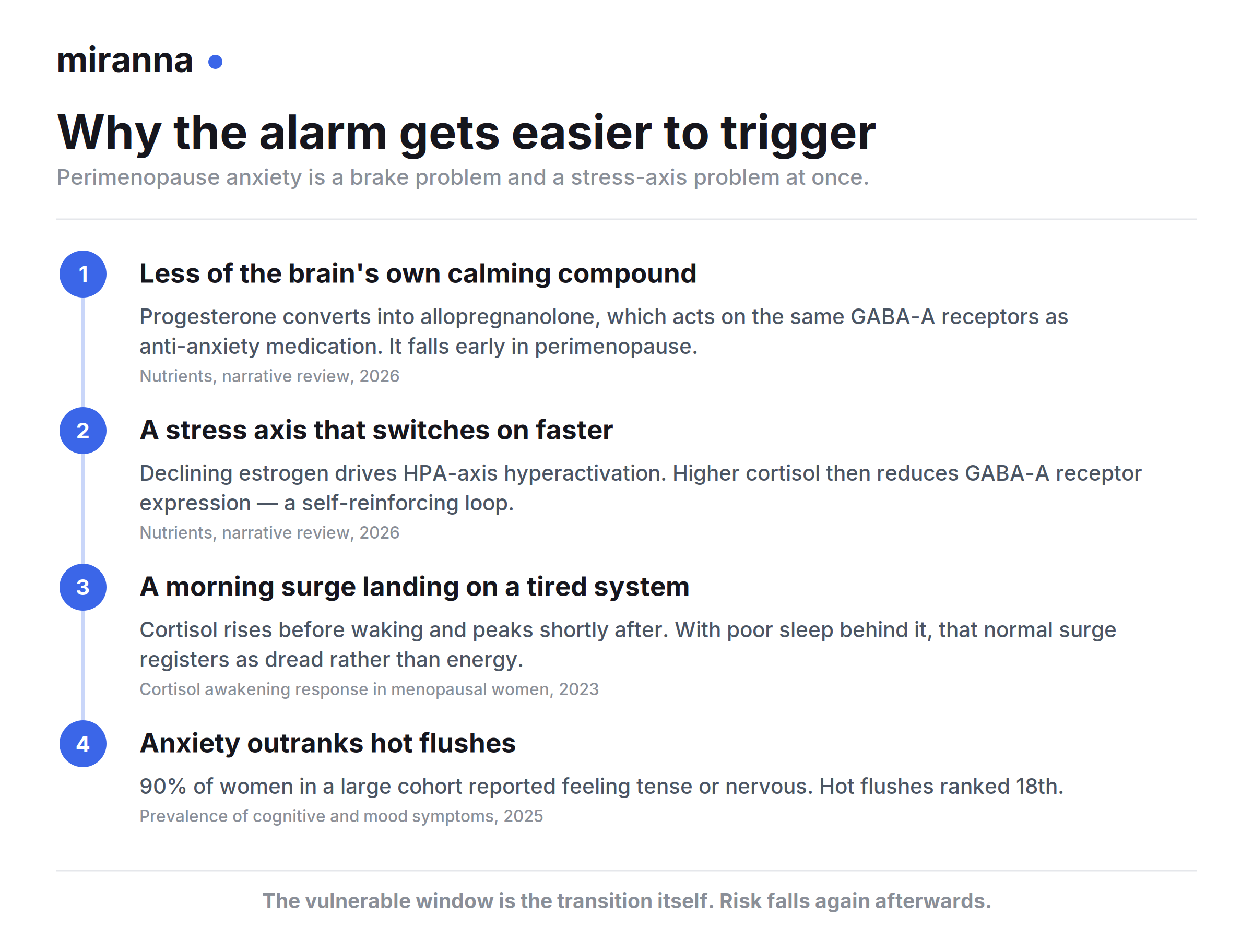
This is not a fringe symptom. In a large cohort of perimenopausal and menopausal women, 90% reported feeling tense or nervous — ranking well above hot flushes, which came 18th. And the global burden of anxiety disorders among perimenopausal women has been rising for decades, with projections of a further sharp increase by 2035.
Can perimenopause cause anxiety if you have never been anxious?
Yes, and this is the single most disorienting version of it.
Women who managed high-pressure jobs, small children, and family crises without ever describing themselves as anxious find themselves unable to make a phone call. The absence of history makes it worse, not better — with no template for what is happening, the mind reaches for the most frightening explanations available.
Two things are worth knowing. First, a new anxiety in your forties is far more likely to be hormonal than to be evidence that something in your life has secretly gone wrong. Second, sensitivity to hormonal shifts is a trait: women who had rough premenstrual weeks, postnatal anxiety, or mood changes on the pill are more likely to feel this transition sharply. That is not weakness. It is a nervous system that responds to hormonal change.
Why does perimenopause cause anxiety?
Two shifts, running at once.
You lose a natural anti-anxiety compound. Progesterone converts in the brain to allopregnanolone, which acts on GABA-A receptors — the same target as benzodiazepines. GABA is the brain’s calming signal. Progesterone typically starts falling early in perimenopause, so allopregnanolone falls with it, and the inhibitory brake weakens. A 2026 review sets out the consequence: insufficient GABA inhibition and overactivation of emotion-processing regions like the amygdala.
And the stress axis becomes more reactive. The same review describes declining estrogen driving HPA-axis hyperactivation, with elevated cortisol in turn reducing GABA-A receptor expression — a loop where higher stress hormones make the calming system even less effective. Estrogen also supports serotonin, and in perimenopause it does not fall steadily so much as swing.
Put simply: the alarm is easier to trigger, and harder to turn off.
The reassuring part is the trajectory. Reviews of mood disorders across the menopause transition consistently find the vulnerable window is the transition itself, with risk falling again afterwards. This stage is a passage, not a destination.
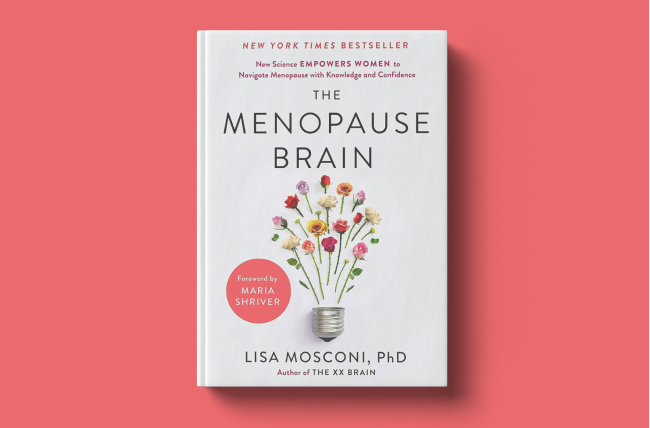
Neuroscientist Dr. Lisa Mosconi’s whole argument is that these symptoms are neurological rather than characterological — her ten-minute summary of The Menopause Brain covers mood and anxiety alongside the fog.
Why is anxiety worse in the morning?
Because you are waking into a hormonal surge, not a calm start.
Cortisol naturally rises in the last hours of sleep and peaks shortly after waking — a normal daily pattern that is supposed to get you out of bed. It has been studied specifically in menopausal women, and it is influenced by sleep quality and stress. When you arrive at that surge already under-slept and with a weakened calming system, the same rise that should feel like energy lands as dread.
The practical implication matters: morning anxiety is often at its worst in the first thirty to sixty minutes and genuinely does soften. Getting up, getting light, and eating something is more effective than lying still and negotiating with it.
Why do I wake at 3 a.m. with my heart racing?
Several things converge in the early hours: cortisol is climbing, sleep is lighter, blood sugar is at its lowest, and temperature regulation is at its most unstable. A night sweat or a dip in blood sugar can produce an adrenaline response that wakes you — and being woken by adrenaline feels identical to fear.
Palpitations are commonly reported during the transition, and they overlap almost perfectly with what a panic response feels like. It is genuinely hard to tell apart from the inside.
Which is why it is worth being clear about when to get it checked rather than reasoned away.
When should you see a doctor?
None of this is medical advice, and no article can assess you. Please take it to a professional if:
- Palpitations come with chest pain, breathlessness, or fainting — this needs proper assessment, not reassurance from the internet
- The anxiety sits alongside persistent low mood, hopelessness, or loss of interest in things you used to enjoy
- You are avoiding work, driving, or leaving the house
- You are using alcohol to take the edge off in the evenings
- It is simply not lifting, or you are frightened by how you feel
Anxiety in this window is treatable, and there are real options — including therapy, and medical routes worth discussing with a clinician who knows your history. Snoring and interrupted breathing are also worth mentioning, since sleep-disordered breathing can produce night-time panic and is easy to miss.
{{Article Banner}}
What helps in the moment?
The aim is to shorten the wave, not to argue with it.
- Lengthen the exhale. Breathe in for four, out for six or eight. Longer out-breaths engage the calming branch of the nervous system directly, and it works in minutes.
- Cold water on the face or wrists. It triggers a reflex that slows the heart. Useful when palpitations are part of it.
- Name it accurately. “This is a hormonal alarm response. It will pass.” Labeling what is happening reduces its intensity, and it is more honest than telling yourself nothing is wrong.
- Get out of bed if you are awake past twenty minutes. Lying there teaches your brain that bed is where you feel afraid. A dim room and something dull works better.
- Move. Ten minutes of walking metabolizes the adrenaline that talking yourself down does not.
- Leave the phone. Searching your symptoms at 4 a.m. has never once helped anyone.
What helps over the following months?
- Protect sleep as the first intervention. Under-slept nervous systems are anxious nervous systems, and this loop is the one most worth breaking.
- Get morning light early. It anchors the circadian rhythm that is driving both your sleep timing and your cortisol curve.
- Eat before the anxiety, not after. Blood-sugar dips are indistinguishable from anxiety from the inside. Protein at breakfast does more than most people expect.
- Move most days. Exercise is one of the best-supported non-drug interventions for anxiety in any population.
- Audit caffeine and alcohol honestly. Caffeine adds to a system already running hot; alcohol buys two hours of calm and returns them with interest at 3 a.m.
- Consider proper therapy rather than coping harder. CBT has strong evidence for anxiety, and it works on the same mechanism as the “name it accurately” trick — just systematically.
And stop trying to control the uncontrollable. Anxiety expands to fill whatever it is given. Mel Robbins’s argument about how much energy goes into managing other people and outcomes is summarized in about twenty minutes and lands differently when your baseline is already high.
If the anxiety is arriving mostly as a short fuse rather than dread, that is a related but different pattern — we have written separately about perimenopause rage and irritability.
FAQ
The alarm is loud, but it is not information
The hardest part of this kind of anxiety is that it feels like a message. Your body is signalling danger with total conviction, and the mind’s job is to find the danger — so it finds something. Your health, your job, your children, your marriage.
It is worth knowing that the signal can be loud and still be wrong. Not imagined, not weakness — just an alarm system running with weaker brakes for a few years.
Most women find this settles. In the meantime, the goal is not to be fearless. It is to stop treating a physiological alarm as evidence about your life.
Miranna turns the best books on the female brain into short audio summaries — Mosconi, McKay, and more — so you can understand what is happening to you in ten minutes. Try Miranna free.
This article is for information only and is not medical advice. If anxiety is affecting your daily life, or you have physical symptoms like chest pain or breathlessness, please speak with a qualified healthcare professional.

When you'd rather not sit with it alone
Some mornings in perimenopause need more than an article. Miranna's menopause coaches work with women on the hard, specific stuff — waking at 4 a.m. with your heart going, dread with nothing attached to it, saying out loud to someone that you do not feel like yourself — at your pace, when you're ready. Browse who you'd want to talk to right in the app.
When you're ready to talk to someone
Sometimes the next step is having one good conversation. Miranna's coaches work with women navigating burnout, hormonal shifts, relationships, and the in-between moments — at your pace, when you're ready.
Browse who you'd want to talk to and book a session right in the app.


People ❤️ Miranna