Join our newsletters and be the first to receive app updates, exclusive content, and connect with a supportive network of accomplished women. Sign up today to unlock your journey to success with Miranna

Perimenopause Rage: Why You're So Angry and What Helps


Perimenopause rage is sudden, disproportionate anger during the menopause transition. It happens because falling progesterone weakens the brain’s main calming system while estrogen swings destabilize serotonin — leaving the emotional alarm louder and the brakes weaker. It is common, it is physiological, and it is not a personality change.
You snapped at your kid over a dropped fork. Someone chewed too loudly and you had to leave the room. A colleague sent a perfectly normal email and you felt something white and fast rise up your spine before you had finished reading it.
Then, twenty minutes later, the shame. What is wrong with me. I have become someone I do not like.
Nothing is wrong with you. Something is happening to you, and it has a mechanism.
What does perimenopause rage actually feel like?
It is not the slow build of ordinary irritation. Women describe a set of features that are strikingly specific:
- Zero to sixty. No warning ramp. You are fine, then you are furious.
- Wildly out of proportion. The trigger is a sock, a question, a chewing noise.
- Physical. Heat in the chest and face, a jaw that locks, hands that need to do something.
- Hard to stop once it starts. The part of you that used to interrupt this is not answering.
- Followed by shame. The rage passes and leaves a residue of self-disgust that lasts far longer.
- Aimed at the safest people. Which is precisely what makes it unbearable.
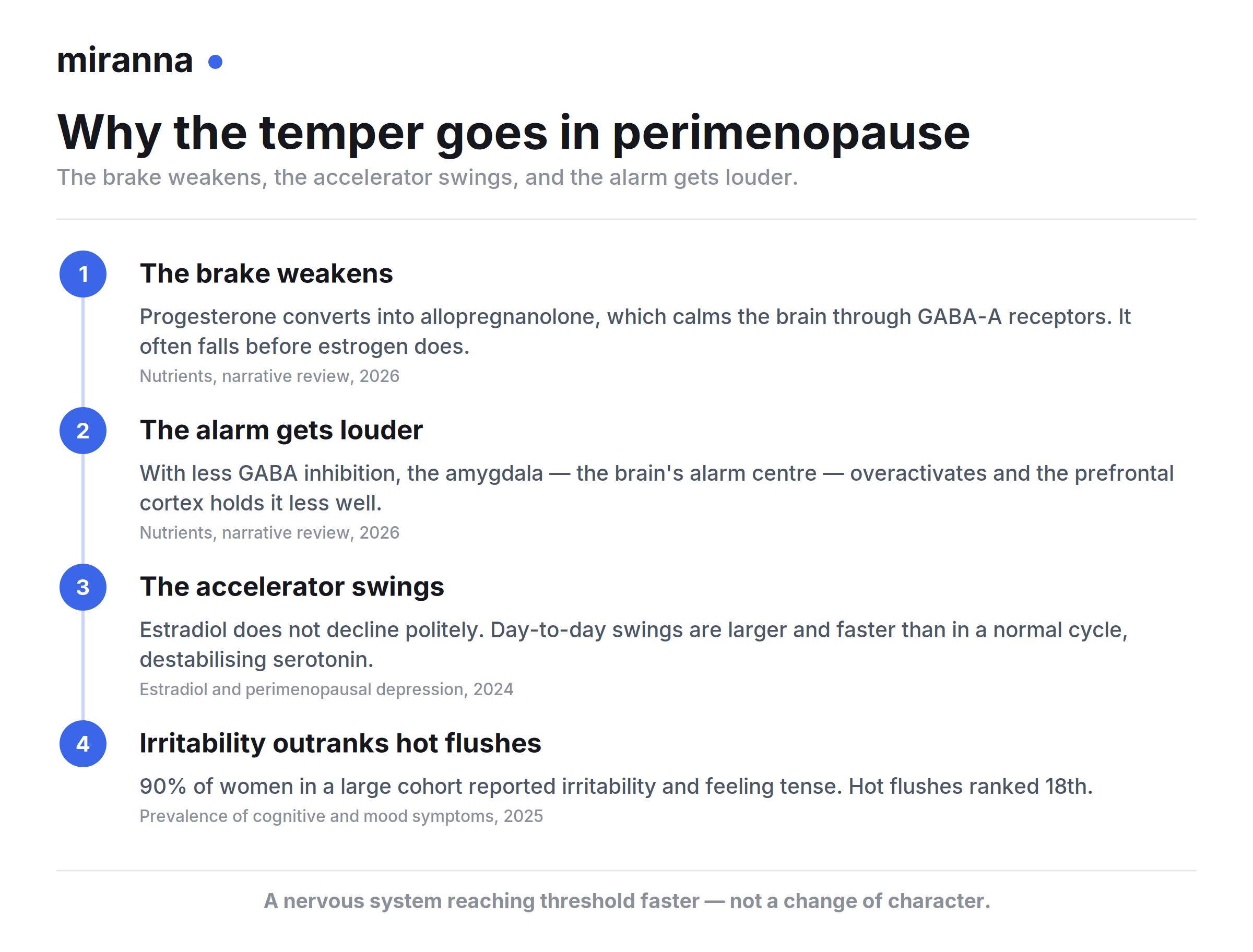
Mood symptoms are not a footnote to this transition — they are often the main event. In a study of a large cohort of perimenopausal and menopausal women, irritability was reported by 90% and feeling tense or nervous by 90%, ranking above hot flushes and night sweats, which came 18th and 14th.
So when you assume you are the only one white-knuckling it through a family dinner: you are, statistically, in the majority.
Why does perimenopause cause rage and irritability?
Two systems that hold your temper together are being destabilized at the same time.
You are losing your brake. Progesterone converts in the brain into allopregnanolone, which acts on GABA-A receptors — the same system targeted by anti-anxiety medication. GABA is the brain’s primary calming signal. Progesterone often starts falling before estrogen does in perimenopause, so allopregnanolone drops, and the inhibitory brake on the nervous system weakens. A 2026 review describes the result plainly: insufficient GABA inhibition, overactivation of the amygdala — the brain’s alarm center — and disrupted balance in the prefrontal cortex, the region that would normally talk you down.
And your accelerator is unpredictable. Estrogen supports serotonin production and receptor sensitivity. In perimenopause, estradiol does not decline politely — women experience larger and faster day-to-day swings, with higher peaks and lower troughs than in a normal menstrual cycle. Your mood chemistry is being rewired on a schedule nobody gave you.
Add poor sleep and rising cortisol, and you have a nervous system that reaches threshold faster and takes longer to come down. That is not a metaphor for how you feel. It is a description of what is happening.
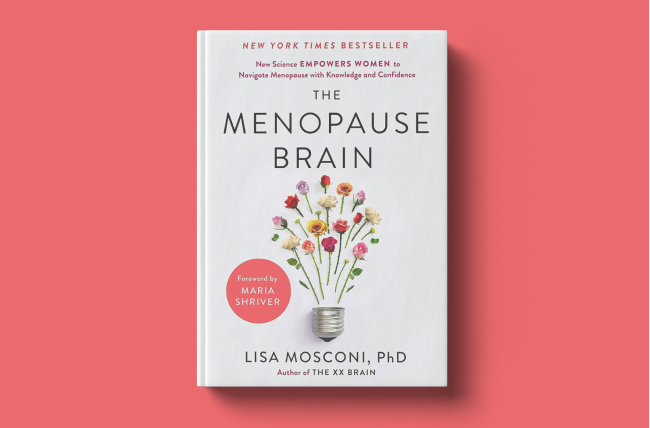
Neuroscientist Dr. Lisa Mosconi’s framing is that the perimenopausal brain is a house mid-renovation — noisy, disruptive, and temporary. Her ten-minute summary of The Menopause Brain covers the mood chapter as well as the fog.
Why rage, and not sadness?
This is the question women ask most and the one that gets answered least.
Part of it is mechanical: the amygdala fires faster and the prefrontal cortex holds it less well, and anger is the emotion that moves quickest through that gap.
But part of it is that the brake you are losing was never only chemical. Many women spend decades with the volume turned down — absorbing, accommodating, being easy to be around. That takes constant effort, and effort takes regulatory capacity. When the capacity thins, everything that was being held down stops being held down.
Which means the anger often is not random. It arrives disproportionate, but it lands on things that were genuinely annoying all along — the invisible logistics, the unequal load, the person who asks where things are kept in his own house. The eruption is a symptom. The subject matter frequently is not.
That is worth sitting with rather than only managing. If it is showing up mostly at your partner, we have written separately about anger toward a partner and how to explain any of it to him, and about how menopause reshapes a marriage.
Is menopause rage different from PMS?
Same machinery, different weather.
PMS anger arrives on a schedule — you can predict it, and it lifts when your period starts. Perimenopausal rage has no timetable, because the hormonal swings driving it have no timetable. That unpredictability is what makes it so destabilizing: you cannot brace for it, and you cannot reassure yourself that it will be over by Thursday.
If you were someone who always got hit hard premenstrually, you may find this stage harder than average. Sensitivity to hormonal change tends to be a trait, not a phase.
Am I going crazy?
No. And the fact that so many women type exactly this into a search bar at 11 p.m. tells you how badly this stage is explained.
What is actually happening is that the gap between how you are behaving and who you believe yourself to be has widened, and that gap is genuinely frightening. It does not mean the self is gone. It means the regulatory system holding it steady is running on unstable supply.
Two things tend to help more than any technique:
Name it out loud to one person. Rage kept secret metastasizes into shame, and shame makes emotional control harder, which produces more rage. Saying “my temper is not mine right now” to one trusted person breaks the loop.
Separate the feeling from the verdict. Feeling murderous about a chewing noise is data about your nervous system. It is not evidence about your character or your love for your family. The same goes for the dread that arrives without a reason, which runs on the same weakened brakes.
Psychiatrist Dr. Paul Conti’s argument — that growth starts from noticing what is working rather than cataloguing what is wrong with you — is summarized in about nineteen minutes and is a useful counterweight when the self-criticism gets loud.
What helps in the moment?
The goal is not to never feel it. It is to keep the ninety seconds of physiology from becoming an hour of damage.
- Leave the room. Unglamorous, undignified, extremely effective. You do not have to win the exchange in front of you.
- Move the energy through. Rage is a body event. Stairs, a fast walk, twenty seconds of pushing against a wall — all of it discharges faster than sitting still and gritting.
- Slow the exhale. Long out-breaths engage the calming branch of the nervous system directly. Six seconds out, longer than in.
- Cold water on the wrists or face. Physiological, not mystical.
- Delay the sentence. Almost nothing has to be said right now. The sentence you would choose in ten minutes is usually better and always cheaper.
And afterwards: repair, briefly, without a full confession. “I snapped and that was not about you, I am sorry.” Children and partners recover from anger far better than they recover from anger that is never acknowledged.
{{Article Banner}}
What helps over the following months?
- Protect sleep first. A short night lowers your threshold before the day has even started. This is the highest-return change available.
- Track the pattern. A few weeks of noting when the flares hit — cycle timing, sleep, hunger, alcohol — usually reveals a shape. Predictable is much easier than random, and it is also the most useful thing you can bring to a doctor.
- Eat regularly. Blood-sugar dips and rage are close relatives, and skipped meals are common in busy midlife weeks.
- Move most days. Exercise raises the threshold rather than just discharging what is already there.
- Rethink evening alcohol. It disrupts the second half of the night, and unrested is where rage lives.
- Take the load off, genuinely. Not a self-care bath. A real subtraction from your actual responsibilities. If regulatory capacity is finite this year, spend less of it on things that were never yours to carry.
And get help if it is more than mood. Depression risk rises measurably during this window. This is not medical advice and no article can assess you — but if the anger sits on top of persistent hopelessness, if you have stopped enjoying anything, or if you are frightened by the intensity of what you feel, that is a conversation to have with a doctor or therapist rather than a phase to outlast alone.
FAQ
How long does perimenopause rage last?
It fluctuates with the hormonal swings driving it and tends to settle after the transition, when hormone levels become steadier. Most women describe it as worst during the volatile perimenopausal years rather than after menopause.
Is perimenopause rage normal?
Yes. Irritability is one of the most commonly reported symptoms of the transition — reported by around 90% of women in one large cohort, more often than hot flushes.
Why do I get so angry before my period in perimenopause?
Progesterone falls in the second half of the cycle, taking allopregnanolone and its calming effect on GABA with it. In perimenopause those drops are steeper and less predictable, so the premenstrual window often hits harder than it used to.
Can menopause rage damage relationships?
It can strain them, mostly through the things said in the ninety seconds and the silence afterwards. Naming what is happening and repairing quickly matters more than never losing your temper.
Does perimenopause rage mean I am depressed?
Not on its own. Irritability can be part of depression, so if the anger comes with persistent low mood, loss of interest, or hopelessness, that is worth raising with a professional.
What can I take for menopause mood swings?
Options exist and they belong in a conversation with a qualified clinician who knows your history. There is no supplement with strong evidence behind it, and the wellness market for this symptom is large and largely unregulated.
The rage is not who you are
It is what a nervous system does when the calming system thins out and the alarm gets louder — while you keep carrying everything you were carrying before.
Most women get this stage back. Not by finding the perfect supplement, but by understanding what is happening, lowering the load, protecting sleep, and stopping the private prosecution of their own character.
Miranna turns the best books on the female brain into short audio summaries — Mosconi, McKay, and more — so you can understand your own biology in ten minutes, not ten chapters. Try Miranna free.
This article is for information only and is not medical advice. If your mood is affecting your daily life or relationships, or you are worried about how you feel, please speak with a qualified healthcare professional.

When you'd rather not white-knuckle it alone
Some days in perimenopause need more than an article. Miranna's menopause coaches work with women on the hard, specific stuff — the thing you said and cannot take back, the shame that arrives twenty minutes later, finding the pause before it comes out of your mouth — at your pace, when you're ready. Browse who you'd want to talk to right in the app.
When you're ready to talk to someone
Sometimes the next step is having one good conversation. Miranna's coaches work with women navigating burnout, hormonal shifts, relationships, and the in-between moments — at your pace, when you're ready.
Browse who you'd want to talk to and book a session right in the app.


People ❤️ Miranna