Join our newsletters and be the first to receive app updates, exclusive content, and connect with a supportive network of accomplished women. Sign up today to unlock your journey to success with Miranna

How Long Does Menopause Last? Stages and Timeline


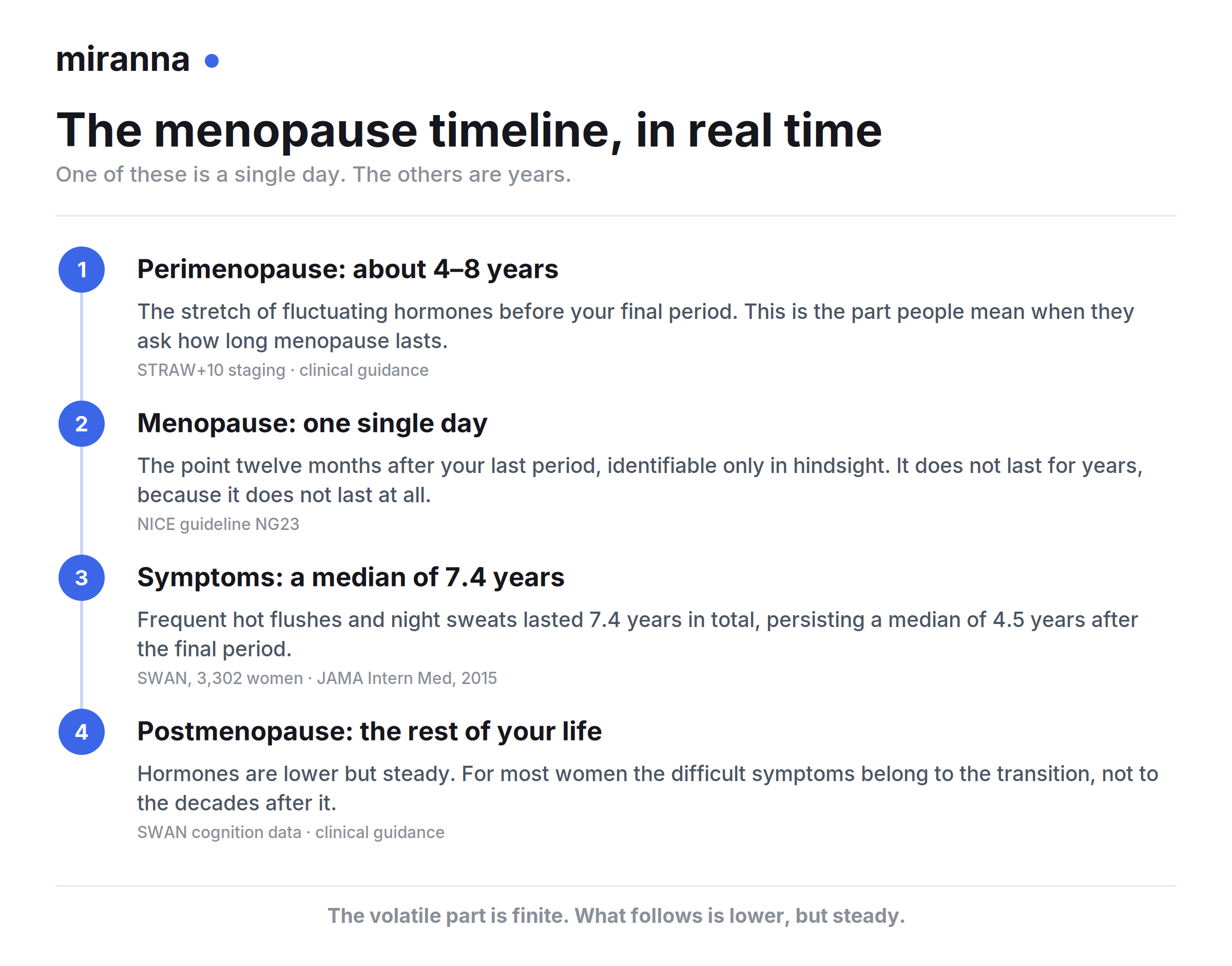
Menopause itself lasts one day: the point twelve months after your final period. What people mean by “how long does menopause last” is usually perimenopause, which runs around four to eight years. Symptoms are a separate question — in SWAN, frequent hot flushes lasted a median of 7.4 years, persisting 4.5 years past the final period.
The question behind the question is almost always: when does this end?
It is a fair thing to want to know, and most sources answer it badly — either with a breezy “two to five years” that does not match what women actually experience, or with a definition so technical it tells you nothing about your life.
So here is the timeline as researchers actually measure it.
How long does menopause last?
The confusion comes from the word itself doing two jobs.
Menopause, technically, is a single point in time. It is the day that marks twelve months since your last period. You can only identify it looking backwards. It does not last for years, because it does not last at all.
Perimenopause is the stretch that people mean. It is the years of hormonal fluctuation leading up to that point — typically four to eight years, though it can be shorter or considerably longer.
Postmenopause is everything after. It does not end. You are postmenopausal for the rest of your life, which sounds ominous and mostly is not: for most women, the difficult symptoms belong to the transition, not to the decades that follow.
So the honest answer is: the disruptive part is perimenopause plus a few years, and it is finite.
What are the stages of menopause?
Researchers use a staging system to make sense of a process that feels formless from the inside. Simplified, it goes:
- Late reproductive years. Cycles still regular, but subtly changing — often slightly shorter, and premenstrual weeks getting rougher.
- Early perimenopause. Cycle length starts varying by seven days or more between cycles. This is usually when sleep, mood, and focus first shift.
- Late perimenopause. Gaps of 60 days or more between periods. Hot flushes are most common here and in the first years after.
- The final menstrual period. Identifiable only in hindsight, twelve months later.
- Early postmenopause. Roughly the first five to eight years. Hormones settle; many symptoms fade.
- Late postmenopause. The long stretch. Symptom-wise, usually the quietest part.
Two things are worth noticing. The stages are defined by your cycle, not by how you feel — which is why symptoms can be severe while you are still technically “early.” And the cognitive and emotional symptoms tend to arrive early, before the changes that make the stage official.
How long do menopause symptoms actually last?
This is where the standard answer has been quietly wrong for decades.
Clinical guidance long suggested hot flushes last six months to two years. Then SWAN followed 3,302 women for seventeen years and found something different: among women with frequent hot flushes and night sweats, the median total duration was 7.4 years, and they persisted a median of 4.5 years after the final period.
The variation matters as much as the average:
- Women whose symptoms started early — while still premenopausal or in early perimenopause — had the longest run, a median of over 11.8 years.
- Women whose symptoms started only after menopause had the shortest, a median of 3.4 years.
- Black women reported the longest total duration at a median of 10.1 years; Japanese and Chinese women the shortest, at 4.8 and 5.4 years.
Starting early tends to mean lasting longer. That is worth knowing, not to be discouraging, but because it explains why the two-year figure leaves so many women feeling like something has gone wrong with them specifically.
What is the average age of menopause?
Around 51 in Western populations, with a normal range of roughly 45 to 55.
Perimenopause therefore usually begins somewhere in the mid-forties, though starting in the late thirties is within normal variation. Before 45 is termed early menopause; before 40, premature ovarian insufficiency — and that one warrants proper investigation rather than waiting it out.
Some things shift the timing: smoking is associated with earlier menopause, as are certain surgeries and cancer treatments. Family history is a rough guide but not a prediction.
What is the difference between perimenopause and menopause?
Briefly: perimenopause is the process, menopause is the finish line, postmenopause is afterwards. Perimenopause is when you still have periods and wildly fluctuating hormones. Postmenopause is when hormones are low but steady — and steady turns out to be much easier to live in.
We have written a fuller comparison of perimenopause versus menopause if you want the detail.
{{Article Banner}}
What are the signs perimenopause is ending?
There is no announcement, but there are patterns:
- Long gaps between periods. Sixty days or more marks late perimenopause. Gaps tend to lengthen before stopping altogether.
- Symptoms becoming more predictable. Less of the wild week-to-week swing, more of a steady baseline — a sign hormones are stabilizing rather than oscillating.
- Sleep and mood settling first. Often these improve before hot flushes do.
- Hot flushes changing character. For many women they thin out gradually rather than stopping abruptly.
The frustrating caveat: a long gap is not the end. Periods can return after months of absence, and the twelve-month clock restarts. That is normal, and it is also the reason for the next question.
Can you get pregnant after menopause?
Not after menopause, no — but the gap between “probably nearly there” and “actually there” is where accidental pregnancies happen.
Fertility declines steeply in the forties, but ovulation during perimenopause is unpredictable rather than absent. Standard guidance is to keep using contraception until twelve months without a period if you are over 50, or twenty-four months if you are under 50. After genuine menopause, natural conception is not possible.
This is a conversation to have with a clinician rather than an article, particularly about which method suits this stage — and worth having early, because it is the one part of this timeline with consequences.
What gets better, and what does not?
The most useful framing is not “when does it end” but “what ends, and what changes permanently.”
Usually improves after the transition: sleep, mood swings, anxiety, brain fog, and eventually hot flushes. The SWAN cognition data show the cognitive dip of perimenopause is largely reversible. If fog and broken nights are your main problem, the trajectory genuinely is in your favor — we have covered what to do about the sleep in the meantime.
Tends to persist or progress: vaginal and urinary changes, which respond to treatment but do not resolve on their own. Unlike hot flushes, this one does not wait itself out, and it is the symptom women are least likely to raise.
Becomes a long-term health question: bone density and cardiovascular risk both change after menopause. Not symptoms, exactly — reasons to have a proper conversation about the decades ahead.
Neuroscientist Dr. Lisa Mosconi calls the years around menopause the most decisive window your brain will get. Her six-minute summary of The XX Brain makes the case for treating this decade as an investment rather than a siege.
FAQ
How long does menopause last on average?
Menopause itself is a single day — twelve months after your final period. Perimenopause, the transition people usually mean, lasts around four to eight years, and symptoms can persist several years beyond it.
How long do hot flushes last?
Longer than most guidance suggests. In SWAN, frequent hot flushes lasted a median of 7.4 years in total and continued a median of 4.5 years after the final period.
What are the three stages of menopause?
Perimenopause, menopause, and postmenopause. Researchers subdivide these further by cycle changes: early and late perimenopause, then early and late postmenopause.
Does menopause ever fully end?
The transition ends; postmenopause is permanent. For most women the disruptive symptoms belong to the transition and the first years after it, not to the decades that follow.
Can perimenopause last 10 years?
Yes. Four to eight years is typical, but longer transitions happen — particularly for women whose symptoms began early.
How do I know my last period was my last?
Only in hindsight. Menopause is confirmed after twelve consecutive months without a period, which is also why contraception is advised until that point.
Finite, but longer than you were told
Two things are true at once, and most articles pick one.
It lasts longer than the two-year figure women get handed — long enough that being told “it will pass soon” for the fifth year running is genuinely maddening.
And it does end. The volatility that makes perimenopause hard is caused by fluctuation, and fluctuation stops. What follows is lower but steady, and steady is a much easier place to live.
Knowing which stage you are actually in changes what you do about it. It is the difference between waiting for something to be over and making decisions about a decade you can see the shape of. If you are not sure where you are, our guide to working out whether you are in perimenopause has a symptom check to start from.
Miranna turns the best books on the female body and brain into short audio summaries — so you can understand the map while you are still walking it. Try Miranna free.
This article is for information only and is not medical advice. Timelines vary widely between women, so please speak with a qualified healthcare professional about your own.

When you'd rather not work out the map alone
Some questions about perimenopause need more than an article. Miranna's menopause coaches work with women on the hard, specific stuff — not knowing which stage you are in, being told it will pass soon for the fifth year running, deciding what to do with the decade ahead — at your pace, when you're ready. Browse who you'd want to talk to right in the app.
When you're ready to talk to someone
Sometimes the next step is having one good conversation. Miranna's coaches work with women navigating burnout, hormonal shifts, relationships, and the in-between moments — at your pace, when you're ready.
Browse who you'd want to talk to and book a session right in the app.


People ❤️ Miranna