Join our newsletters and be the first to receive app updates, exclusive content, and connect with a supportive network of accomplished women. Sign up today to unlock your journey to success with Miranna

How to Spice Up Your Relationship Without the Usual Advice


Most advice on this topic fails for a structural reason: it adds novelty to a sex life whose actual problem is that nothing is being removed. Lingerie, a weekend away, a new position — all of it presses the accelerator while the brakes stay on. What reliably changes things is smaller and less photogenic: rebuilding the everyday touch that disappeared first, finding out what actually turns you on rather than what’s supposed to, and doing new things together that have nothing to do with sex.
Why doesn’t the usual advice work?
This piece leans on two summaries in the Miranna app: psychosexologist Dr. Karen Gurney on how long-term desire actually behaves, and journalist Katherine Rowland’s five years of interviews with women about what their sex lives are like from the inside.
The standard listicle assumes desire is a fire that needs more fuel. For most people in long relationships, it’s closer to a car with the handbrake engaged. You can rev as hard as you like.
What’s usually on the brake: exhaustion, an unfinished argument, a body you’ve been criticizing in the mirror, children who might wake, a phone in the room, the sense that sex has become one more thing you’re failing at. None of that responds to lingerie.
There’s also a second problem with novelty-based advice, which is that it’s someone else’s novelty. A suggestion only works if it maps onto something that genuinely does it for you — and most women were never given the chance to find out what that is.
Rebuild sexual currency before anything else
Gurney’s term for the small, non-goal-oriented physical intimacies a couple keeps in circulation: a kiss that lasts longer than three seconds, a hand on the lower back when passing, a text you’d only send to them, eye contact held a beat too long, a compliment about their body rather than their outfit.
Couples who lose their sexual currency usually lose their sex life a few months later. The reason is mechanical. When ordinary affectionate touch disappears, every advance becomes an unmistakable proposal — there’s no middle ground left. So the stakes go up on every gesture, and both people quietly stop making them.
This is the least exciting item on any list of ways to spice things up, and it’s the one that has to come first. Rebuild the currency before you try to rebuild the sex. Gurney’s full case for how long-term desire behaves runs about nine minutes in the app.
{{Article Banner}}
How do you find out what actually turns you on?
Don’t try to feel your way there. Investigate it.
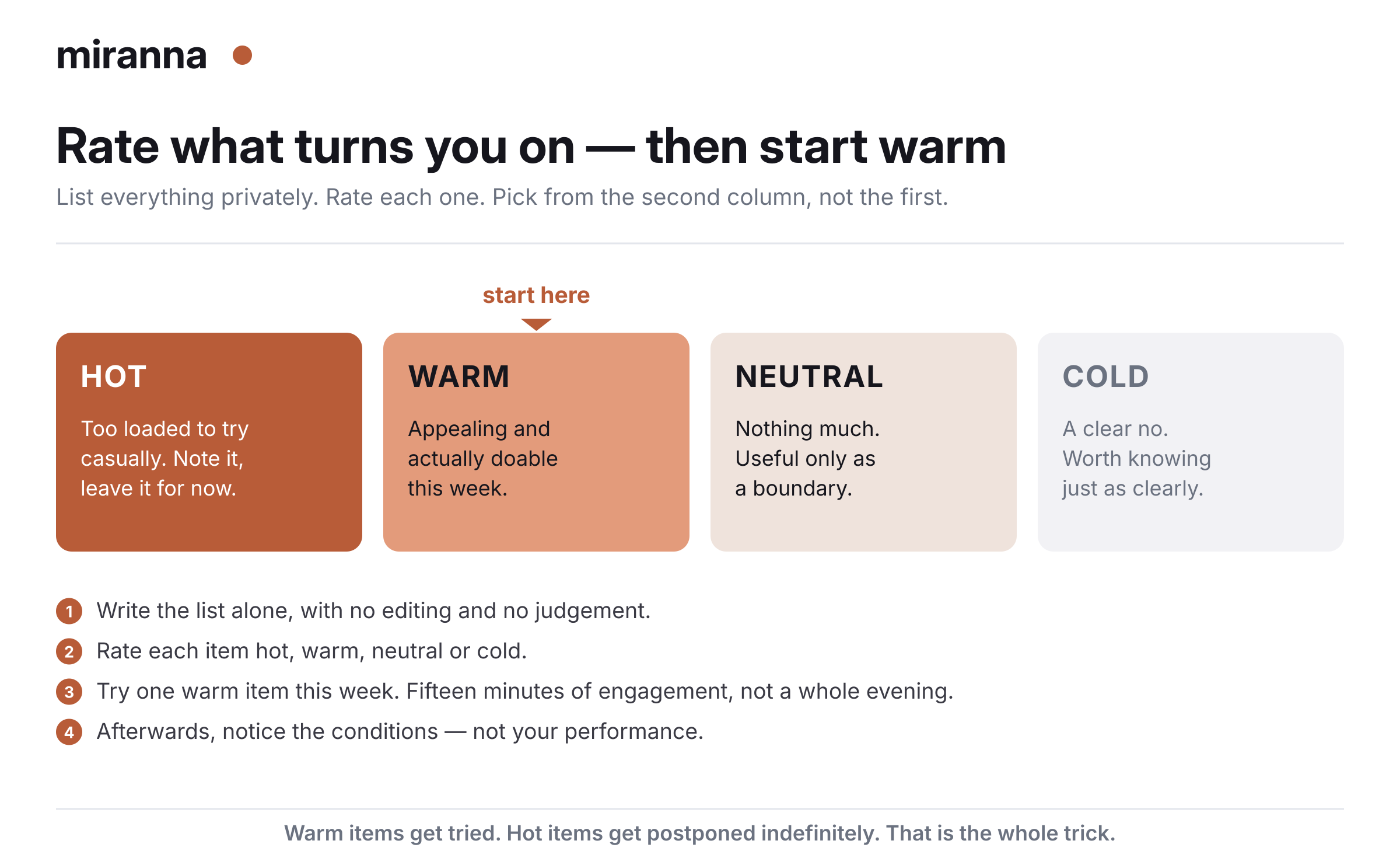
Gurney uses a structured exercise with clients, and it’s the most useful thing in this article:
- Make a stimuli list, alone. Every situation, image, memory, sensation or story that has ever turned you on. Don’t edit. Don’t judge whether it’s reasonable or says something about you.
- Rate each one: hot, warm, neutral, cold. Patterns show up fast, and they’re rarely what you expected.
- Pick one warm item to test this week. Not the hottest — the most accessible. Warm items have a much better completion rate than ambitious ones.
- Set a low bar: fifteen minutes of engagement. Not “have sex.” Just engagement — reading, touch, sensory attention. The point is to find out whether desire follows action.
- Reflect afterwards. Not to score your performance. To notice what conditions were present and what was different.
The stance matters more than the outcome. You’re running experiments on your own sexuality, not testing whether you’re broken.
Rowland’s version of the same work is about vocabulary. Most women can’t describe their own sensations with any precision, because nobody ever asked them to. Practise the words — warm, buzzy, heavy, pulsing, too fast, stay there — before you need them in a conversation. You can’t advocate for an experience you can’t name.
Why “sexier” isn’t the goal
The most uncomfortable finding in Rowland’s reporting is about who women become in bed. Many of the women she interviewed hold senior jobs, run households, are listened to in every other room — and in the bedroom become deferential, apologetic, and preoccupied with whether he’s enjoying it.
The patterns she documents are specific: waiting to be wanted rather than saying what you want, anxiously tracking his experience while your own fades to background noise, apologising for needing lubricant or time or a different position, rushing to reciprocate before you’ve finished receiving, and an underlying fear of being too much — too loud, too needy, too hard to please.
Add chronic body shame to that and you get a woman monitoring herself from the outside during the exact activity that requires being inside her own body. You cannot spice up an experience you are watching yourself have.
Which is why the fix isn’t looking sexier. It’s taking up the same amount of room you take up everywhere else — which is the whole subject of sexual self-esteem.
Why new experiences beat new techniques
The research on long-term sexual satisfaction keeps landing on the same three habits: responsiveness to a partner’s bids, treating your sex life as something you actively maintain rather than something that happens to you, and self-expanding activities — doing genuinely new things together.
The third one is the surprise. It isn’t about sex at all. Novel shared experience activates the reward pathways that make you feel drawn to someone, and the effect attaches to whoever you had the experience with. A class neither of you has taken, a route neither of you has walked, a skill you’re both bad at.
Which is why “do something new together” outperforms “try something new in bed” for most couples. The first one lowers the stakes. The second one raises them.
Rewrite the script
The default script for heterosexual sex is narrow: kissing leads to touching, touching leads to penetration, penetration ends when he does. Gurney’s point is that this fails women mathematically — only a minority orgasm from penetration alone — and structurally, because it treats everything else as a warm-up.
Spicing things up, in that frame, mostly means widening the definition:
- Sex doesn’t have to include penetration to count
- It doesn’t have to end with his orgasm
- Planned doesn’t mean failed. For plenty of couples, scheduled time is the only reason sex happens at all, and everything else you value is in the calendar too
- Sessions can have a stated shape — tonight is only this, and that’s the whole plan
None of that requires props. It requires saying out loud what the evening is, which most couples never do.
What kink communities get right — even if you’re not interested
Rowland spends time with women who found relief through consensual power play, and her conclusion is useful regardless of whether any of it appeals to you. What those communities model is negotiation, and mainstream sex mostly lacks it.
Four things worth borrowing: everything is discussed before it happens rather than assumed; limits are stated plainly and without apology; structured reconnection afterwards is treated as normal rather than optional; and power dynamics are named instead of quietly operating in the background.
You don’t have to be kinky to take those four. Most couples would find their ordinary sex life improved by any one of them. Rowland’s full reporting runs about nine minutes in the app.
FAQ
How do you spice things up when you’re exhausted?
Start with sexual currency, which costs seconds rather than evenings. Ambitious plans made while depleted don’t survive contact with Wednesday.
Is it a bad sign if we need to work at this?
No. Early desire runs on novelty, which is a temporary system. Every long relationship reaches the point where the thing has to be maintained deliberately. That’s the normal course, not a failure.
What if my partner isn’t interested in trying anything?
Ask for something specific and small rather than announcing a project. “Would you try this one thing with me for two weeks” gets a different answer than “we need to work on our sex life.” More on that in communication exercises for couples.
Does scheduling sex ruin spontaneity?
It protects the runway that spontaneity used to provide. For most women in long relationships, desire is responsive rather than spontaneous, so waiting to feel like it first is the losing strategy — we cover that in responsive desire.
When is this a bigger issue than novelty can fix?
When there’s real resentment, when one of you feels persistently pressured or rejected, or when sex has stopped entirely and neither of you can raise it. Sexless marriage covers that ground, and a couples therapist or sex therapist is the right next step.
Skip the props. Put the kiss that isn’t a question back, find out what actually does it for you, and go do something new together that has nothing to do with the bedroom.

When you'd rather not figure it out alone
Miranna's coaches work with women on desire, confidence, and asking for what you actually want — one session at a time.
When you're ready to talk to someone
Sometimes the next step is having one good conversation. Miranna's coaches work with women navigating burnout, hormonal shifts, relationships, and the in-between moments — at your pace, when you're ready.
Browse who you'd want to talk to and book a session right in the app.



People ❤️ Miranna