Join our newsletters and be the first to receive app updates, exclusive content, and connect with a supportive network of accomplished women. Sign up today to unlock your journey to success with Miranna

Responsive Desire: How Desire Actually Works


If you never think about sex until you’re already in the middle of it, nothing is wrong with you. That’s responsive desire — desire that shows up after arousal rather than before it — and for a large share of women it’s the default setting, not a malfunction. The spontaneous kind, the out-of-nowhere craving that films treat as the only real version, describes a minority of women and tends to fade in long relationships for everyone. Once you know which system you’re running, the question stops being “why don’t I want it?” and becomes “what conditions does my desire need?”
What is responsive desire?
Two researchers do most of the work in this piece: Emily Nagoski and Dr. Karen Gurney. We’ve summarized both in the Miranna app, and this is where they agree.
Responsive desire is desire that emerges in response to pleasure, rather than in anticipation of it. You don’t feel like it beforehand. You start — a kiss, a massage, unhurried touch — your body responds, and somewhere in the middle the wanting arrives. Sex educator Emily Nagoski’s line for it: spontaneous desire appears in anticipation of pleasure, responsive desire emerges in response to it.
The practical consequence is large. If you assume desire has to come first, then no desire means no sex, and you conclude your libido is broken. If desire can come second, then the question is simply whether you’re willing to begin without it — and whether the beginning is good enough to be worth responding to.
Spontaneous vs. responsive desire: what’s the difference?
Timing, mostly. Spontaneous desire arrives before any stimulation. Responsive desire arrives after it.
The proportions are the part that surprises people. Drawing on Natsal-3, the largest UK sex survey, Gurney reports that only about 15% of women in long-term relationships experience frequent spontaneous desire. Nagoski’s figures run the same way — she puts predominantly spontaneous desire at roughly 75% of men and 15% of women, and predominantly responsive desire at around 30% of women and 5% of men. Either way, the version of desire our culture treats as standard describes about one woman in six.
Gurney’s comparison is the one that tends to land: waiting to feel spontaneously in the mood for sex with a long-term partner is like waiting to feel spontaneously in the mood for the gym. For most women, motivation follows action rather than preceding it.
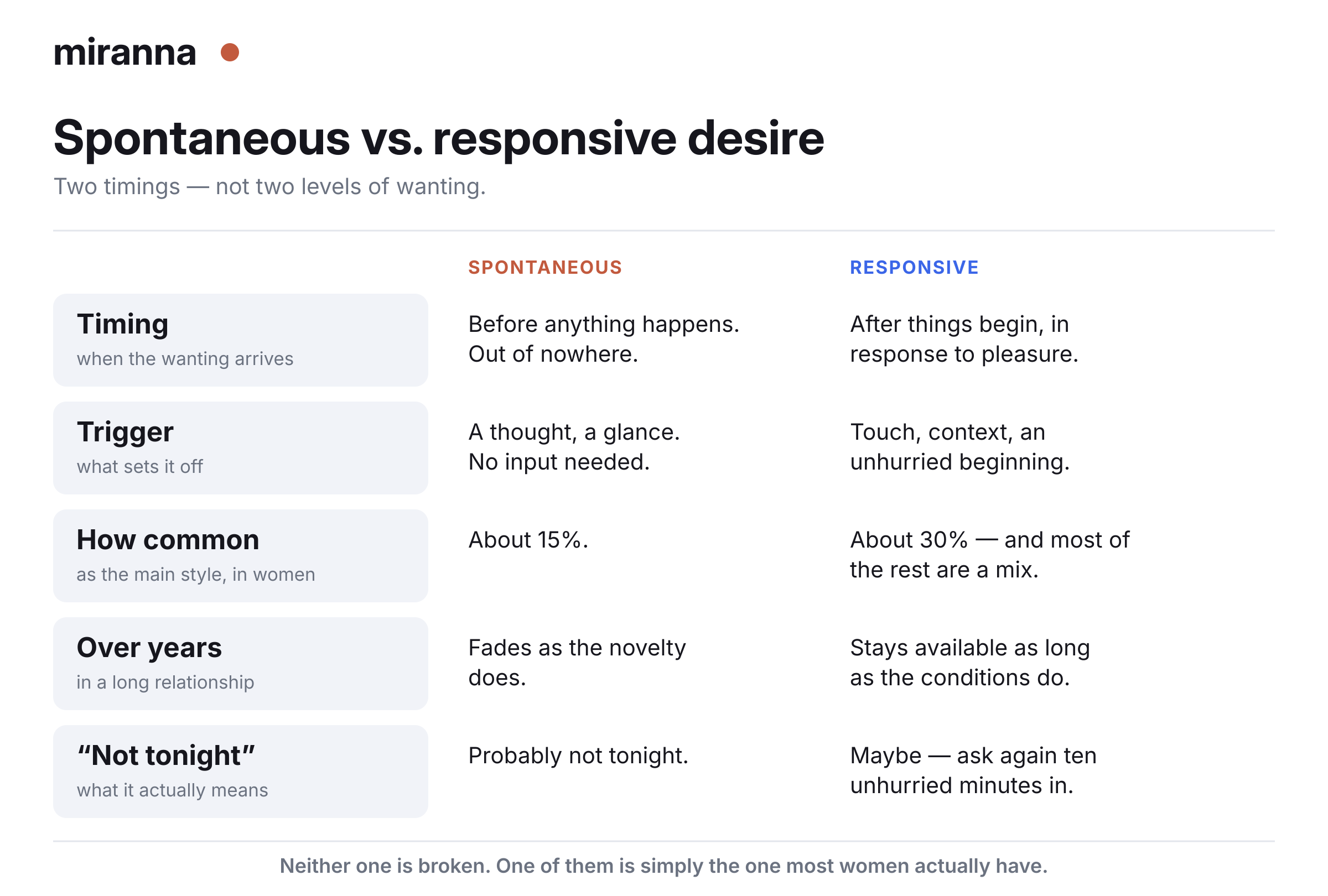
Two things follow. First, a woman with responsive desire isn’t a low-desire woman; she’s a differently-timed one. Second, desire style isn’t fixed. Early in a relationship, novelty does a lot of the accelerating for you, which is why the same person can feel spontaneous at six months and responsive at six years. That shift is developmental, not a verdict on the relationship.
What is the dual control model?
Nagoski’s dual control model describes the brain running two systems at once: an accelerator that notices anything sexually relevant — she calls it the sexual excitation system, or SES — and brakes that notice every reason not to, the sexual inhibition system, or SIS. Arousal is the net result of the two, not the accelerator alone.
Most people who feel their desire has disappeared don’t have a weak accelerator. They have sensitive brakes, and a life full of things pressing them:
- The mental load of remembering everything for everyone
- Being touched all day by children and wanting your body back
- The unwashed dishes visible from the bed
- Worry about how long you’re taking, or how you look
- Unrepaired conflict from Tuesday
This reframes the whole project. Adding more accelerator — lingerie, a weekend away, trying harder — does very little when the brakes are on. Taking a foot off the brake does a great deal. It’s why the most effective thing is often unglamorous: the argument finished properly, the door with a lock, the earlier bedtime. If stress is the brake doing most of the work in your case, we go deeper into that in how stress affects desire.
What is desire discrepancy — and what do you do about it?
Desire discrepancy is when two partners want sex at different frequencies. It’s also called mismatched libido or, plainly, different sex drives in a relationship, and it’s close to universal — in any couple, someone wants it more often, and the gap usually widens over time.
What makes it painful is rarely the gap itself. It’s the meaning each person attaches to it. The higher-desire partner reads rejection: you don’t want me. The lower-desire partner reads pressure: I’m failing you, and now even a hug is a question. Both then avoid the subject, which reliably makes both feelings worse.
Five shifts that help:
- Separate desire from love. Wanting sex less often is not wanting your partner less. Say that part out loud; it’s usually the thing the other person needs to hear most.
- Stop negotiating in the bedroom. The conversation goes better fully dressed, on a walk, at a time nobody is being turned down.
- Ask what conditions would make yes easy. “Why don’t you want it?” has no useful answer. “What would have to be true for you to want to?” usually does.
- Stop keeping score. Counting requests and refusals turns sex into a ledger, and nobody wants debt sex. Gurney is blunt about this one.
- Widen what counts as sex. If one kind is off the table this week, closeness doesn’t have to be. Touch, mutual pleasure and unhurried attention are not consolation prizes.
Psychosexologist Dr. Karen Gurney makes the point that a discrepancy is a shared problem to solve, not one partner’s deficiency to fix — and if you want her full case for how long-term desire really behaves, it runs about nine minutes in the Miranna app.
{{Article Banner}}
Is maintenance sex a good idea?
Maintenance sex is the term for sex you have to keep the connection going rather than because you were struck by desire beforehand. It gets a bad reputation, and half of that reputation is deserved.
The version that damages a relationship is sex you don’t want, given to keep the peace. That’s not maintenance; it’s appeasement, and it teaches your body that sex is something to endure.
The version that works is different: you’re not in the mood, you are willing to find out whether you could be, and you can stop at any point without it becoming an incident. That’s responsive desire being given its conditions. For plenty of couples this looks like planned intimacy, which sounds unromantic until you notice that everything else you value in your life is also scheduled.
The test is simple. Are you starting because you’re curious whether desire will show up, or because you’ll be in trouble if you don’t? One is maintenance. The other is a different problem.
How do you create the conditions for desire?
If desire is responsive, then conditions aren’t a nice extra — they’re the mechanism. Gurney works with a simple triangle: psychological arousal (the mental permission to be present), physical touch (the kind your body actually responds to), and context (time, privacy, energy, no one about to walk in). When one point is missing, the other two can’t compensate for it.
- Keep sexual currency in circulation. Gurney’s term for the ordinary, non-goal-oriented touch and flirting a couple maintains: a kiss that isn’t a question, a hand on the back. When it disappears, every advance becomes a proposal, and the stakes get too high to bother.
- Deal with the brakes you can actually reach. Not all of them are movable. Some are: the phone out of the room, the door locked, the argument finished.
- Give the beginning more time than feels necessary. Responsive desire needs a runway. Most couples cut it short because they’re measuring from the wrong starting line.
- Talk about it outside the moment. Couples who discuss sex openly report more satisfaction; the barrier is usually not knowing how to start. Begin with something that’s working — we walk through the whole conversation in how to talk to your partner about sex.
- Protect emotional closeness. Desire rarely recovers in a relationship where nobody feels known — that work is covered in our piece on emotional intimacy.
Nagoski’s broader argument — that there is no normal, only context — runs about fourteen minutes if you’d rather listen.
FAQ
Is responsive desire the same as low libido?
No. Low desire describes how much you want; responsive describes when the wanting arrives. Someone with responsive desire can have a rich sex life once the conditions are right.
Can spontaneous desire come back?
Often, in bursts — novelty, time away, a change of scene. But building a long-term sex life around waiting for it is a losing strategy for most women. Building it around conditions works better.
What if my partner and I have completely different sex drives?
Assume it’s normal and treat it as a joint logistics problem rather than a fault. Agree on what a yes needs, what a no sounds like, and how either of you can stop without it becoming a fight.
Is scheduled sex a bad sign?
No. For responsive desire it’s often the opposite — it protects the runway that spontaneity used to provide.
When is low desire worth seeing a professional about?
When it’s distressing to you, when it changed suddenly, or when it comes with pain, or with a low mood that’s affecting the rest of your life. This article is about the psychology of desire, not a medical assessment — a doctor or a qualified sex therapist is the right place for those questions.
Desire that needs conditions isn’t lesser desire. It’s the more common kind, and the one you can actually do something about — because conditions are buildable in a way that a spark isn’t. Pick the brake you can reach this week and take your foot off it.

When you'd rather not figure it out alone
Miranna's coaches work with women on desire, intimacy, and the conversations that are hard to start — one session at a time.
When you're ready to talk to someone
Sometimes the next step is having one good conversation. Miranna's coaches work with women navigating burnout, hormonal shifts, relationships, and the in-between moments — at your pace, when you're ready.
Browse who you'd want to talk to and book a session right in the app.



People ❤️ Miranna