Join our newsletters and be the first to receive app updates, exclusive content, and connect with a supportive network of accomplished women. Sign up today to unlock your journey to success with Miranna

Sexless Marriage: Why It Happens and How to Rebuild


A sexless marriage is usually not a marriage that stopped loving. It’s a marriage where sex became a separate, high-stakes event instead of an extension of everyday closeness — and then, reasonably enough, both people started avoiding it. That’s why the fix rarely starts in the bedroom. It starts with the small, ordinary contact that used to make sex feel like the obvious next thing rather than a proposal someone has to accept or refuse.
What counts as a sexless marriage?
We turn books and podcasts into short summaries at Miranna, and two of them do most of the explaining here — Dr. Karen Gurney on how desire behaves over years, Terry Real on what unrepaired conflict does to a couple.
Researchers generally draw the line at sex fewer than ten times a year. By that measure, somewhere between one in six and one in five married couples in the US qualifies at any given point — and the share has been drifting upward as overall sexual frequency in the country falls.
Gurney adds the finding that matters more than the count: frequency correlates only weakly with how satisfied couples say they are. Two couples having sex the same number of times a month can be in completely different relationships.
Two things worth taking from that number. First, you are not an outlier, whatever the silence around this suggests. Second, the threshold is arbitrary. If you’re both content, ten times a year is not a problem. If one of you is quietly miserable at twice a month, that is one. The useful question isn’t how often — it’s whether anyone is suffering, and whether either of you can say so out loud.
Why does sex stop in a marriage?
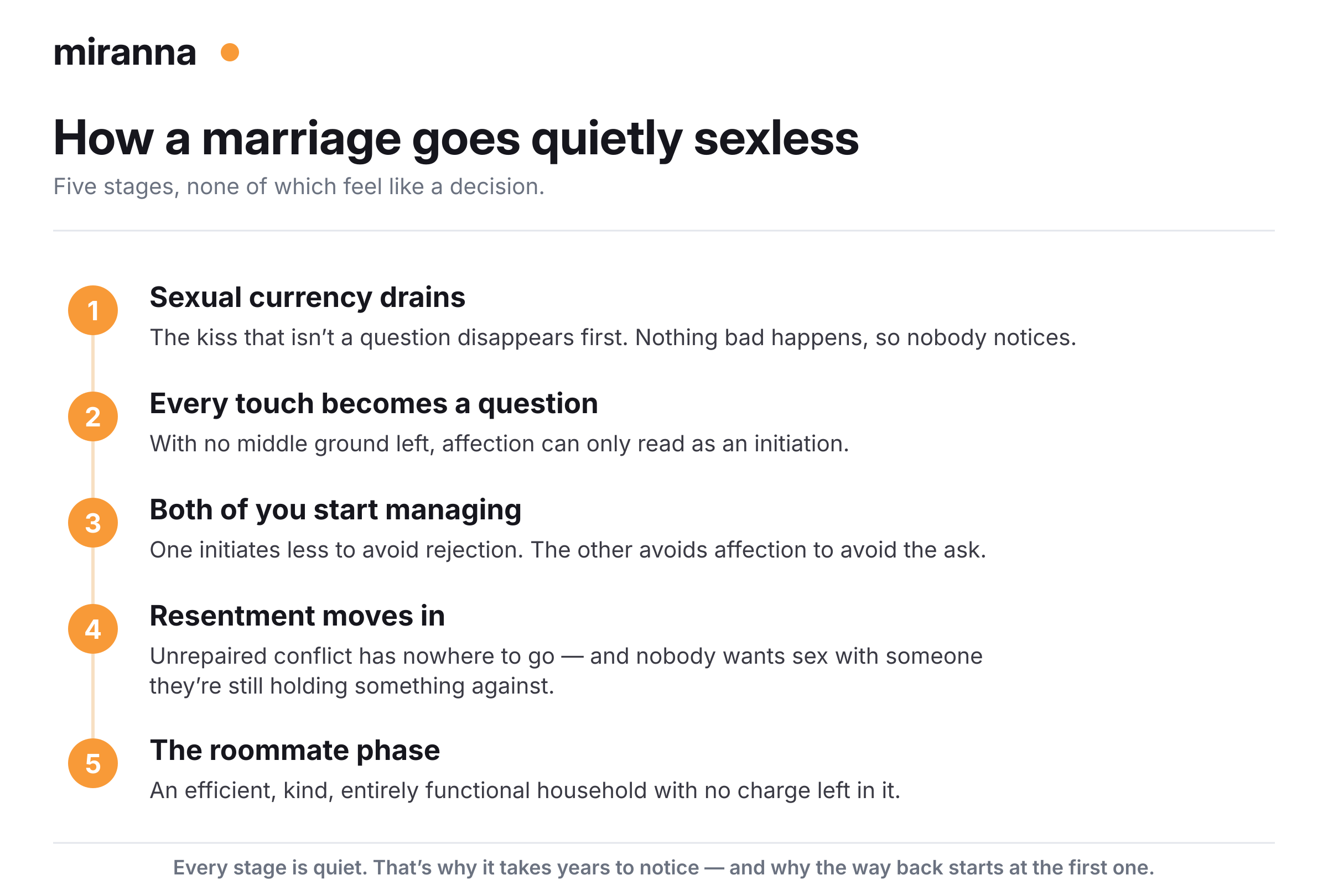
Almost never because of one decision. It goes in stages, and each stage makes the next one easier.
It usually starts with what psychosexologist Dr. Karen Gurney calls sexual currency: the everyday, non-goal-oriented touch a couple keeps in circulation. A kiss that isn’t a question. A hand on the back while passing in the kitchen. Flirting with no destination. This is the connective tissue of a physical relationship, and it’s the first thing to go when life gets busy, because nothing bad happens immediately when it does. Her full case for how long-term desire behaves runs about nine minutes in the app.
But once it’s gone, every advance becomes an unmistakable proposal. There’s no middle ground left — no way to be affectionate without it reading as an initiation. So the higher-desire partner initiates less to avoid rejection, the lower-desire partner avoids affection to avoid the implied question, and both are now managing the situation rather than being in it.
{{Article Banner}}
Underneath that sits a second engine: unrepaired conflict. Couples therapist Terry Real describes relationships as cycling through harmony, disharmony and repair. Skip the repair often enough and the resentment doesn’t vanish; it settles quietly into the body. Very few people want sex with someone they’re still holding something against.
Add the ordinary brakes — small children, the mental load, exhaustion, a body that doesn’t feel like your own — and the wonder isn’t that sex fades. It’s that anyone manages to keep it going. More on how that machinery works in responsive desire.
What is the roommate phase of marriage?
The roommate phase is what a sexless marriage usually feels like from the inside: an efficient, affectionate, entirely functional household with no erotic charge in it at all. You coordinate well. You’re kind to each other. You are also, unmistakably, colleagues.
It’s rarely the result of a fight. It’s the result of a very long stretch of competence. Two people who are good at logistics gradually become people who mostly do logistics, and the parts of each other they used to be curious about stop coming up.
The reason this matters more than the frequency count: the roommate phase is reversible, but not by having more sex. Sex is the output. What’s missing is the input — the sense of being someone’s person rather than their most reliable co-worker. If that’s landing, feeling lonely in a relationship covers the same ground from the emotional side.
What does a lack of intimacy in marriage look like?
Some of these are physical, most aren’t:
- Touch has become functional — a hand on the shoulder to get past, nothing else
- You can’t remember the last time either of you flirted
- Sex, when it happens, is efficient and slightly formal
- Bedtimes have drifted apart, and neither of you has mentioned it
- One of you has stopped initiating entirely, and it isn’t discussed
- Conversation is almost entirely operational
- You’d rather scroll than turn over
The pattern that matters isn’t any single item. It’s that none of them has ever been said out loud.
Can a sexless marriage be saved?
Usually, yes — with two conditions.
The first is that both people treat it as a shared problem rather than one person’s fault or one person’s demand. As long as it’s framed as “you don’t want me” versus “you’re pressuring me,” nobody can move, because every move confirms the other’s story. Terry Real’s whole argument is that repair is a skill rather than a mood, and it’s summarized in about eleven minutes if you want the method — and the step-by-step version of finishing an argument is in how to reconnect with your partner.
The second is that you stop aiming at sex. Couples who set out to have more sex tend to fail, because they’ve made the thing itself the test, and a test is not an erotic environment. Couples who set out to rebuild ordinary affection with no obligation attached tend to find sex returns on its own, later, without being scheduled into existence.
What doesn’t work: waiting for spontaneous desire to reappear. For most women, desire in a long relationship is responsive — it shows up after things start, not before, which is exactly why “we’ll wait until we both feel like it” can quietly last four years.
How to rebuild intimacy in a marriage
- Put sexual currency back first. Non-goal-oriented touch, deliberately. A six-second kiss. A hand on the back. The point is to make affection stop meaning so, tonight?
- Say the unsayable sentence, kindly. “I miss you, and I don’t know how to start this conversation” outperforms any strategy, because it names the thing without assigning blame.
- Take sex off the table for a set period, on purpose. A mutually agreed pause removes the pressure that’s been preventing everything else. Touch without a destination is much easier when both of you know where it isn’t going.
- Rebuild the conditions, not the mood. Earlier nights. A lock on the door. The argument actually finished. Desire responds to circumstances far more than to intention.
- Schedule time, not sex. Protected, unhurried time with no required outcome. Everything else you value is in the calendar; this deserves the same status without becoming an appointment to perform. For what to actually do with that time, see how to spice up your relationship.
- Deal with resentment separately. If there’s a real unfinished thing between you, the bedroom is the last place it will get resolved. Finish it in daylight, fully dressed.
How to fall back in love with your husband
The phrase suggests a feeling you have to locate. In practice it works the other way around: the feeling follows the behavior, not the reverse.
Three things reliably move it. Novelty — anything you do together that neither of you has done before, because shared new experience registers as aliveness and attaches to the person you had it with. Curiosity — asking your partner something you don’t already know the answer to, which is harder than it sounds after fifteen years. And seeing them from the outside — watching them be good at something, or be admired by someone who isn’t you.
None of that manufactures passion on demand. What it does is interrupt the story that you already know everything there is to know about this person, which is the actual thing that’s died.
FAQ
How long can a marriage go without intimacy?
Indefinitely, in practice — plenty do. The relevant question is whether it’s a shared choice or a mutual avoidance. The second one erodes the marriage; the first often doesn’t.
Is a sexless marriage grounds for divorce?
It’s a reason to have a real conversation and, if that goes nowhere, to see a couples therapist. It becomes something else when one partner refuses to discuss it at all over a long period — but that’s about willingness, not frequency.
Can a sexless marriage be saved without therapy?
Often, if it hasn’t been going on for years and neither person feels rejected past the point of trying. If there’s real resentment, a therapist shortens the process considerably.
Whose responsibility is it to fix a sexless marriage?
Both, but not identically. The lower-desire partner isn’t obliged to want more; the higher-desire partner isn’t obliged to stop wanting. What both owe each other is honesty about it and a genuine attempt.
When is this a medical question rather than a relationship one?
When it started suddenly, when sex is painful, when it coincides with a medication change or a major hormonal shift, or when low mood is affecting the rest of your life. Those belong with a doctor or a qualified sex therapist — this article is about the relational side. If menopause is the backdrop, we cover that in how menopause impacts marriage.
Sexless doesn’t mean loveless, and it doesn’t mean finished. It means one channel closed while nobody was looking. Reopen the small stuff first — the kiss that isn’t a question — and give it longer than one weekend.

When you'd rather not figure it out alone
Miranna's coaches work with women on desire, closeness, and the conversations that keep getting postponed — one session at a time.
When you're ready to talk to someone
Sometimes the next step is having one good conversation. Miranna's coaches work with women navigating burnout, hormonal shifts, relationships, and the in-between moments — at your pace, when you're ready.
Browse who you'd want to talk to and book a session right in the app.



People ❤️ Miranna