Join our newsletters and be the first to receive app updates, exclusive content, and connect with a supportive network of accomplished women. Sign up today to unlock your journey to success with Miranna

Communication Exercises for Couples That Actually Work


Most communication advice fails for the same reason: it tells you what to say, in a moment when you can’t say anything well. The exercises that work are the ones you practise when nothing is wrong — small, slightly awkward routines that build the habit before you need it. None of them take more than fifteen minutes. All of them are easier than the conversation you’ll have to have if you skip them.
Why doesn’t communication advice usually work?
Two sources do the work here, both summarized in the Miranna app: couples therapist Terry Real, and Elaine Lin Hering, who studies how people learn to stay quiet.
The standard advice — use “I” statements, listen actively, don’t go to bed angry — isn’t wrong. It just assumes a version of you that isn’t available at the moment you need it. When we feel criticized or dismissed, the part of the brain responsible for calm thinking goes offline. What takes over is whatever you learned in childhood: attack, or collapse and agree to end it. Real’s full case for how couples get out of that loop runs about eleven minutes in the app.
You can’t install a new skill in that state. You can only run one you’ve already practised.
Which is why these are exercises rather than tips. The point isn’t to have a better argument next Tuesday. The point is to build enough ordinary conversational muscle that Tuesday’s argument starts from somewhere different.
{{Article Banner}}
What are the best communication exercises for couples?
Nine, ordered from easiest to most demanding. Start with one. Adding all nine at once is how couples do this for four days and stop.
1. The twenty-minute no-phones window. After dinner, a few nights a week, phones in another room. Not a scheduled Conversation — just a window where interrupting is impossible. Most couples discover they have nothing to say for the first three evenings. That’s the exercise working, not failing.
2. One question a day about the inside of their life. “How was your day” is a checkbox and gets a checkbox answer. “What was the hardest part of today?” isn’t. One question, once a day, and you answer it too — one-way questions are an interview.
3. The repeat-back drill. Ten minutes, once a week. One person talks about something that mattered this week. The other says back what they heard before responding to it. It feels stilted and slightly ridiculous. It also reveals, fast, how often you were preparing your reply instead of listening. Hering has a name for the thing that goes wrong here: switchtracking. Your partner starts describing something, and within two sentences the conversation has moved to your reaction to it. Both of you are now talking, and only one topic is being dropped.
4. Turn one complaint into one request. A complaint tells your partner what’s wrong. A request tells them what to do. “You never help with bedtime” versus “Could you take bedtime on Wednesdays?” Same wish, and only one of them can be granted. Do this once a day, out loud, in your own head first if necessary.
5. Name one attempt. When your partner tries something — awkwardly, partially, not quite right — say you noticed. Terry Real’s point is that people learn through encouragement and shut down under shame. Efforts that get acknowledged multiply. Efforts that get graded stop.
6. The state-of-the-us, fifteen minutes weekly. Same time each week. Three questions: what went well between us, what was hard, what do we each want more of next week. No logistics allowed — no calendar, no money, no childcare rota. Those get their own meeting.
7. Teach instead of correcting. When something lands badly, describe how it works for you rather than what they got wrong. “It helps me when you ask before fixing it” instead of “you always jump straight to solutions.” This one is genuinely hard and worth the effort.
8. Say one true thing that costs a little. Daily. Not a confession — just something slightly more honest than you’d default to. What actually annoyed you. What you were worried about. What you liked. This is the exercise that builds everything else, because the whole system depends on both people staying slightly more visible than is comfortable.
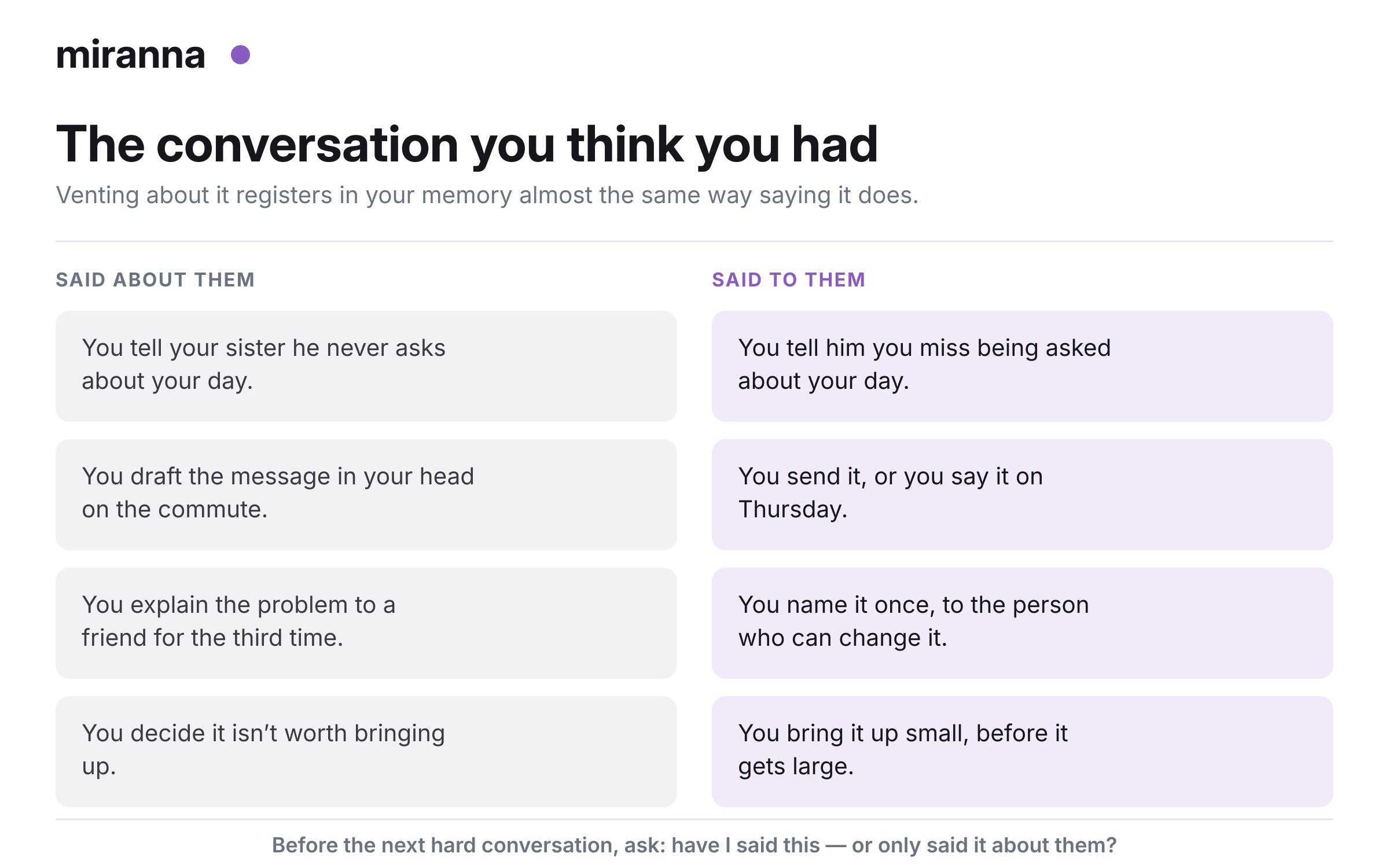
9. Check whether you actually said it. Hering describes something called the illusory truth effect: when you vent about a problem to a friend, your sister, the group chat, your brain starts logging it as a conversation that happened. It didn’t. Once a month, pick one thing you’re annoyed about and ask yourself honestly whether you’ve said it to your partner, or only about them. The answer is uncomfortable more often than you’d think.
How do you communicate better in a relationship?
Underneath the exercises are four principles that decide whether any of them work.
Timing beats wording. The best-phrased sentence delivered at eleven at night, mid-argument, will fail. A clumsy sentence on a Sunday walk will land. Most couples optimize the words and ignore the moment.
Pause deliberately, and say you’re doing it. When you’re too worked up to speak well, name it: “I want to finish this and I’m too heated to do it properly — twenty minutes?” That isn’t stonewalling. Stonewalling is leaving without a return time.
Firmness isn’t harshness. You can hold a line without contempt. Harsh tone and harsh judgments don’t produce change — they produce fear, withdrawal and resistance. Those two get confused constantly, usually by people who think being direct requires being sharp.
Not all silence is a problem. Hering draws the line at choice: silence you’ve chosen — because the timing is wrong, because you need the energy, because this isn’t the hill — is self-preservation. Silence that was chosen for you, because speaking felt too costly, is something else. The list of things you’ve quietly decided not to bring up is usually the actual state of the relationship. Her full case for how that habit forms and comes apart runs about fourteen minutes in the app.
How often should couples do these?
Daily for the small ones, weekly for the structured ones, and for longer than feels reasonable.
The measure of progress isn’t how the big conversation went. It’s whether the small exchanges have started to feel easier — a lighter tone in the morning, a question that doesn’t need working up to. That shifts in a few weeks. Trusting that the shift is real takes months.
Two failure modes worth naming. The first is doing all nine for five days and quitting; one exercise done for two months beats nine done for a week. The second is turning the exercises into a performance review — if the weekly check-in becomes the place where grievances get filed, it will be quietly cancelled by week three.
What if my partner won’t participate?
Common, and not necessarily a refusal of you.
Framing decides most of it. “I read an article and we need to work on our communication” sounds like a diagnosis with them as the patient. “Would you try something with me for two weeks?” is an invitation with a defined end. Most people say yes to two weeks.
Pick the least clinical exercise to start — the phones-away window, not the repeat-back drill. Nobody’s first experience of this should be a listening exercise that makes them feel tested.
And several of these work one-sided. Your own response rate, your own requests instead of complaints, your own noticing of their attempts — none of that requires agreement. Relationships tend to move when one person changes their half, which is either encouraging or annoying depending on the day.
If it’s a flat refusal to discuss anything, repeatedly, that’s different information — and worth taking to a couples therapist rather than solving with exercises.
FAQ
How long before communication exercises make a difference?
A few weeks for the tone to shift, months for it to hold. Response rate changes quickly; trust that the change is permanent is slower.
Do these work if we’re already fighting a lot?
They help, but not in the middle of it. Practise them in calm periods; the point is to have the skill available when things heat up. If you’re in constant conflict, our piece on how to reconnect with your partner covers repair specifically.
Can you do communication exercises alone?
Partly. The listening drill and the weekly check-in need two people. Requests instead of complaints, noticing attempts, and saying one true thing a day are all one-sided and still change the dynamic.
What’s the difference between these and couples therapy?
Exercises build a habit. Therapy addresses what’s blocking the habit. If you keep starting and stopping, or one topic reliably explodes, that’s the thing therapy is for.
We talk constantly and still feel distant. What’s missing?
Almost certainly the content, not the volume. Households run on logistics, and logistics feel like conversation while doing none of the work. Emotional intimacy goes into that gap, and feeling lonely in a relationship covers what it’s like from the inside.
Pick one exercise. Do it for two weeks before deciding whether it works. The couples who get somewhere with this aren’t the ones who tried everything — they’re the ones who kept doing the least impressive thing on the list.

When you'd rather not figure it out alone
Miranna's coaches work with women on communication, boundaries, and working out what you actually want to ask for — one session at a time.
When you're ready to talk to someone
Sometimes the next step is having one good conversation. Miranna's coaches work with women navigating burnout, hormonal shifts, relationships, and the in-between moments — at your pace, when you're ready.
Browse who you'd want to talk to and book a session right in the app.



People ❤️ Miranna