Join our newsletters and be the first to receive app updates, exclusive content, and connect with a supportive network of accomplished women. Sign up today to unlock your journey to success with Miranna

How to Have an Orgasm: What the Research Actually Says


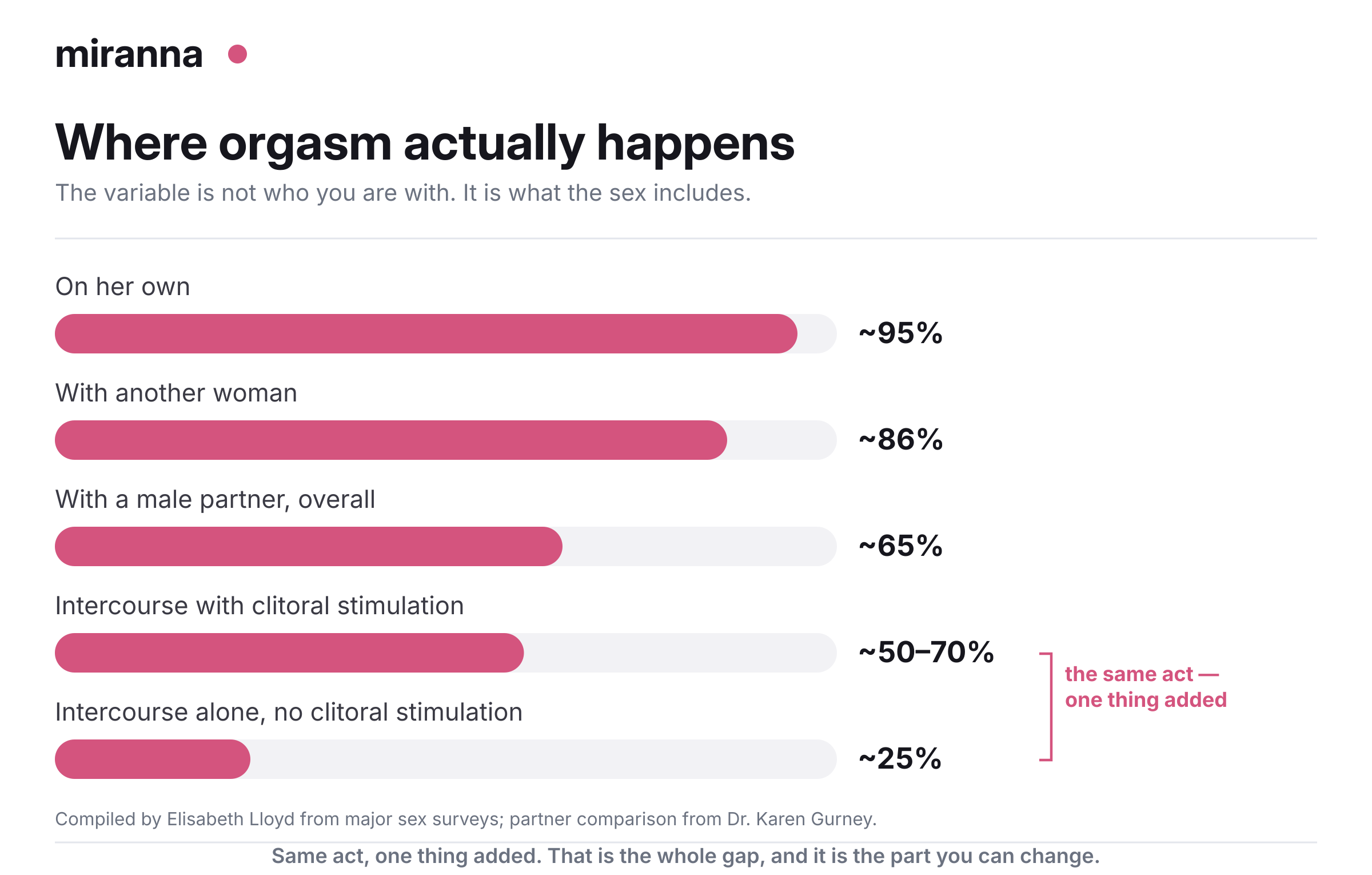
If orgasm rarely happens for you during sex with a partner, the most useful thing to know is that this is the statistical norm, not a malfunction. Around 95% of women orgasm reliably on their own. During intercourse without clitoral stimulation, that figure drops to roughly a quarter. The gap between those two numbers isn’t a gap in your body — it’s a gap between what your anatomy responds to and what most sex is structured around. Which is fixable, and mostly not by trying harder.
Why can’t I orgasm?
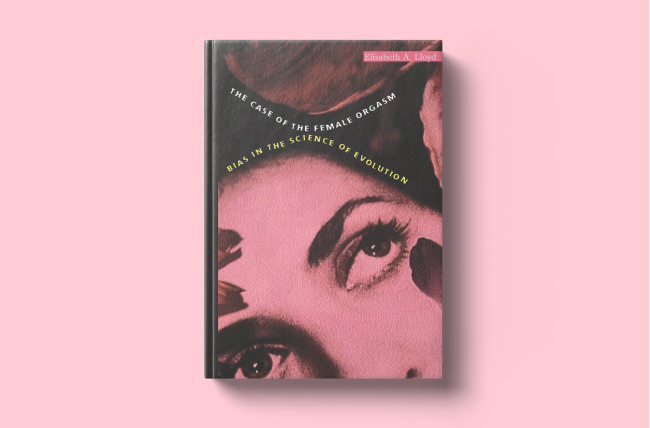
Two sources carry this piece, both summarized in the Miranna app: philosopher of biology Elisabeth Lloyd, who spent years testing every evolutionary explanation for female orgasm against the actual evidence, and journalist Katherine Rowland, who interviewed more than 120 women about what their sex lives are actually like.
Start with the numbers, because they reframe the question. Lloyd compiled the data from every major sex survey:
- ~95% of women orgasm reliably during solo masturbation
- ~50–70% during intercourse with clitoral stimulation
- ~25% during intercourse alone, with no clitoral stimulation
- ~10–15% rarely or never from any partnered activity
- ~60% have faked an orgasm at least sometimes
Three-quarters of women do not reliably orgasm from intercourse alone. If your body works one way alone and another way with a partner, nothing has broken. Two different things are being asked of it.
What is the orgasm gap?
The orgasm gap is the difference in how often women and men orgasm during heterosexual sex. Psychosexologist Dr. Karen Gurney lays out the comparison that settles the argument about whose problem it is: women orgasm in around 95% of solo sessions, about 65% of partnered sex with men, and roughly 86% of encounters with another woman.
Same bodies. Different scripts. If the equipment were the issue, the third number wouldn’t exist.
Rowland goes further and splits the phrase into three gaps, which is more useful than the version usually discussed:
- Between men and women — the orgasm disparity itself, well documented and endlessly written about
- Between your mind and your body — your body responds while your attention is elsewhere, or the reverse
- Between the sex you’re having and the sex you’d actually want — the one almost nobody names
The first gap is about closing distance with a partner. The other two are about closing distance with yourself, and they’re the ones that change things.
Why doesn’t penetration alone work for most women?
Because of what the clitoris is, and what intercourse mechanically does.
The clitoris is the primary orgasmic organ, with around 8,000 nerve endings — more densely packed than anywhere else on the body. The vagina is far less innervated. Orgasm itself is a sensory-motor reflex: Alfred Kinsey defined it as a discharge of neuromuscular tension triggered by a spinal reflex, closer in kind to a knee-jerk than to a mystical event. Reflexes need the right input. Intercourse doesn’t reliably deliver that input to the clitoris the way direct stimulation does.
Lloyd’s larger argument explains why nobody told you this. For over a century, evolutionary biologists assumed female orgasm had to be an adaptation — that it must serve reproduction somehow — and produced more than twenty theories trying to prove it. She tested each against the data. Nearly all fail.
Her conclusion, drawing on Donald Symons: female orgasm is a developmental byproduct, like the male nipple. Men have nipples not because nipples do anything for male reproduction, but because the embryonic program is shared. The same logic runs in reverse for orgasm — male orgasm was strongly selected because it delivers sperm, and female bodies inherit the same neuromuscular scaffolding.
Byproduct doesn’t mean unimportant, and Lloyd is emphatic about that. It means nature gave you the capacity without designing it to switch on automatically during any particular act. Accessing it is a matter of stimulation and context, not biology being on your side or against you. Her full case runs about nine minutes in the app.
{{Article Banner}}
What are the types of female orgasm?
This question gets more airtime than it deserves.
The popular taxonomy — clitoral, vaginal, blended, cervical — implies a hierarchy where some orgasms are more advanced or more real than others. The physiology doesn’t support that. There’s one reflex, reached through different routes and different depths of stimulation, with genuine variation in how it feels from person to person and from day to day.
What’s worth knowing instead: the internal structure of the clitoris extends several centimeters into the body, which is why stimulation that isn’t obviously “clitoral” can still be reaching clitoral tissue. The categories describe the route, not different destinations.
The reason this matters is that women who don’t have the supposedly superior kind conclude they’re missing something. There is no biologically correct kind. That’s the whole point of Lloyd’s argument.
How to have an orgasm
Ordered from most reliable to most collaborative.
Learn it alone first, without apology. The 95% figure exists for a reason: alone, you deliver exactly the stimulation you need with no performance layer. Rowland is blunt that girls are trained out of this early — the clitoris is missing from most sex education, and masturbation is joked about for boys and hushed for girls, so half the population arrives at partnered sex having never practised their own pleasure. Solo is the reference experience. You can’t ask for what you haven’t found.
Build a body map. Slow, unhurried attention with no goal attached, noticing what wakes up and what stays quiet. This is a Rowland exercise and it sounds unremarkable until you try to describe your own sensations and discover you don’t have the words.
Get the vocabulary before the conversation. Most women can’t be specific about what they want because nobody ever asked them. Practise precision: warm, buzzy, heavy, pulsing, too fast, more pressure, stay there. “It’s fine” is not information a partner can use.
Centre clitoral stimulation rather than adding it. If it’s treated as a warm-up before the real thing, the numbers above are what you get. Treating it as the main event is not a special request — it’s what your anatomy responds to.
Fix the conditions before the technique. Arousal lives in the parasympathetic nervous system, the same one that runs digestion and rest. If you’re chronically activated, you aren’t “not sexual” — you’re physiologically unavailable for pleasure. More on that machinery in how stress affects desire, and on the timing of wanting in responsive desire.
Stop faking, starting now. About 60% of women have. Every faked orgasm teaches a partner that their approach works, which entrenches the script for you and for whoever comes after you — and it quietly reinforces the belief that your real response is the wrong one, which is where sexual self-esteem starts to go.
Take the goal off. Rowland’s reporting is full of women who orgasm and still feel nothing that matters. Orgasm without an erotic experience around it is a physical event, not a good one. Aiming exclusively at the finish reliably makes it harder to reach.
What do people with genuinely good sex lives have in common?
Rowland draws on psychologist Peggy Kleinplatz, who studied people — often long-partnered, often middle-aged — reporting extraordinary sex. What they shared wasn’t youth, novelty, or technique.
It was presence, real emotional connection, unusually direct communication about sex, willingness to be seen being awkward, authenticity rather than performance, and a sense of humour about the whole thing.
Not one of those is physical. Not one is a skill you buy. Which is either discouraging or the most encouraging thing in this article, depending on how you read it — it means the thing standing between most people and better sex isn’t their body. Rowland’s full case runs about nine minutes in the app. If talking about any of this with a partner is the hard part, we cover that in communication exercises for couples.
FAQ
Why can’t I orgasm with a partner but can alone?
Because alone you deliver precise stimulation without a performance layer. This is extremely common and isn’t a sign of a problem with the relationship or with you. The route to changing it is communication and centring clitoral stimulation, not trying harder.
Is it normal to have never had an orgasm?
Around 10–15% of women rarely or never orgasm from partnered activity, and some have never had one at all. If you’d like to, starting solo is the usual route. If it has never happened in any context and that distresses you, it’s worth raising with a doctor or a qualified sex therapist.
Does the type of orgasm matter?
No. The hierarchy implied by the labels isn’t supported by the physiology. One reflex, different routes.
How long is it supposed to take?
Longer than most sex allows — that’s the entire gap in one sentence. There’s no correct duration, but the assumption that it should be quick is doing damage.
When should I see a professional?
If sex is painful, if orgasm suddenly stopped being possible when it wasn’t before, if it coincides with a medication change or a major hormonal shift, or if pelvic tension or numbness is part of the picture. Pelvic floor physiotherapy is underused and evidence-backed. This article covers the psychology and the research, not diagnosis.
Nothing about your body is working incorrectly. The instructions were written for someone else’s. Start alone, find the words, and ask for the thing your anatomy actually responds to.

When you'd rather not figure it out alone
Miranna's coaches work with women on pleasure, body image, and the conversations that are hard to start — one session at a time.
When you're ready to talk to someone
Sometimes the next step is having one good conversation. Miranna's coaches work with women navigating burnout, hormonal shifts, relationships, and the in-between moments — at your pace, when you're ready.
Browse who you'd want to talk to and book a session right in the app.

People ❤️ Miranna