Join our newsletters and be the first to receive app updates, exclusive content, and connect with a supportive network of accomplished women. Sign up today to unlock your journey to success with Miranna

Sexual Self-Esteem: Why It's Low and How It Rebuilds

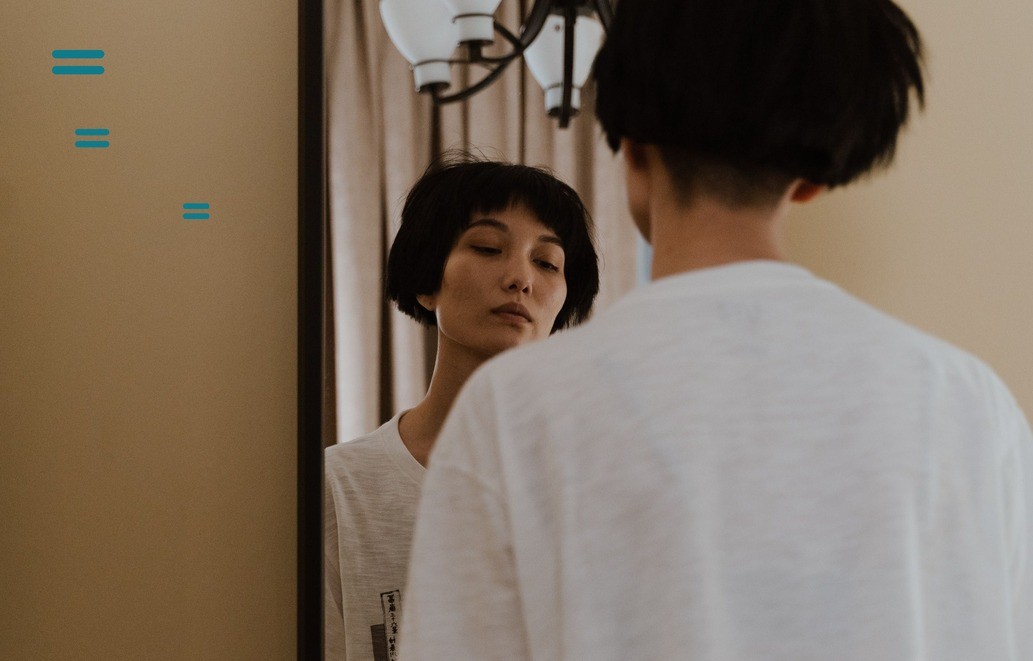
Sexual self-esteem is what you believe about yourself as a sexual person — whether you’re allowed to want things, whether your body is acceptable, whether your pleasure is worth someone’s time. It’s not confidence in bed, and it isn’t fixed by anything you wear. It’s built from what you were told and what you were never told, and it rebuilds the same way: through small pieces of accurate information about your own body, mostly gathered alone.
What is sexual self-esteem?
Two sources carry this piece, both summarized in the Miranna app: sex educator Emily Nagoski, whose entire argument is that there is no normal, and journalist Katherine Rowland, who spent five years asking women what their sex lives are actually like.
It’s a set of beliefs, not a feeling. Roughly four of them:
- Permission — am I allowed to want this, and to want it in my particular way
- Acceptability — is my body, as it is right now, fine
- Deservingness — is my pleasure worth time and attention, or is it a bonus
- Agency — can I ask for things and refuse things without it costing me
Low sexual self-esteem isn’t shyness. It’s a working assumption that you’re somehow the wrong version, held so long it stopped feeling like an opinion.
And it shows up in behavior rather than in feelings: apologising for needing time or lubricant, faking to end things faster, never saying what you’d like, agreeing to things you don’t want because refusing seems more expensive.
Where does low sexual self-esteem come from?
Not from one thing. From a curriculum that ran for two decades.
The word itself. For centuries the standard anatomical term for female genitalia was pudendum — from the Latin for “to be ashamed.” That’s the vocabulary handed to medicine, and through medicine to everyone else.
What sex education left out. Rowland’s finding is that standard curricula name every reproductive organ and routinely skip the one built purely for pleasure. You cannot value a part of yourself you were never told exists.
Who got permission to practise. Masturbation is joked about for boys and hushed for girls. Half the population therefore arrives at partnered sex having practised their own pleasure, and half hasn’t. That gap is not about willpower.
Being wanted instead of wanting. Media, family and peer culture praise girls for being attractive, not for having appetites. Rowland’s phrase for the result is that girls are trained out of their own desire before they’ve had a chance to find it. Her full reporting runs about nine minutes in the app.
Duty as the frame. Many women arrive at adult sex having never asked what they want — only whether they’re doing it correctly. And duty sex compounds: every act performed without genuine desire trains the nervous system a little further away from erotic cues.
{{Article Banner}}
Spectatoring: why attention matters more than appearance
The mechanism that does the most damage isn’t how you look. It’s where your attention is.
Spectatoring is watching yourself from the outside during sex — monitoring how your stomach looks in this position, whether your face is doing something odd, how long you’re taking. Rowland documents it as chronic body shame turned into internalised surveillance, and the effect is precise: attention that’s on your appearance cannot also be on sensation.
Which makes this a practical problem rather than a moral one. Arousal requires being inside your own body. Spectatoring puts you on the ceiling watching. You can’t feel much from up there.
Nagoski’s point runs alongside it: it’s close to impossible to be sexually confident while carrying a running commentary of self-criticism. Not because confidence is a mood you should summon, but because criticism occupies the same bandwidth that pleasure needs.
The double bind: too much or not enough
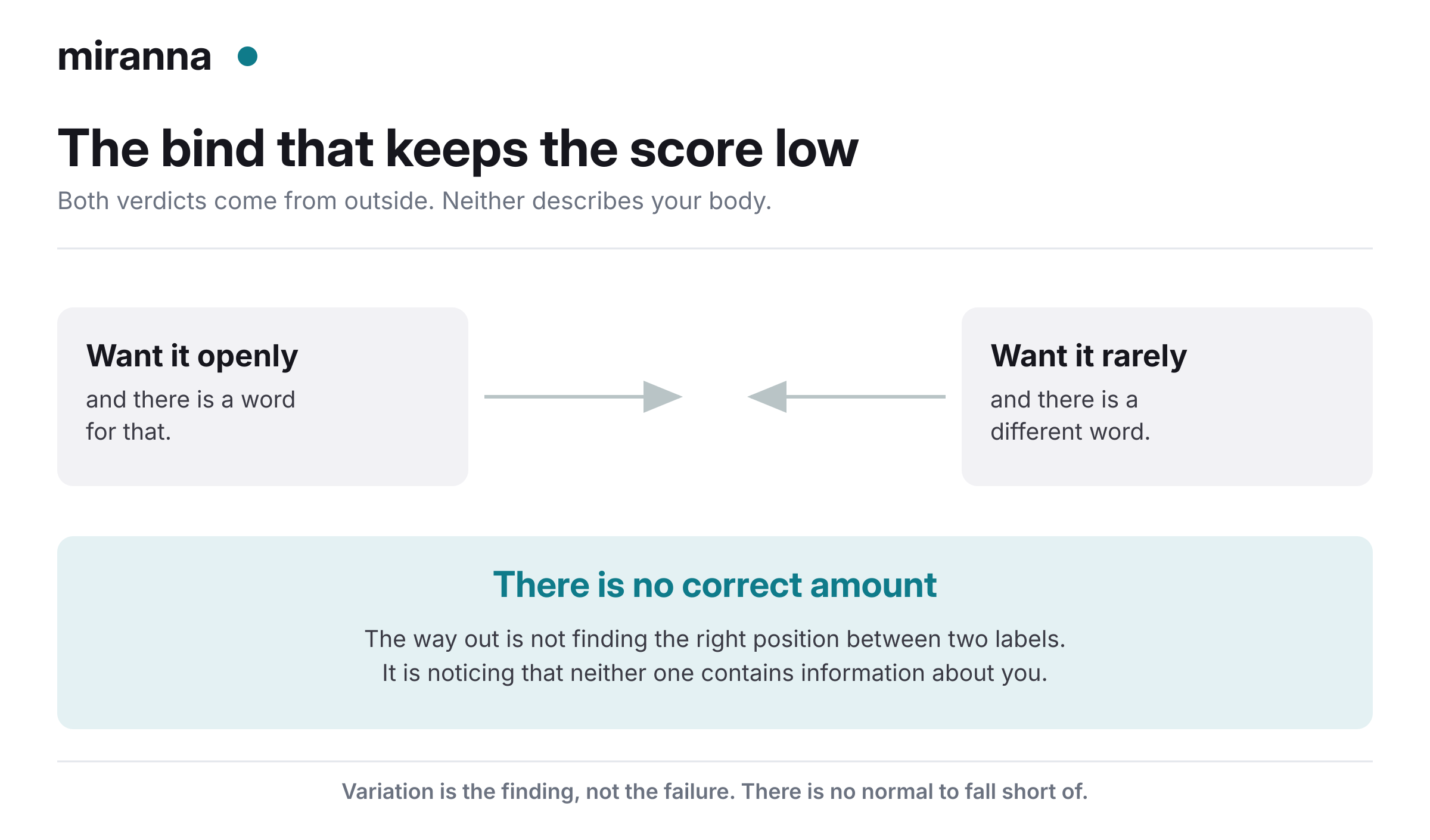
Here’s the trap that keeps sexual self-esteem low no matter which way a woman moves.
Enjoy sex openly and there’s a word for that. Don’t want it much and there’s a different word. Both are judgments, both come from outside, and there is no position between them that avoids one or the other.
The way out isn’t finding the correct amount to want. It’s noticing that both labels describe how someone else has decided to categorise you, and neither contains any information about your own body. Nagoski’s central argument is exactly this: there’s no normal to fail at. Variation is the actual finding, and her full case runs about fourteen minutes in the app.
That reframe does more for sexual self-esteem than any amount of trying to feel confident, because it removes the scoreboard rather than trying to score better on it.
What about body image specifically?
It gets treated as the whole problem, and it is one input among several. But it deserves its own note, because the standard advice is wrong in a specific way.
The usual instruction is to learn to love your body, which sets an enormous prerequisite in front of an ordinary activity. Nagoski’s framing is more workable: you do not have to have resolved your feelings about your body in order to feel things with it. Acceptance is not the entry fee.
Two things follow. First, the goal during sex is not to feel beautiful — it is to be present. Those are different states, and the second one is available on days the first one isn’t. Second, the criticism does not need to be argued down before it can be set aside. Noticing it and returning attention to a sensation works even while the thought is still there.
Worth adding: what women are usually comparing themselves against isn’t other women. It’s images — lit, posed, selected and edited — held up as the ordinary standard. That comparison was never survivable, which is why losing it feels less like defeat and more like putting something heavy down.
How to rebuild sexual self-esteem
Slowly, through evidence rather than affirmations.
Get accurate information about your own body. Most of what lowers sexual self-esteem is false — that you’re taking too long, that your response is unusual, that penetration should be enough. It usually isn’t, and knowing the actual numbers helps: how to have an orgasm covers what the research says.
Practise alone, without framing it as a problem to solve. Solo is where the body gives honest feedback and there’s no performance layer. It’s also where most of the vocabulary comes from.
Do the mirror exercise, properly. Nagoski’s version: stand in front of a mirror and make a list of what you like. Not a balanced assessment — only what you like. Most women have never once completed this exercise, and have run the opposite version daily for years.
Practise refusal, not just consent. “Not that, but this” is a complete sentence and it builds agency faster than anything else on this list. More on that in how to talk to your partner about sex.
Stop faking. Around 60% of women have. Each time reinforces the belief that your real response is the wrong one and needs covering up.
Redirect attention rather than fighting the thoughts. When you notice you’ve gone to the ceiling, don’t argue with the self-criticism — put attention on one physical sensation instead. Arguing keeps you in your head, which is where the problem is.
Give it a long horizon. This was built over twenty years by a culture that had a lot of practice. It comes apart over months, in small pieces, mostly unglamorously.
FAQ
Is sexual self-esteem the same as body confidence?
Related but not the same. Body image is one input; permission, agency and deservingness are the others. Plenty of women who like how they look still can’t say what they want.
Can low sexual self-esteem affect desire?
Yes, and it’s one of the most underestimated brakes. Self-criticism and arousal compete for the same attention, and self-criticism usually wins because it has more practice. More on that machinery in responsive desire.
Does having a supportive partner fix it?
It helps enormously and doesn’t finish the job. A partner can provide evidence; they can’t install permission. That part is built alone.
Where do I start if this feels like a lot?
The mirror list. It takes ten minutes, requires nobody’s cooperation, and is the exercise women most consistently report finding harder — and more useful — than they expected. If you want more reading, we rounded up the useful ones in best self-love books.
When is this worth taking to a professional?
When it traces back to an experience that frightened you, when sex is painful, or when the self-criticism is part of a broader low mood affecting the rest of your life. Coaching helps with the practice; a therapist is the right place for the rest. This article covers the psychology, not treatment.
There is no correct amount to want and no correct body to want it in. What there is: a lot of inherited information that was never checked, and a slow process of replacing it with your own. Start with the mirror and the list.

When you'd rather not figure it out alone
Miranna's coaches work with women on confidence, body image, and permission — one session at a time.
When you're ready to talk to someone
Sometimes the next step is having one good conversation. Miranna's coaches work with women navigating burnout, hormonal shifts, relationships, and the in-between moments — at your pace, when you're ready.
Browse who you'd want to talk to and book a session right in the app.


People ❤️ Miranna