Join our newsletters and be the first to receive app updates, exclusive content, and connect with a supportive network of accomplished women. Sign up today to unlock your journey to success with Miranna

Attention-Seeking Behavior in Kids: What It Really Means


Attention-seeking behavior in kids is almost never about manipulation. When a child whines, clowns around, interrupts, or “acts out for attention,” they’re usually sending a signal that a need — most often the need for connection — isn’t being met. Kids are wired to reach for our attention, and when calm, positive attention runs low, many of them will reach for it in louder, messier ways instead. Once you see the behavior as a message rather than a battle, your response changes completely. Here’s what’s really going on, and what actually helps.
What is attention-seeking behavior in children?
Attention-seeking behavior is any action a child uses — consciously or not — to pull an adult’s focus back onto them. It can look sweet (constant “watch me!”), or it can look like trouble (whining, silliness at the worst moment, hitting a sibling the second you pick up your phone).
The key thing to understand: attention isn’t a luxury for a child. It’s a developmental need. Researchers at Harvard’s Center on the Developing Child describe healthy development as a process of “serve and return” — the back-and-forth of a child reaching out and an adult responding. When those responsive exchanges are missing, it’s not a small thing; the absence of them is treated as a genuine threat to how a child grows.
So a child who is “always” seeking attention isn’t spoiled. They’re doing exactly what human children are built to do — asking to be seen.
In the last few months, our team kept getting the same kind of request: summaries of books and podcasts on parenting — and especially the tricky, specific moments, like a kid who suddenly can’t stop acting out for attention. So we pulled the best of what we’ve read into one place. You can always listen to the full book and podcast summaries in the app — but for now, let’s get into what the experts actually say about this one.
Why do kids act out for attention?
Two things are usually happening at once.
First, there’s a simple loop: behavior that gets a reaction tends to repeat. In Raising Mentally Strong Kids, psychiatrist Dr. Daniel Amen and psychologist Dr. Charles Fay — drawing on more than 80 combined years of work with parents and kids — put it bluntly: if the only time you reliably notice your child is when they mess up, you’ve taught them that misbehavior is how to get attention. To a child who feels a little invisible, being told off can feel better than being ignored. That’s the logic behind negative attention seeking — and if you want Amen and Fay’s full approach in about seven minutes, you can hear it summarized in the Miranna app.
Second, the behavior points to an unmet need underneath. The job isn’t to shut the bid down — it’s to read it, and then make the calm version of your child the one that gets your focus.
That reframe matters because it points you toward a response that works. When children get more warm, back-and-forth interaction, you can see the difference in their development — one study of everyday parent-child conversation found the amount of back-and-forth explained nearly half of the link between a child’s language exposure and their verbal ability. Attention, given well, is not indulgence. It’s how kids are built.
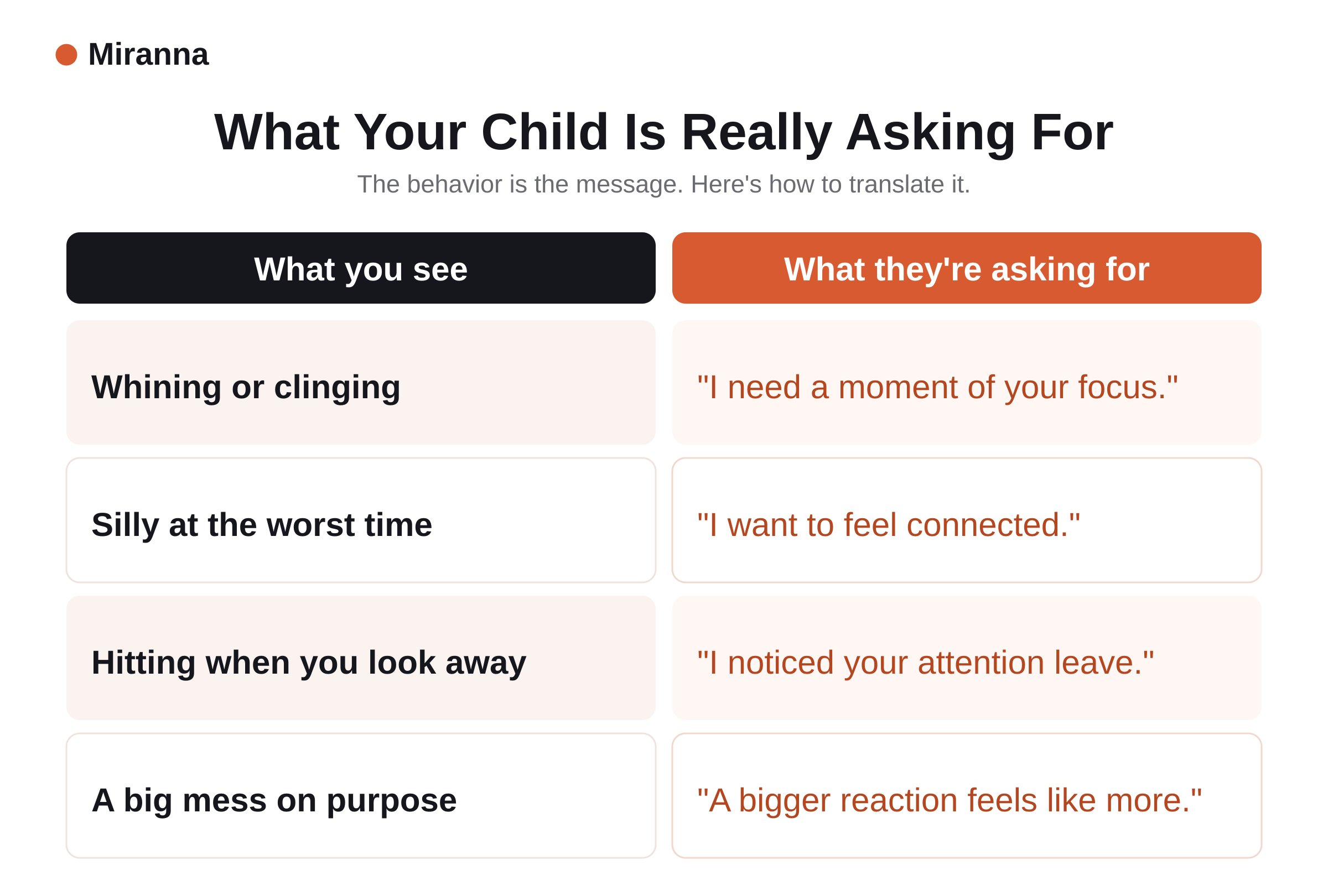
What does attention-seeking behavior look like?
It changes with age, and it isn’t always loud.
- Toddlers tend to be physical: grabbing, climbing on you mid-sentence, a tantrum the moment your attention shifts to someone else.
- Preschool and early school age gets more creative: silliness on repeat, tattling, “I can’t do it” about something they clearly can, or the classic — a 5-year-old who needs constant attention and dissolves the instant you try to make a phone call.
- Negative attention seeking shows up when a child has learned that misbehavior works fastest. That’s the logic behind behaviors that baffle parents, like a potty-trained child suddenly peeing on the floor: it’s rarely about the bathroom and often about getting a big, immediate response.
None of these mean something is wrong with your child. They mean the “connection tank” is running low and your child is improvising.
Positive vs. negative attention: what’s the difference?
Not all attention lands the same way. Positive attention is the warm, proactive kind — eye contact, listening, praising effort, a few minutes of one-on-one time. Negative attention is the big reaction a child gets after they misbehave: the raised voice, the long lecture, the whole room turning to them. Both are attention. The trouble starts when the negative kind becomes the most reliable way to be noticed, because kids will keep choosing whatever works.
The fix isn’t to withhold attention — it’s to flip which behaviors earn it. When your calm, connected moments get your focus and the loud ones get a smaller, steadier response, acting out slowly loses its payoff.
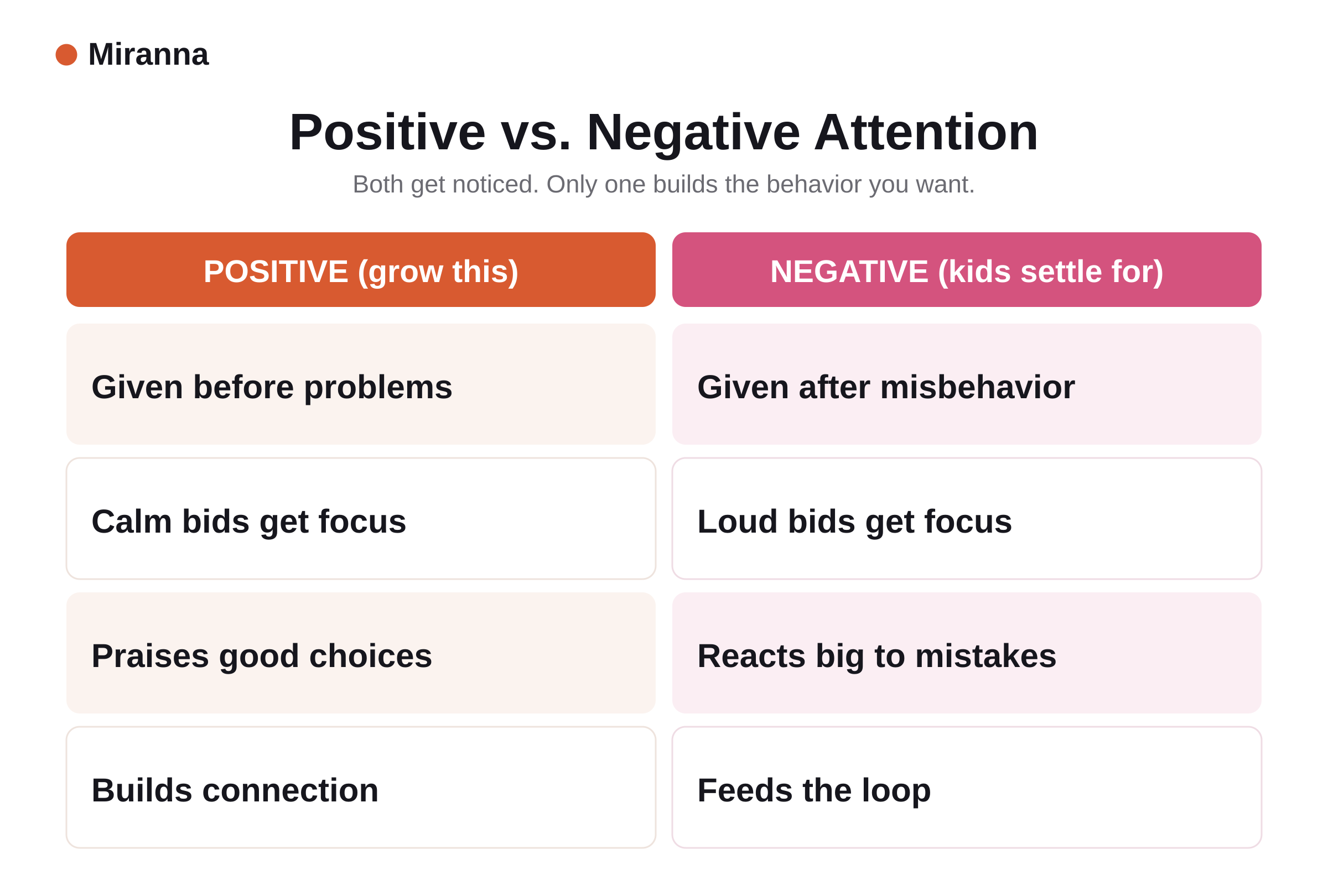
How to respond to attention-seeking behavior
The goal isn’t to give more attention or less — it’s to give it differently, so the calm version of your child gets your focus more reliably than the loud one.
- Fill the cup first. Offer a short burst of undistracted, one-on-one time before the difficult behavior shows up — even 10 focused minutes changes the pattern. Proactive attention beats reactive attention every time.
- Catch the good, out loud. This is Amen and Fay’s most-repeated move in Raising Mentally Strong Kids: notice and name the moments your child plays calmly, waits, or asks nicely. Kids repeat what gets attention, so put yours on what you want more of — and praising the effort rather than the child is also how you build a growth mindset in kids.
- Stay consistent and stay calm. Here’s where the data is reassuring. Economist Emily Oster, who built Cribsheet by reading the actual research instead of the folklore, found that the two things that reliably improve young children’s behavior are consistency and a parent who keeps their own emotions steady — not harsher punishment. In the studies she reviewed, brief and consistent responses worked, while spanking was linked to worse behavior over time — you can hear Oster walk through the evidence in the app if you want the studies themselves.
- Hold the boundary with empathy. You don’t have to choose between kindness and limits. “I won’t let you hit your brother. You really wanted my attention right now, didn’t you? Let’s finish this together in two minutes.” The limit and the warmth go together — that pairing is the whole idea behind positive discipline.
- Check the basics. In Raising Mentally Strong Kids, Amen makes a point every tired parent should hear: a tired, hungry, or overstimulated child looks exactly like a defiant one. Before you treat it as a behavior problem, rule out sleep, food, and too much screen time.
And staying calm is harder than most parenting advice admits. In Matrescence, science writer Lucy Jones documents how much a parent’s own ability to self-regulate gets worn down by sleep loss and sheer depletion — which is why self-compassion here isn’t a soft extra. It’s part of the method. You can’t pour connection from an empty cup either.
If you’re somewhere between gentle and firm and not sure where you land, it helps to understand the difference between gentle and permissive parenting — meeting a need is not the same as dropping a limit.
{{Article Banner}}
When does attention-seeking behavior need more support?
Most attention-seeking is ordinary and eases as connection improves. But trust your gut if the behavior is intense, constant across every setting, tied to aggression or self-harm, or paired with a sudden change in mood or development. Those are worth a conversation with your pediatrician or a child psychologist — not because you’ve done something wrong, but because a professional can help you look underneath.
FAQ
Is attention-seeking behavior in children normal?
Yes. Seeking attention is a normal developmental need, not a sign of a spoiled or manipulative child. It usually increases when a child’s need for connection isn’t being met.
Should you ignore attention-seeking behavior?
Ignore the behavior you don’t want to reinforce, not the child. Keep your reaction to the misbehavior small and calm, then meet the underlying need for connection at a better moment. Blanket “ignoring” tends to escalate things.
Why does my child need constant attention?
Often because the calm, connected version of them isn’t getting enough of your focus, so they keep reaching for it. Proactive one-on-one time — offered before the clinginess starts — usually lowers the constant demands.
Why is my child peeing on the floor on purpose?
In a potty-trained child, this is usually a bid for a strong, immediate reaction rather than a bathroom issue. Respond calmly and matter-of-factly, then add more proactive positive attention during the rest of the day.
What’s the difference between attention-seeking and a real problem?
Ordinary attention-seeking eases when connection improves and shows up mainly with you. Behavior that’s intense, present everywhere, or linked to aggression, self-harm, or developmental changes is worth checking with a professional.
Attention-seeking behavior isn’t a problem to crush — it’s a message to answer. Read the bid, hold your limits with warmth, and put your focus on the calm moments, and the loud ones start to shrink on their own.

When you’re ready to talk to someone
When you're ready to talk to someone
Sometimes the next step is having one good conversation. Miranna's coaches work with women navigating burnout, hormonal shifts, relationships, and the in-between moments — at your pace, when you're ready.
Browse who you'd want to talk to and book a session right in the app.



People ❤️ Miranna