Join our newsletters and be the first to receive app updates, exclusive content, and connect with a supportive network of accomplished women. Sign up today to unlock your journey to success with Miranna

Growth Mindset for Kids: How to Raise a Resilient Child

.jpg)
A growth mindset is a child’s belief that ability grows with effort and practice — the opposite of thinking you’re simply “good” or “bad” at something and stuck there. It matters because kids who hold it attempt harder things, recover faster from failure, and quit less often. The good news: it isn’t a personality a child is born with. It’s built — mostly by how we respond when they struggle and succeed, and the single biggest lever is what you praise. Here’s what a growth mindset really is, and how to grow one at home.
What is a growth mindset in children?
At Miranna, we turn the latest books and the work of today’s doctors and parenting experts into short summaries — and for this piece, we gathered the ideas from several of them on how to raise a child who doesn’t fall apart the moment something gets hard.
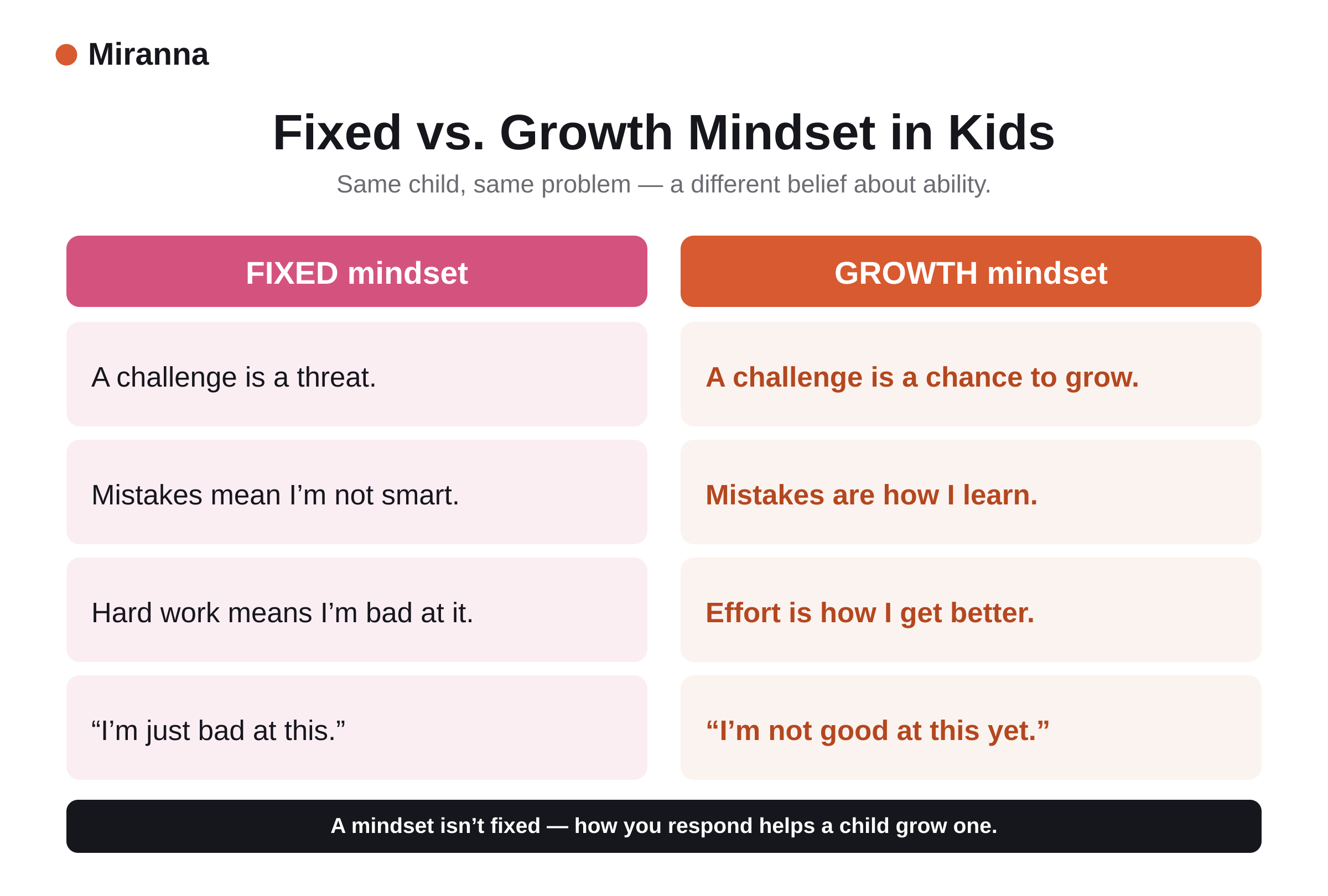
A growth mindset — a term from Stanford psychologist Carol Dweck — is the belief that intelligence and ability can be developed through effort, good strategies, and practice. Its opposite, a fixed mindset, is the belief that you’re born with a set amount of talent and that’s that. Most kids (and adults) are a mix of both, and which one shows up can shift with the situation — which is exactly why it can be taught.
A child in a growth mindset sees a hard problem as a chance to get better. A child in a fixed mindset sees the same problem as a test of whether they’re smart — so they avoid it, because failing would prove they’re “not smart.”
Why does a growth mindset matter for kids?
Because it changes how a child meets difficulty. In studies with children aged 4 to 12, Dweck and colleagues found that praising kids for being smart after a success made them more likely to reject challenges and fall apart when things got hard — while praising the process they used (effort, strategies, focus) made them eager for challenges and far more persistent. One study even found that the kind of praise mothers gave their babies between ages one and three predicted the child’s growth mindset five years later.
This lines up with what Dr. Daniel Amen and Dr. Charles Fay argue in Raising Mentally Strong Kids: praise effort, not smarts. Self-esteem built on hard work survives failure; self-esteem built on “you’re so smart” collapses at the first real challenge. A growth mindset is basically resilience with an engine — and if you want Amen and Fay’s brain-first approach in about seven minutes, you can hear it summarized in the Miranna app.
Signs your child has a fixed mindset
Fixed-mindset thinking is easy to spot once you know the sound of it. Your child might:
- give up quickly the moment something feels hard (“I can’t do it”)
- avoid challenges they might not ace
- say things like “I’m just bad at math” or “I always lose”
- get defensive or crumble after a mistake
- only want to do what they’re already good at
If your child gives up easily, this is usually why — not laziness. In Raising Mentally Strong Kids, Amen calls all-or-nothing thoughts like “I always fail” ANTs — automatic negative thoughts — and teaching a child to catch and question them is one of the most durable gifts a parent can give.
How to build a growth mindset in your child
Here’s the part most advice gets wrong: it isn’t cheerleading “just try harder.”
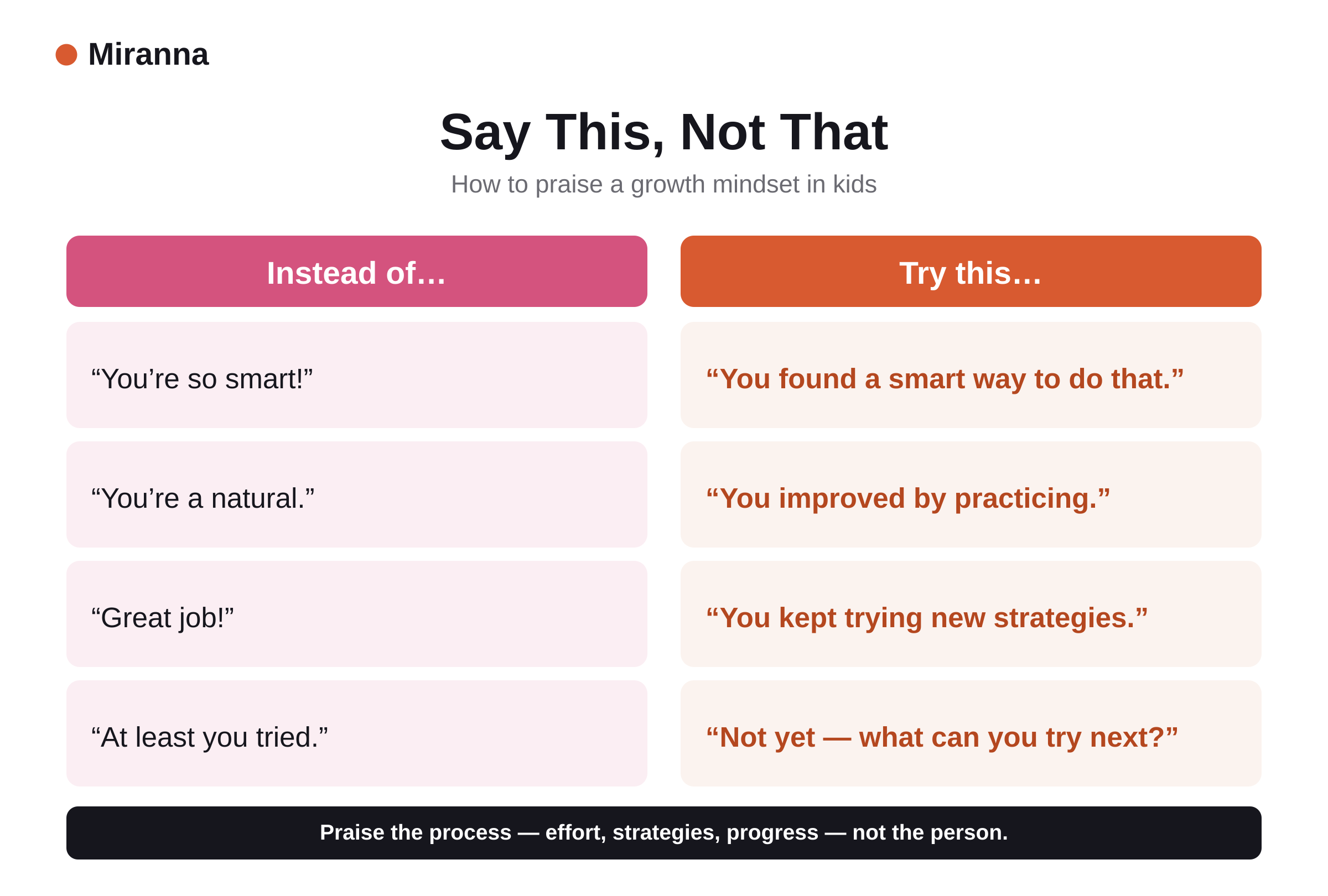
- Praise the process, not the person. Swap “You’re so smart” for “You found a smart way to do that” or “You stuck with it even when it got hard.” You’re pointing at the thing they can repeat. Kids also repeat whatever reliably earns your focus — the same mechanism behind attention-seeking behavior in kids.
- But make it real. Dweck is blunt that empty effort-praise — “well, at least you tried” when a child made no progress — backfires and becomes a consolation prize. Praise the strategy, the focus, the improvement — and when something isn’t working, help them find a different approach, not just more effort.
- Add the word “yet.” “I can’t do this” becomes “I can’t do this yet.” Dweck’s research shows that one word hands a child a path forward and measurably more persistence.
- Let them struggle — and sometimes fail. This is where Lauren Fleshman’s Good for a Girl is bracing: she argues we quietly rob kids of their own development when we make results the whole point — you can hear her full story in the app. Let effort, not the trophy, be the family scoreboard, and let your child stay in the hard part long enough to get through it themselves.
- Model your own failures out loud. Name when something is hard for you, what you’re trying, what you learned. Kids copy what we do far more than what we say.
- Teach the brain-as-muscle idea. Explaining that practice literally builds new connections (“when you work on hard things, you grow your brain”) lands better than a vague pep talk.
Growth mindset activities to try this week
You don’t need a curriculum — small, repeatable moments do the work:
- A “yet” jar or wall. When your child says “I can’t,” help them write it on a slip with yet added (“I can’t ride my bike yet”). Revisit it in a few weeks and celebrate what moved.
- Share a daily struggle at dinner. Everyone names one thing that was hard that day and what they tried. It makes effort and mistakes normal, and shows kids the adults do it too.
- Swap the question after school. Instead of “Did you win?” or “What grade did you get?”, ask “What was hard today, and how did you work on it?” You’re pointing their attention at the process.
- Do a “hard thing” together. Learn something new alongside them — a knot, a recipe, a song — and narrate your own fumbling. Being the beginner with them is the lesson.
{{Article Banner}}
What if my child gives up easily no matter what?
Mindset is powerful, but it isn’t everything. If your child gives up across every setting, seems persistently down on themselves, or keeps struggling with a specific skill (reading, focus, motor skills) despite support, it’s worth a conversation with their teacher, pediatrician, or a child psychologist. Sometimes what looks like a fixed mindset is an unmet need — a learning difference, anxiety, or a missing skill — hiding underneath.
Some children have the opposite problem: they don’t quit, they dig in, and every request turns into a standoff. That persistence is the same raw material, aimed differently — parenting a strong-willed child takes a different set of moves.
FAQ
What is a growth mindset in simple terms?
It’s the belief that you can get better at things through effort, practice, and good strategies — instead of believing your abilities are fixed at birth. For kids, it’s the difference between “I’m bad at this” and “I’m not good at this yet.”
How do I teach my child a growth mindset?
Mostly through how you respond: praise the process (effort, strategies, improvement) rather than being “smart,” add the word “yet,” let them struggle a little, and model your own learning out loud.
Why does my child give up so easily?
Often because they read difficulty as proof they’re “not good at it.” Shifting your praise toward effort and strategy — and treating mistakes as normal parts of learning — usually rebuilds their willingness to keep going.
Is praising effort enough?
No — and this is the part people miss. Praising effort when a child made no progress becomes a hollow consolation prize. Praise the specific strategy, focus, or improvement, and help them find a new approach when they’re stuck.
At what age can a child develop a growth mindset?
Very early — research links the praise toddlers hear as young as one to three to their mindset years later. It’s never too early or too late to shift how you respond.
A growth mindset isn’t telling your child they can do anything. It’s showing them that hard is where growth happens — and that you’re not measuring them by the result. Praise the process, add “yet,” and let them struggle a little. The persistence takes care of itself.

When you're ready to talk to someone
When you're ready to talk to someone
Sometimes the next step is having one good conversation. Miranna's coaches work with women navigating burnout, hormonal shifts, relationships, and the in-between moments — at your pace, when you're ready.
Browse who you'd want to talk to and book a session right in the app.



People ❤️ Miranna