Join our newsletters and be the first to receive app updates, exclusive content, and connect with a supportive network of accomplished women. Sign up today to unlock your journey to success with Miranna

The Clingy Toddler: Why Your Child Won't Let Go — and What Helps


A clingy toddler isn’t spoiled, and it isn’t a sign you’ve done something wrong — it’s usually a normal stage driven by how their brain is built right now. A young child knows you still exist when you leave the room, but has no real sense of time, so “back in five minutes” and “gone forever” feel the same. The clinginess is fear, not manipulation. You help not by pushing them off, but by being a reliable safe base: connect first, keep goodbyes short and warm, never sneak out, and let them venture out from a full tank. Here’s what’s going on and what actually works.
Why is my toddler so clingy?
At Miranna, we turn the latest books and the work of today’s doctors and parenting experts into short summaries — and for this piece, we gathered the ideas from several of them on the velcro-toddler stage, when your child treats three feet of distance like a crisis.
Start with the brain. Dr. Dan Siegel and Dr. Tina Payne Bryson, in The Whole-Brain Child, describe a child’s “downstairs brain” — the older, instinctive part that runs fear, attachment, and the alarm that goes off when a small human feels unsafe. Clinginess is that downstairs brain doing its job: keeping the child close to the person who means safety. The thinking, exploring “upstairs brain” that could reason she always comes back is still years from finished. So a clingy child isn’t being difficult on purpose — the part of the brain that would calm them down can’t yet outvote the part that’s scared. Their whole method for working with that wiring is summarized in the app if you want it in one sitting.
There’s a specific engine underneath a lot of it: separation anxiety. It shows up once a baby develops object permanence — the understanding that things still exist when they’re out of sight. Now your child knows you’re somewhere without them, but, as the Cleveland Clinic explains, they don’t yet grasp time, so they can’t know whether you’ll be gone for a minute or for good. The protest — crying, clutching, following you to the bathroom — is how they try to bring their safe person back.
And here’s the reframe that helps most: clinginess is a sign of a secure attachment, not a fragile one. A child clings because the bond with you is strong and you’re the one they trust to keep them safe. It’s evidence something is going right.
Is clinginess normal — and when does it stop?
Almost always, yes. Separation anxiety is a normal developmental stage that usually begins somewhere around 6 to 12 months, peaks between roughly 10 and 18 months, and eases as a child comes to understand that you always come back — typically around age three, per the Cleveland Clinic.
But it isn’t a straight line. Clinginess comes in waves, and it often flares again around age two or three, and during the big developmental leaps in between. A child learning to walk, talk, or sleep somewhere new frequently gets clingier for a stretch — the new skill uses up their reserves, and they reach for their safe base to refuel. Tiredness, hunger, teething, and illness all turn the clinginess up, too. None of it means you’re sliding backward. It means your child is growing, and checking that home base is still there while they do.
How do I help a clingy child?
The goal isn’t to make your child need you less — it’s to help them feel secure enough to venture out on their own. Counterintuitively, meeting the need for closeness is what builds the independence — the resilient, adaptable child that Harvard-trained educator Polina Maltseva’s Modern Parenting framework is built around, which you can hear broken into its building blocks in the app.
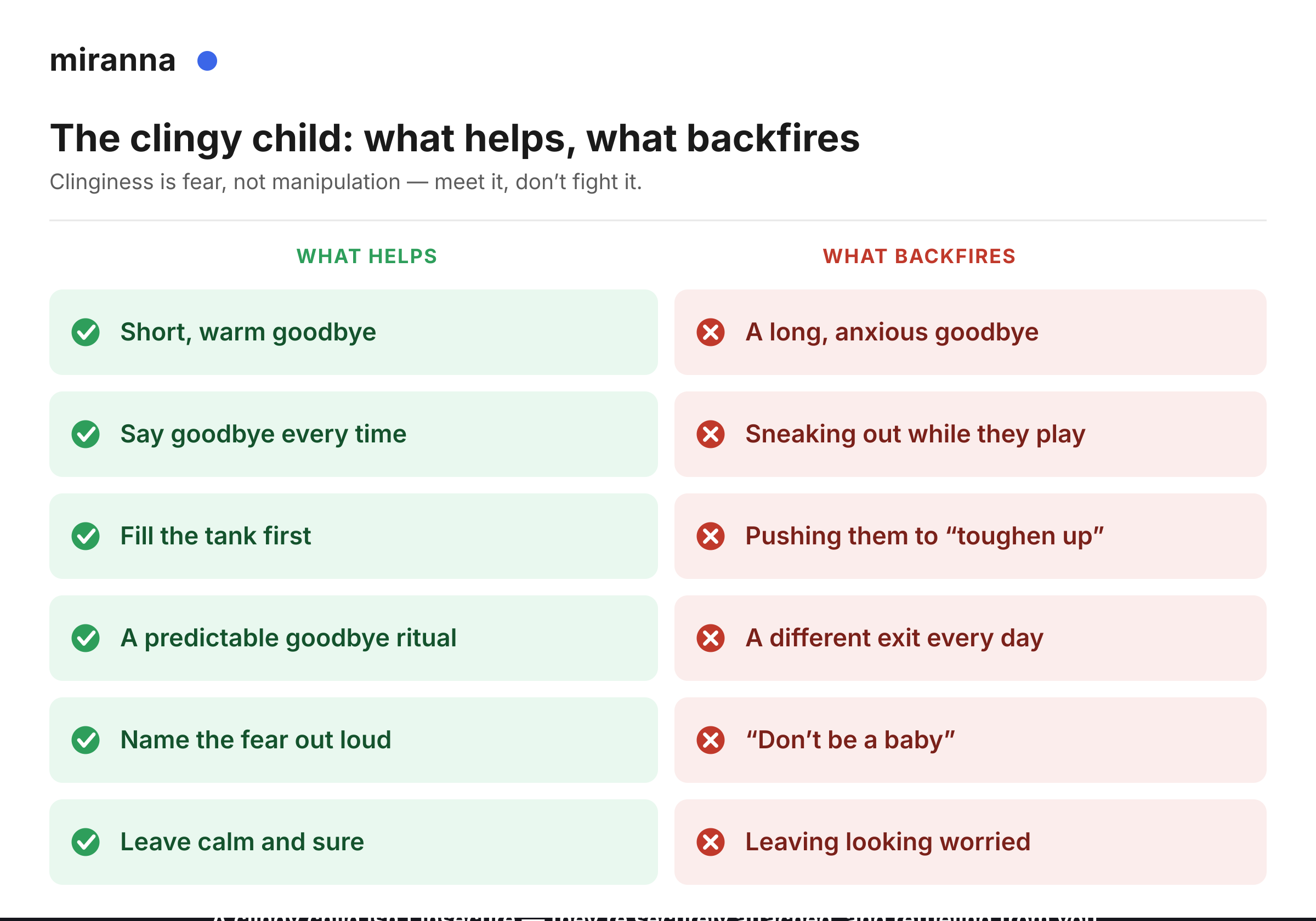
- Fill the tank first. A short burst of undivided, one-on-one time — even ten focused minutes before a transition — tops up the security a child ventures out from. Kids explore best from a full cup, not an empty one.
- Keep goodbyes short, warm, and confident. A long, anxious goodbye tells a child there’s something here to be afraid of. A quick hug, one clear line — “I’m going to work, I’ll be back after your nap, I love you” — and a calm exit works better than lingering.
- Never sneak out. Slipping away while they’re distracted feels easier in the moment, but it teaches a child you might vanish at any second — which makes them cling harder and watch you more closely. Always say goodbye, even to tears.
- Build a goodbye ritual. The same three steps every time — a special handshake, a wave at the window, “see you later, alligator” — gives a child something predictable to hold when the world feels unpredictable.
- Hold the boundary and the feeling together. This is Dr. Becky Kennedy’s core pairing: you can honor the fear and still leave. “You don’t want me to go. That’s so hard. I’m going, and I always come back.” You’re being a safe base — warm and steady. Her framework is summarized in the app if you want it in full.
- Practice small separations. Play peekaboo, then hide-and-seek; step into the next room and call back; leave with a trusted person for twenty minutes and build from there. Each safe return is proof that leaving isn’t forever.
- Manage your own face. Children read your body before your words. If you leave looking guilty and worried, they learn the situation is worrying. Calm, warm, and matter-of-fact tells them this is safe.
- Skip the shame. “Don’t be a baby” or “big kids don’t cry” teaches a child to hide the fear, not to feel safe. Name it instead: “You’re going to miss me. I’ll miss you too — and I’ll be right back.”
One thing not to do: don’t treat the clinginess as a bid to be extinguished. A clingy child who suddenly needs you more isn’t being manipulative; they’re telling you the tank is low. Meeting that need is what lets it pass.
{{Article Banner}}
Why is my child suddenly clingy again?
If your independent toddler has turned back into your shadow overnight, look at what’s changed. A new sibling, a house move, starting daycare, a parent traveling, an illness, a rough patch of sleep — any of it can send a child back to their safe base for a while. It’s the same mechanism as before: their sense of security took a hit, and they’re refueling from you.
The move that helps is more connection, not less — plus predictability. A child in the middle of change craves the two things that feel safe: your warm attention and a routine they can count on. If the clinginess spikes when your attention is elsewhere, it can blur into attention-seeking behavior, and the fix is the same: fill the cup proactively, before the shadowing starts, rather than only responding once it does.
When is clinginess a sign of something more?
Most clinginess is ordinary and fades as a child grows to trust that separations are temporary. But it’s worth a conversation with your pediatrician if the distress is severe and constant rather than coming in waves, continues well past age three without easing, seriously disrupts daily life — school, sleep, friendships — or comes with physical complaints like frequent headaches or stomachaches around separations. Past a certain point and intensity, ordinary separation anxiety can tip into separation anxiety disorder, and a professional can help you tell the difference. Raising it isn’t an overreaction; it’s how you find out whether there’s a need hiding underneath.
FAQ
Why is my 3-year-old suddenly so clingy?
Usually a change or a developmental leap knocked their sense of security off balance — a new sibling, daycare, travel, illness, or a sleep regression. Clinginess also naturally surges again around age two to three. More connection and a predictable routine usually settle it.
Should I sneak out to avoid the tears?
No. Slipping away teaches a child you might disappear without warning, which makes clinginess worse and keeps them on guard. Always say a short, warm goodbye — even if it means tears in the moment.
Does a clingy child mean insecure attachment?
It’s usually the opposite. Clinginess reflects a strong, secure bond — your child reaches for you because you’re the one they trust to keep them safe. It’s a sign something is going right.
Why is my toddler only clingy with me?
Because you’re their safe base. Children often save their biggest feelings for the person they feel most secure with, so the clinginess lands on the parent they trust most — often the primary caregiver.
At what age does clinginess stop?
Separation anxiety usually eases around age three, as children learn that you always come back — but it comes and goes with growth spurts, tiredness, and change well beyond that. It fades as the sense of time and object permanence mature.
A clingy stage isn’t a problem to fix — it’s a small person telling you that you’re their safe place, and asking to top up before they head back out. Connect first, keep your goodbyes short and sure, and let them come and go. The venturing out grows right alongside the trust that you’ll be there when they get back.

When you're ready to talk to someone
When you're ready to talk to someone
Sometimes the next step is having one good conversation. Miranna's coaches work with women navigating burnout, hormonal shifts, relationships, and the in-between moments — at your pace, when you're ready.
Browse who you'd want to talk to and book a session right in the app.



People ❤️ Miranna