Join our newsletters and be the first to receive app updates, exclusive content, and connect with a supportive network of accomplished women. Sign up today to unlock your journey to success with Miranna

Positive Discipline: How to Set Limits Without Yelling


Positive discipline is a way of teaching your child how to behave — setting firm limits while staying warm and calm — instead of controlling them through yelling, shaming, or punishment. It works because it does two jobs at once: it holds the boundary your child needs, and it keeps the connection that makes them want to cooperate. The research is clear that harsh tactics backfire, while consistent, empathetic limits build real self-control over time. Here’s what positive discipline actually is, why it works, and how to do it without raising your voice.
What is positive discipline?
At Miranna, we turn the latest parenting books and the work of today’s child psychologists into short summaries — and for this piece, we pulled together what several of them agree on about discipline that actually works, without fear.
Positive discipline isn’t permissiveness, and it isn’t “gentle” in the sense of having no rules. It’s the middle path: high warmth and high structure. The American Academy of Pediatrics describes effective discipline as resting on three things — a warm, supportive parent-child relationship, positive reinforcement of the behavior you want, and consistent, calm consequences for the behavior you don’t.
Clinical psychologist Dr. Becky Kennedy frames the same idea as a parent’s two jobs: setting the boundary, and validating the feeling underneath the behavior. You can do both at once — “I won’t let you throw that, and I can see how frustrated you are.” The limit keeps your child safe; the empathy keeps them connected to you. If you want her whole framework, it’s summarized in the app in about six minutes.
Positive discipline vs. punishment — and why it works better
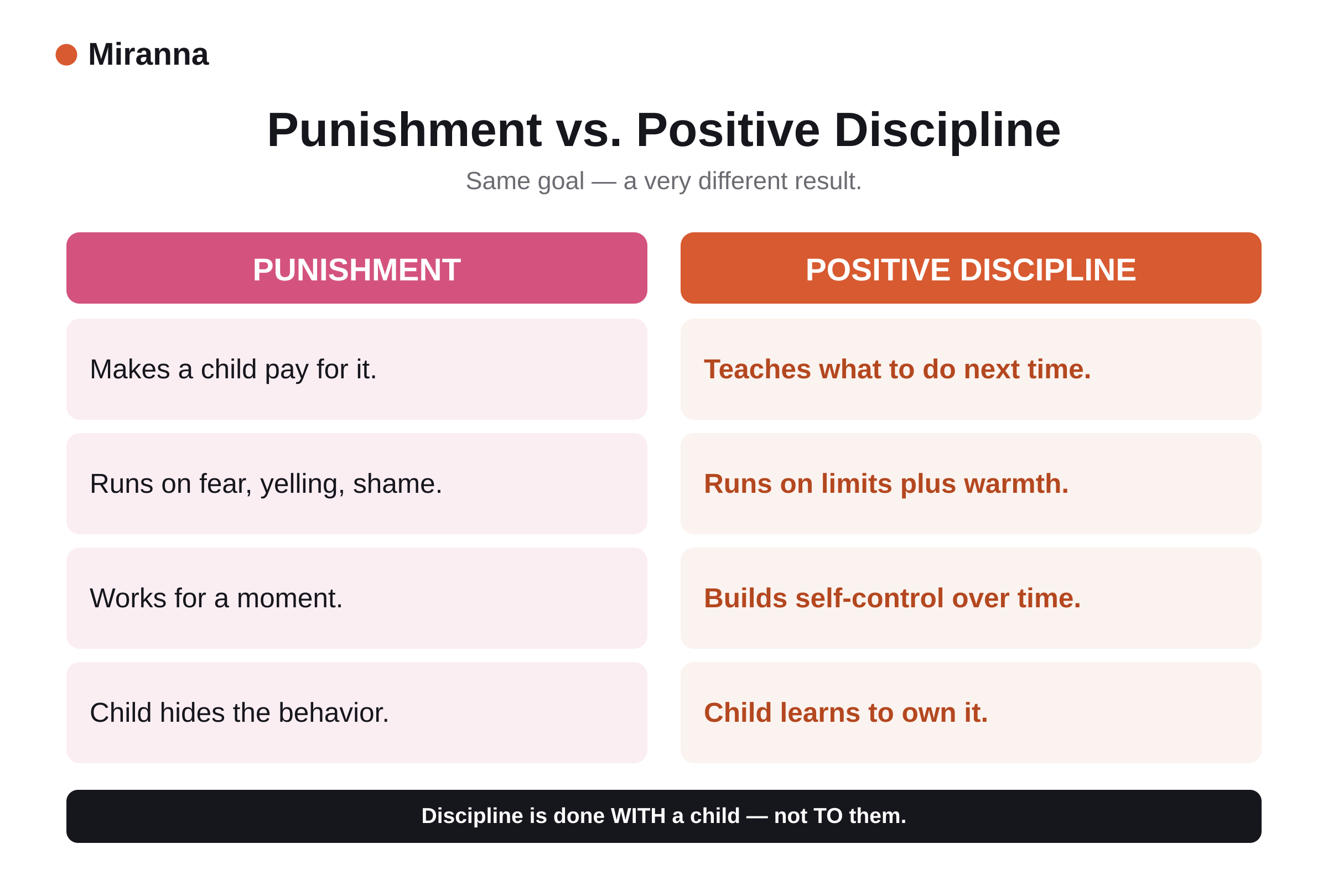
Punishment and discipline sound similar, but they aim at different things. As Dr. Daniel Amen and Dr. Charles Fay put it in Raising Mentally Strong Kids: punishment is something done to a child to make them pay for a mistake, while discipline is something done with a child to teach them to handle the next one. One builds fear; the other builds skills — and their brain-first approach to the whole question is summarized in the app.
The evidence backs the shift. The AAP found that harsh strategies — spanking, yelling, shaming — are minimally effective in the short term and not effective in the long term, and can even raise stress hormones in a developing brain. Economist Emily Oster, who reviewed the actual studies for Cribsheet, reached a matching bottom line: the two things that reliably improve young children’s behavior are consistency and a parent who stays emotionally regulated — not severity. Spanking, in the research she read, was linked to worse behavior over time — you can hear Oster walk through the evidence in the app if you want the studies themselves.
How to discipline without yelling
Yelling usually means your own tank is empty, not that your child needs more volume. Here’s the calmer sequence that actually teaches.
- Regulate yourself first. You can’t teach calm from a place of rage. Take the breath, lower your voice on purpose, and remember discipline is a teaching moment, not a scoreboard. That deliberate pause is the heart of mindful parenting.
- Connect, then correct. Name the feeling before the rule: “You really wanted that toy. It’s so hard to wait.” A child whose feeling is seen can actually hear the limit that follows.
- Hold the boundary as something you do. Boundaries don’t require your child’s cooperation. “I won’t let you hit — I’m going to move over here” works even mid-meltdown, where “stop hitting!” often doesn’t. If hitting is your daily battle, how to stop your toddler from hitting walks through the moment step by step.
- Use consequences that teach, not punish. In Raising Mentally Strong Kids, Amen’s rule is to enforce with actions, not lectures, and to say no once and mean it. Natural and logical consequences (“if the crayons go on the wall, the crayons go away for today”) teach cause and effect far better than a raised voice.
- Catch the good, out loud. The AAP puts positive reinforcement at the center for a reason: noticing and naming the behavior you want makes it happen more. Praise the effort rather than the child, and you’re also building a growth mindset in your child at the same time.
What to do instead of time-out
Time-out isn’t harmful, and used briefly and consistently it can work — but for many kids, being sent away in their biggest moment adds disconnection right when they need help. A “time-in” often works better: stay nearby, keep them company through the storm, and talk once they’re calm. You’re not rewarding the behavior; you’re coaching the child through the feeling that drove it, then holding the limit.
Why consequences sometimes don’t work
If consequences keep failing, it’s rarely because your child needs a harsher one. Usually it’s one of three things: the response isn’t consistent (the same behavior gets a different reaction each time), the consequence is too big to follow through on, or the need underneath — tired, hungry, craving connection — hasn’t been met. Fix the consistency and the connection first, and most “nothing works” situations start to move.
There’s one more possibility worth naming: some children are built to out-last you. With a strong-willed child, escalating a consequence usually lengthens the fight rather than ending it — the fix is fewer non-negotiables held more calmly, not bigger ones.
Positive discipline at different ages
The principles stay the same; the delivery grows up with your child.
- Toddlers (1–3): Keep limits short and physical, and expect to repeat them many times — that’s learning, not failure. Redirect rather than reason (“we don’t hit; you can squeeze this pillow”), and remove the object or move your child calmly when a limit is crossed.
- Preschoolers (3–5): Offer small choices inside the limit (“shoes on the step or by the door?”), name the feeling out loud before the rule, and use simple logical consequences they can actually connect to what happened.
- School-age (6+): Bring them into the problem-solving — “what’s your plan so tomorrow goes better?” — let natural consequences carry more of the lesson, and keep repairing after blowups. Apologizing when you lose your cool isn’t weakness; it models the exact skill you want them to build.
{{Article Banner}}
Am I too strict or not strict enough?
This is the question that keeps good parents up at night, and the honest answer is that it’s not a dial between the two. Warmth and limits aren’t opposites — the goal is high on both. Too strict (all limits, little warmth) tends to produce compliance that crumbles or rebels; too soft (all warmth, few limits) leaves kids anxious without a container. Positive discipline is simply refusing to trade one for the other.
FAQ
What is positive discipline in simple terms?
It’s teaching your child how to behave by combining firm, consistent limits with warmth and empathy — instead of using fear, yelling, or physical punishment.
Is positive discipline the same as gentle parenting?
They overlap, but positive discipline puts equal weight on the limit and the connection. It is not “no rules” — boundaries are central; they’re just held calmly rather than harshly.
What can I do instead of yelling?
Regulate yourself first, name your child’s feeling, then state the limit calmly as something you’ll do (“I won’t let you…”). Follow through with a small, logical consequence rather than volume.
Does time-out work?
Used briefly and consistently, it can — but a “time-in,” where you stay with your child and coach them through the feeling, often works better and keeps the connection intact.
Why don’t consequences work for my child?
Most often because they’re inconsistent, too large to enforce, or the real need underneath (sleep, food, connection) isn’t being met. Consistency and connection usually matter more than severity.
Positive discipline isn’t about being softer or stricter — it’s about being clearer and calmer. Hold the limit, keep the warmth, and let consistency do the slow work. The yelling was never the part that taught them anyway.

When you're ready to talk to someone
When you're ready to talk to someone
Sometimes the next step is having one good conversation. Miranna's coaches work with women navigating burnout, hormonal shifts, relationships, and the in-between moments — at your pace, when you're ready.
Browse who you'd want to talk to and book a session right in the app.



People ❤️ Miranna