Join our newsletters and be the first to receive app updates, exclusive content, and connect with a supportive network of accomplished women. Sign up today to unlock your journey to success with Miranna

How to Deal With Sibling Jealousy: Why It Happens and What Helps

Sibling jealousy isn’t a sign your child is mean or that you’ve split your love unevenly — it’s a normal, almost universal response to the fear of being replaced in the one relationship a child depends on most. It shows up as regression, clinginess, acting out, or aggression toward the baby, and it’s usually loudest in the first months after a new sibling arrives. You ease it not by punishing the feeling or forcing everyone to be nice, but by naming what’s underneath, protecting one-on-one time with each child, and holding a firm limit on hurting while you honor the emotion driving it. Here’s why it happens and what actually helps.
Why is my child jealous of their sibling?
At Miranna, we turn the latest books and the work of today’s doctors and parenting experts into short summaries — and for this piece, we gathered the ideas from several of them on the oldest family drama there is: a child who suddenly has to share you.
Start with how it feels from the inside. To a young child, your attention isn’t a nicety — it’s the thing that keeps them safe. So a new sibling, or a sibling who seems to be getting more of you, can read as a genuine threat. The National Childbirth Trust notes that sibling jealousy is common and thought to be a natural reaction to the fear that a new baby might take the older child’s place — an instinct that can show up before a child is even one year old.
There’s a brain layer too. A jealous feeling is a big feeling, and big feelings live in what Dr. Dan Siegel and Dr. Tina Payne Bryson, in The Whole-Brain Child, call the downstairs brain — the instinctive, emotional part that runs long before the reasoning “upstairs” part is built. A child in the grip of jealousy can’t talk themselves out of it any more than they can talk themselves out of hunger. Their method for helping a flooded child is summarized in the app if you want it in one sitting.
Here’s the reassuring part: the same research finds that children who feel secure — whose need for connection is being met — show less rivalry. Jealousy isn’t evidence the bond is broken. It’s a child protecting a bond that matters enormously to them.
Is sibling jealousy normal — and how does it show up?
Almost always, yes — and it rarely looks like a child calmly saying “I feel jealous.” It comes out sideways.
The new-baby transition hits the firstborn hardest. Research following older children after a sibling arrives documents a familiar cluster: more clinginess, disrupted sleep, and behavioral regression — the potty-trained three-year-old suddenly having accidents, the big kid wanting a bottle again — with most children settling as new routines take hold over the following months. Other kids go the opposite way and get louder: tantrums, defiance, or aggression aimed at the baby or at you. And some go quiet and withdraw, which is easy to miss precisely because a quiet child doesn’t sound any alarms.
None of these mean something has gone wrong. They’re all the same message in different handwriting: where did I go, and am I still yours?
What makes sibling jealousy worse?
A few well-meaning instincts tend to pour fuel on it:
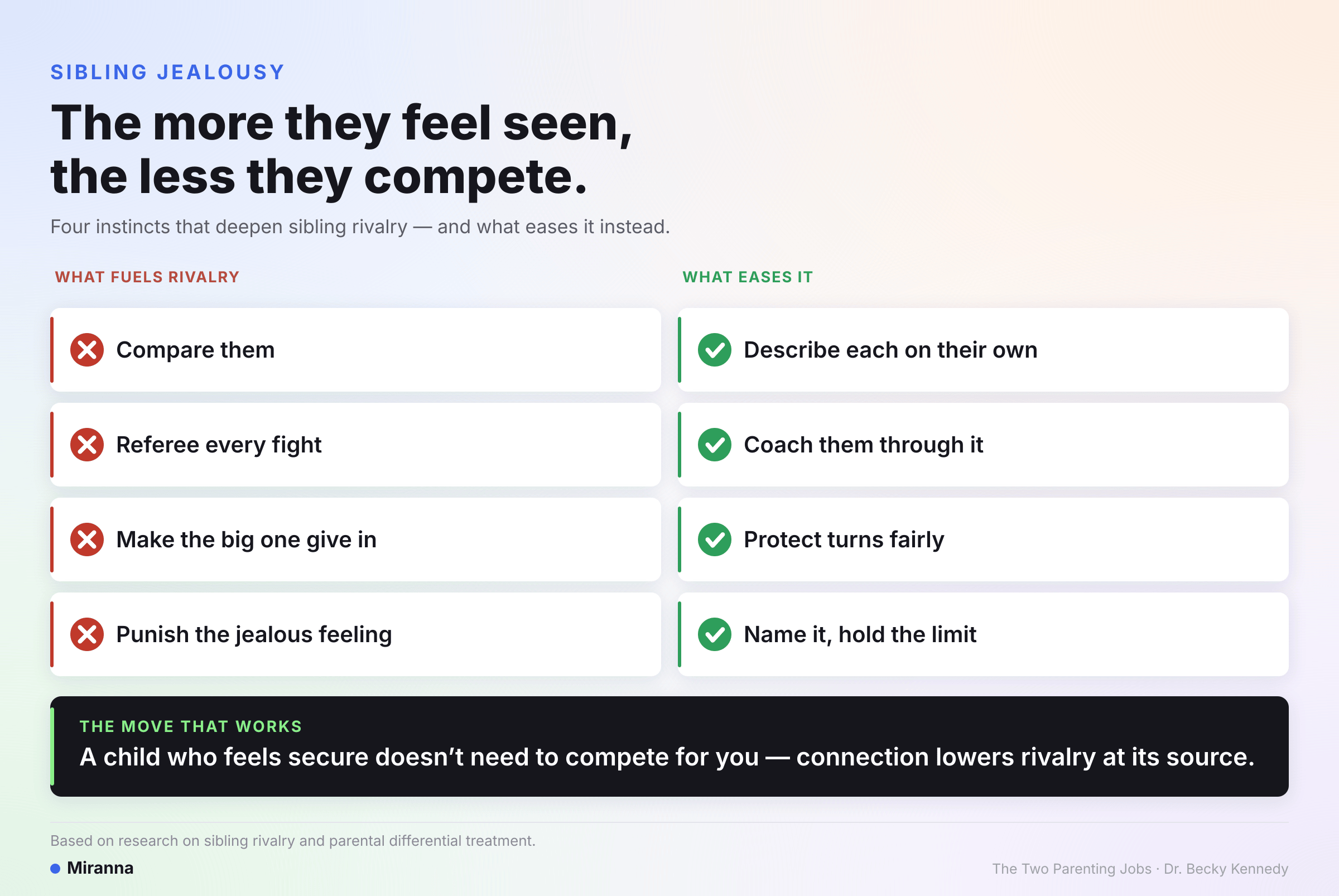
- Comparing them. “Why can’t you be calm like your sister?” lands as a verdict, not a nudge. Even praise that ranks — “you’re my easy one” — teaches kids they’re in a contest.
- Visible favoritism. Most parents treat their children a little differently, and often for good reason — different ages, different needs. But research on sibling rivalry finds that when children perceive that treatment as unfair, it’s linked to more conflict, hostility, and jealousy between them. What matters isn’t perfect sameness; it’s whether each child feels seen.
- Refereeing every fight. Rushing in to find “who started it” makes your attention the prize for conflict, and casts one child as the villain. Kids quickly learn that fighting summons you.
- Punishing the feeling. Telling a child they shouldn’t feel jealous doesn’t remove the feeling — it just teaches them to hide it and adds shame on top. Naming it instead is the same move at the heart of positive discipline.
How do I handle sibling jealousy?
The aim isn’t to make the jealousy disappear on command — it’s to help your child feel secure enough that they don’t need to compete for you.
- Name the feeling, and hold the limit. This is Dr. Becky Kennedy’s core pairing: boundaries and empathy are two separate jobs, and you do both at once. “I won’t let you hit the baby” and “It’s so hard to share me — you wish you had me all to yourself.” The limit keeps everyone safe; the empathy tells your child the feeling itself isn’t bad. Her framework is summarized in the app if you want it in full.
- Protect one-on-one time. A short, predictable burst of undivided attention with each child — even ten minutes that’s just theirs, with a name they choose (“special time”) — refills the cup jealousy is draining. It works best offered proactively, before the acting-out, not as a reward after it.
- Describe instead of compare. Speak to each child about their own effort and qualities, and skip the rankings entirely. “You worked hard on that tower” beats “you’re neater than your brother” every time.
- Don’t automatically make the older one give in. “You’re bigger, just let her have it” teaches the older child that being older means losing. Protect turns and belongings fairly rather than defaulting to the younger one.
- Catch them being kind. In Raising Mentally Strong Kids, Dr. Daniel Amen and Dr. Charles Fay make the case that kids repeat whatever reliably gets your attention — so name the good moments out loud: “You handed her the toy when she was upset. That was so kind.” Their brain-first approach is summarized in the app too. If the acting-out spikes mainly when your focus is on the baby, it can blur into ordinary attention-seeking behavior — and the fix is the same: put your attention on what you want to see more of.
- Let them be “big” on their own terms. Being the older sibling can feel like a demotion. Give the role real perks — a later bedtime, a special job, privileges the baby doesn’t get — so “big” reads as a promotion, not a punishment.
{{Article Banner}}
Preparing an older child for a new baby
A lot of first-baby jealousy can be softened before the baby even arrives. Talk honestly rather than overselling (“the baby will cry a lot and sleep a lot, and won’t play for a while”), and avoid pinning big disruptive changes — a new bed, starting daycare, potty training — right on top of the birth, so the baby doesn’t get blamed for everything that changed. After the baby comes, let the older child help in small real ways, and protect a pocket of time that’s still just theirs. The message you’re building, over and over, is that the family got bigger — not that they got smaller.
When is sibling jealousy a sign of something more?
Most sibling jealousy is ordinary and eases as a child feels secure again. But a few patterns are worth raising with your pediatrician or a child psychologist: aggression that’s frequent and genuinely dangerous rather than the odd shove, hostility that isn’t easing at all over months, a child who seems persistently miserable or withdrawn rather than intermittently upset, or conflict that’s tipping into cruelty. Getting another set of eyes on it isn’t an overreaction — it’s how you find out whether there’s a need hiding underneath.
FAQ
Is sibling jealousy normal?
Yes — it’s common and considered a natural response to the fear of being replaced. It usually peaks after a new baby arrives and eases as the older child feels secure again over the following months.
How do I stop my older child being jealous of the new baby?
You can’t switch the feeling off, but you can shrink it: protect one-on-one time, name the jealousy instead of punishing it, hold a firm limit on any hurting, and give the older child real perks for being big. Security lowers rivalry at the source.
Should I punish my child for hitting the baby?
Stop it firmly and calmly — “I won’t let you hurt the baby” — but pair the limit with empathy for the feeling underneath rather than shaming it. Punishing the emotion tends to drive it underground; naming it helps it settle.
Why is my older child acting like a baby again?
Regression — wanting a bottle, having accidents, baby talk — is one of the most common ways jealousy shows up. It’s a bid to get back the care the baby is getting. Meet it with warmth rather than correction, and it usually passes.
Does treating my kids exactly the same stop rivalry?
Not really. Fair doesn’t mean identical — children have different ages and needs. What lowers rivalry is each child feeling individually seen and valued, not everyone getting the mathematically equal slice.
Sibling jealousy isn’t a flaw to correct out of your child — it’s love with the volume turned up, and a fear that there won’t be enough of you to go around. Name the feeling, guard each child’s time with you, hold the line on hurting, and show them the family grew without anyone getting smaller. The rivalry fades as the security grows.

When you're ready to talk to someone
When you're ready to talk to someone
Sometimes the next step is having one good conversation. Miranna's coaches work with women navigating burnout, hormonal shifts, relationships, and the in-between moments — at your pace, when you're ready.
Browse who you'd want to talk to and book a session right in the app.


People ❤️ Miranna