Join our newsletters and be the first to receive app updates, exclusive content, and connect with a supportive network of accomplished women. Sign up today to unlock your journey to success with Miranna

Feeling Lonely in a Relationship: Why It Happens


Feeling lonely in a relationship usually doesn’t mean you chose the wrong person. It means the specific thing you need from them — being known, not just being around — has quietly stopped happening. Loneliness tracks the quality of connection, not the quantity of it, which is why a full house and a shared bed do nothing for it. The good news buried in that: what’s missing is a particular kind of contact, and particular things can be named, asked for, and rebuilt.
Why do I feel lonely in my relationship?
Most of what follows comes from one source we summarized at Miranna: couples therapist Terry Real, who has spent more than forty years watching couples stop repairing and calling it peace.
Because loneliness isn’t about proximity. It’s the gap between the closeness you have and the closeness you need. You can close that gap with one person who really sees you, or fail to close it in a household of four. About one in six married adults report feeling lonely in their relationship, and what predicts it isn’t how much time partners spend together — it’s whether either of them feels like a confidant.
Usually it arrives through one of three doors:
- The conversation got practical. You still talk constantly. It’s all logistics. Nobody has asked you an actual question in weeks.
- You stopped saying the hard things. Not out of malice — out of efficiency. It’s faster not to bring it up. Then the list of things not brought up becomes the distance.
- You’re being managed rather than met. Your feelings get handled, solved, or waited out instead of received.
What are the signs of disconnection in a relationship?
Disconnection is quiet. It rarely announces itself, and it usually looks like a relationship that’s running perfectly well:
- Conversations are almost entirely operational — schedules, money, kids, repairs
- You edit yourself before speaking, and can’t quite say why
- Something good happens and they’re not the first person you want to tell
- Conflict has stopped, and so has everything else
- You feel more like yourself with a friend, a sibling, a colleague
- Physical affection has become either functional or absent
- You’ve started narrating your inner life to yourself instead of out loud
One or two of those is a busy season. Most of them at once, for months, is a pattern.
Why does it happen when nothing is actually wrong?
Because nothing being wrong is not the same as something being right.
Couples therapist Terry Real describes every relationship as cycling through harmony, then disharmony, then repair. Falling out of harmony isn’t the problem — everyone does, constantly. The problem is the couples who stop completing the loop. When repair goes missing, disharmony doesn’t stay loud. It cools. It turns into politeness, then into two people who are very considerate of each other and profoundly alone.
What blocks repair, in his framing, is the part of us that learned young how to survive conflict. Some of us go on the attack. Some of us collapse, smooth things over, agree in order to end it. The second one is the quieter road to loneliness: every time you appease instead of saying what’s true, you remove a little more of yourself from the room, and then you feel unseen in a room you emptied. His full case for how couples get out of that runs about eleven minutes if you’d rather hear it summarized in the Miranna app.
Lonely in my marriage: is it the relationship, or is it me?
Worth separating, because the answer changes what you do.
Relationship loneliness is specific. It lifts when your partner really engages and returns when they don’t. It’s tied to particular moments: the story that got a distracted nod, the bad day nobody asked about.
General loneliness travels with you. It’s there with friends, at work, on good days. If that’s closer to what you’re feeling, our pieces on the signs of loneliness and solitude versus loneliness are the better starting point — and a partner, however attentive, was never going to fix it alone.
Psychologist Robert Coplan, who has spent more than thirty years studying solitude, adds a detail that matters here: loneliness distorts the lens you look through. Lonely people consistently rate their partners, family and friends as less caring and less supportive than those people actually are. So some of what feels like evidence about your relationship may be evidence about the state you’re reading it from.
Two other things worth ruling out. If you’re depleted rather than unseen — irritable, flat, dreading the relationship as a task — that may be relationship burnout, which needs rest more than it needs conversation. And if you’ve slowly stopped seeing friends, dropped things you loved, and made one person your entire social world, the loneliness is real but the shortage isn’t your partner’s to make up.
{{Article Banner}}
What actually helps
- Name it as a feeling, not a verdict. “I’ve been feeling lonely lately” opens something. “You never talk to me anymore” closes it, because the only available response is a defense.
- Ask for something specific and small. Not more connection — twenty minutes after dinner with phones in the other room. Vague requests can’t be granted, so they can’t succeed.
- Answer their bids too. Disconnection is mutual almost by definition. The fastest change available to you is your own response rate; more on that in emotional intimacy.
- Bring back a question a day. One question about the inside of their life, not the outside of it. “How was your day” is a checkbox. “What was the hardest part of today?” isn’t.
- Rebuild the parts of your life that aren’t the relationship. Not as a threat — as arithmetic. One person cannot be an entire social world, and asking them to be is what turns a shortage into a grievance.
- Give it a real timeframe. Weeks, not one big conversation. If nothing shifts after a genuine attempt from both sides, that’s information worth taking to a couples therapist rather than absorbing alone.
How do you tell your partner you feel lonely?
Pick a neutral moment — not mid-argument, not at midnight. Then keep it to three parts: the feeling, the specific, the invitation.
“I’ve been feeling lonely lately, and it’s not about anything you’ve done wrong. I miss talking to you about things that aren’t the house. Could we take twenty minutes after dinner a few nights a week, no phones?”
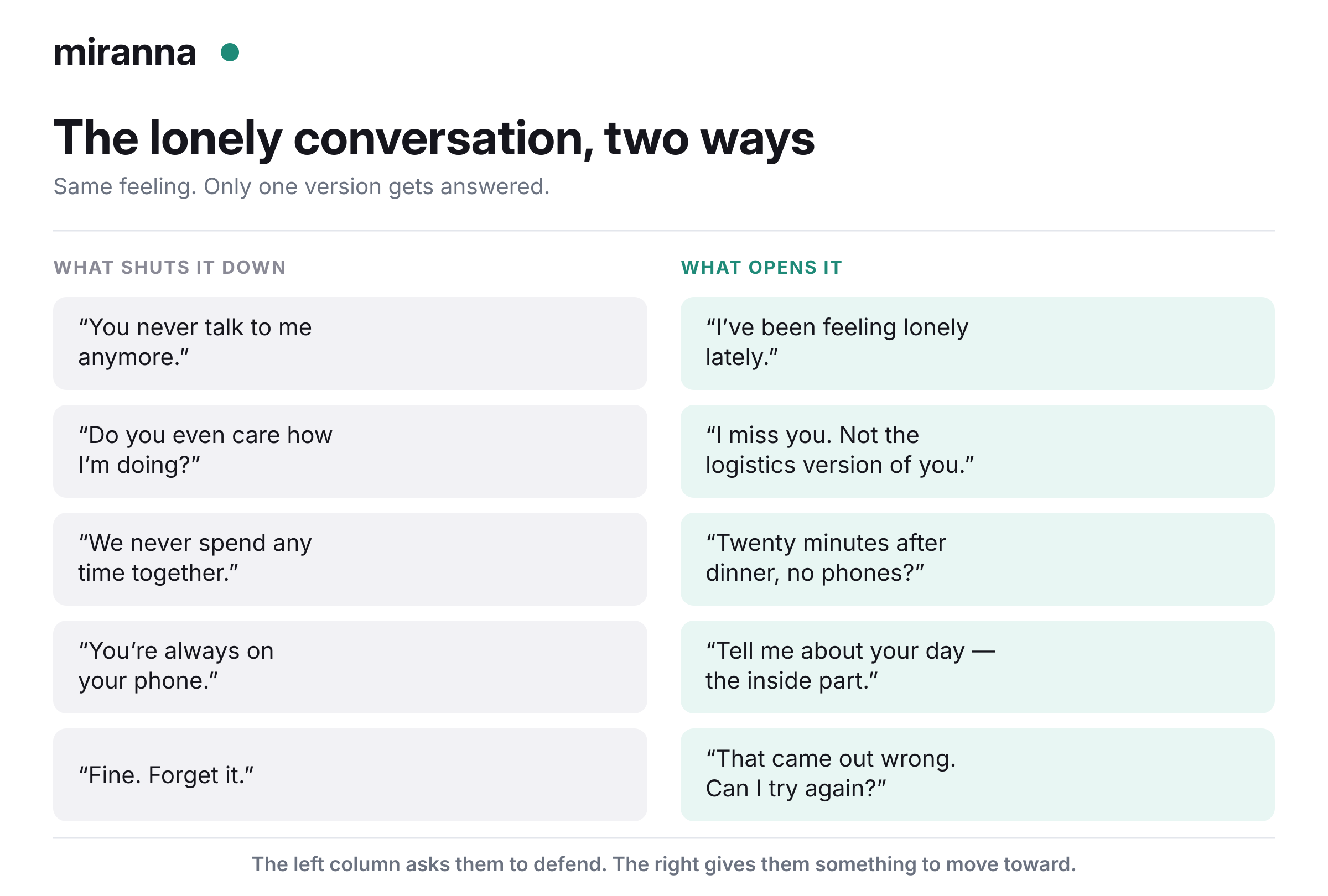
That version is hard to argue with, because there’s nothing to argue with. If it lands badly anyway, that’s worth noticing too — but give the clean version a real try first. Most people have only ever heard the accusation.
What if my partner doesn’t feel lonely at all?
Common, and not a verdict on either of you. People differ in how much closeness they need, and the person who needs more will always notice the shortfall first. That asymmetry gets misread in both directions: as proof they don’t care, or as proof you’re too much. Usually it’s neither.
The move that works is to stop trying to win agreement that there’s a problem. You don’t need a shared diagnosis to run a shared experiment. “I know this isn’t bothering you the way it bothers me. Would you try it with me for two weeks anyway?” Most people will trade twenty minutes for goodwill even when they don’t share the concern — and doing the thing often changes how they feel about it faster than the argument ever would. If they won’t try at all, that tells you something about willingness rather than about closeness, and it’s a different conversation. And if the distance grows specifically when things have been going well, that pattern has a name of its own — see fear of intimacy.
FAQ
Is it normal to feel lonely in a relationship?
Common, yes — roughly one in six married adults reports it. Normal in the sense of “leave it alone,” no. It’s a signal that one specific need has gone unmet for a while.
Why do I feel lonely in my relationship when we spend all our time together?
Because time together and being known aren’t the same input. Hours of shared logistics can leave the need for closeness completely untouched.
Can a relationship recover from feeling this way?
Often, and faster than people expect, if both people are willing. Disconnection built through small omissions tends to be reversible through small additions.
What if I bring it up and nothing changes?
Try once more, more specifically — a small, concrete request rather than a general one. If it still doesn’t move, a couples therapist is the appropriate next step, not more patience.
Is feeling lonely a reason to leave?
Not on its own. It’s a reason to say something. If you’ve said it clearly, more than once, and it’s been dismissed rather than heard — that’s different information, and worth talking through with a professional rather than deciding alone at 2 a.m.
Loneliness inside a relationship is a quiet problem with an unglamorous fix: fewer logistics, more real questions, and saying the thing you’ve been rounding down to “fine.” Start with one sentence tonight.

When you'd rather not figure it out alone
Miranna's coaches work with women on connection, communication, and the conversations that keep getting postponed — one session at a time.
When you're ready to talk to someone
Sometimes the next step is having one good conversation. Miranna's coaches work with women navigating burnout, hormonal shifts, relationships, and the in-between moments — at your pace, when you're ready.
Browse who you'd want to talk to and book a session right in the app.


People ❤️ Miranna