Join our newsletters and be the first to receive app updates, exclusive content, and connect with a supportive network of accomplished women. Sign up today to unlock your journey to success with Miranna

How to Reconnect With Your Partner After Drifting Apart


Reconnecting isn’t a conversation you have once. It’s a repair you complete — and completing it is the step most couples never learned. Every relationship cycles through closeness, then friction, then repair, and the ones that stay warm aren’t the ones with less friction. They’re the ones that finish the loop instead of leaving it open and moving on. The good news is that repair is a skill rather than a mood, which means it can be practiced on a Tuesday without waiting to feel differently first.
Why couples drift apart
The Terry Real summary in the Miranna app makes an argument worth starting with: we’re asking more of relationships than any generation before us, with roughly the same emotional toolkit our grandparents had.
Partners used to be a way to share rent, raise children and manage a household. Emotional closeness was welcome if it happened. Now we expect one person to be a best friend, a safe place, a sexual partner, a co-parent and a lifelong companion — for decades. That isn’t unreasonable. It’s just a much harder job, and almost nobody was taught the skills for it.
Real’s reframe is that a relationship works like a shared ecosystem rather than two people negotiating across a table. Both of you live inside it. When one person is stressed, withdrawn or exhausted, the whole system feels it — which means there’s no such thing as a purely private problem inside a couple. Speaking up isn’t selfishness. It’s maintenance on a space you both occupy.
Drifting, then, usually isn’t a decision either person made. It’s what happens when small ruptures stop getting closed and the shared space slowly gets less habitable. His full method for getting a couple back out of that runs about eleven minutes in the Miranna app.
How do you repair a relationship after a fight?
Start by not doing it immediately.
When we feel criticized, dismissed or overwhelmed, the part of the brain responsible for calm thinking and empathy goes offline. What takes over is a strategy learned in childhood: some people attack — becoming critical, controlling, superior — and some collapse, going quiet and agreeing just to end it. Both feel like self-protection. Neither can produce a repair, because one person is dominating and the other is disappearing.
So the first move is a deliberate pause. Not storming off, and not the silent treatment: a stated, time-limited break. “I want to finish this, and I’m too worked up to do it well. Twenty minutes?” That isn’t avoidance — it’s waiting for the part of you that can actually hear something to come back online.
Then, when you return, there’s a structure that works far better than instinct:
- What happened — the facts, as neutrally as you can manage. Not the interpretation.
- What you made of it — the meaning you attached. “I told myself you didn’t care.”
- How it landed — the feeling, said plainly. Hurt, frightened, embarrassed.
- What you want going forward — one specific, doable request.
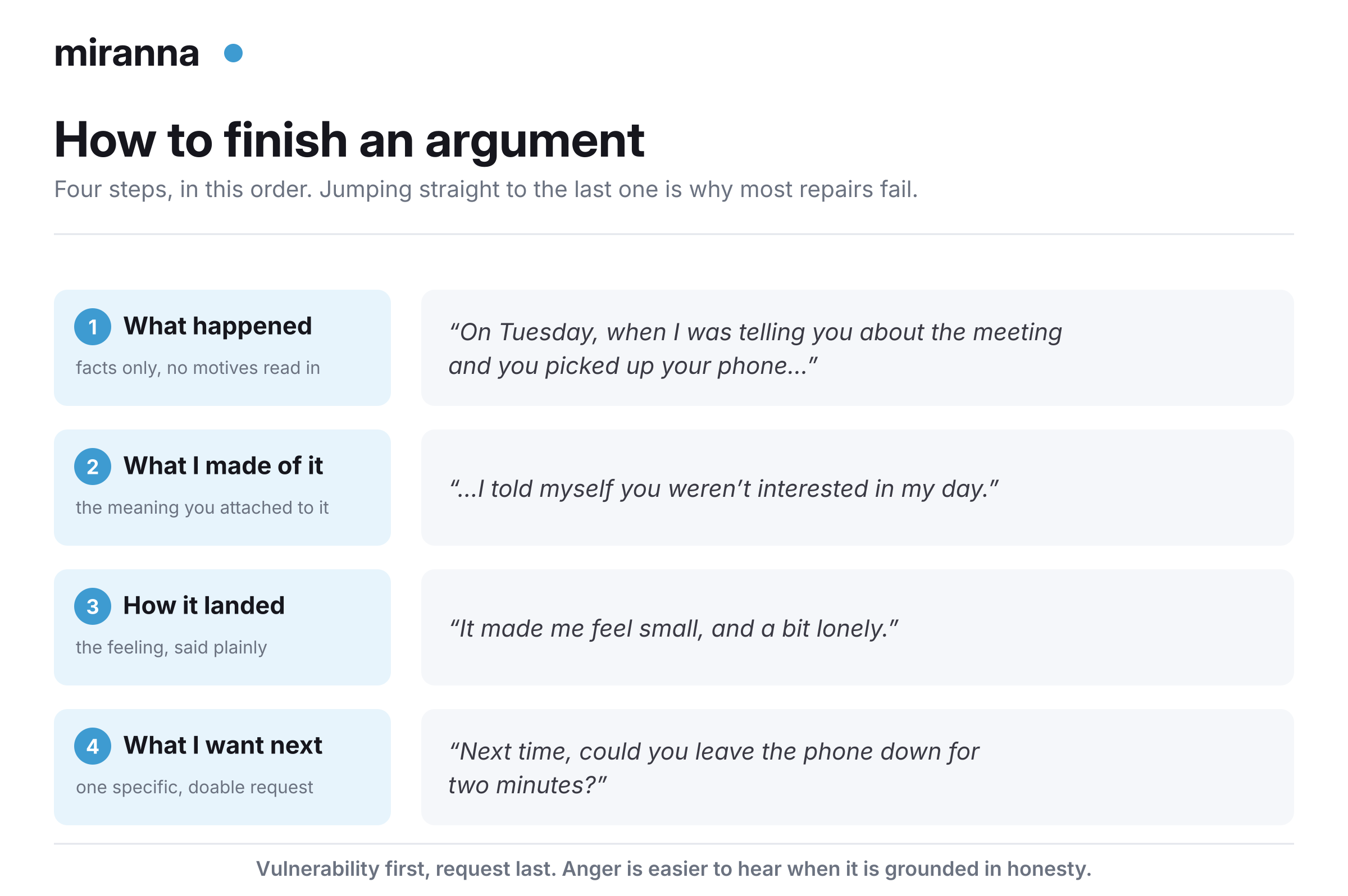
Most arguments skip straight from the first step to a verdict, which is exactly what makes them unwinnable. Leading with the meaning and the feeling before the request softens defensiveness, because there’s nothing yet to defend against.
One more thing decides how this goes: the difference between firmness and harshness. Being firm can be loving — you can hold a line without contempt. Harsh tone, harsh words and harsh judgments never produce change. They produce fear, withdrawal and resistance, which is the opposite of what you came for.
{{Article Banner}}
What if we’re just in a rough patch?
Most of them are, and most rough patches are survivable. What distinguishes a patch from a pattern is repair.
A rough patch is a stretch where life is heavy — a newborn, a bereavement, a job that eats everything — and you’re both worse at each other than usual. It ends when the pressure lifts, provided the arguments you had along the way got finished.
A pattern is a rough patch that never closed. The pressure passed, but nobody went back for the things said in it. Then the next hard stretch starts from a lower baseline, and the one after that lower still.
The test isn’t how bad the last month was. It’s whether you can name a conflict from this year that ended in something other than exhaustion.
Is the honeymoon phase supposed to end?
Yes, and its ending is not a diagnosis.
Early on, a relationship runs on novelty. You don’t yet know what this person will say next, and not knowing does an enormous amount of work — for attention, for desire, for patience. When you finally do know, that engine turns off. Nothing has gone wrong; a temporary system has expired.
What replaces it isn’t automatic. The couples who stay close afterward are the ones who deliberately manufacture what novelty used to give them for free: curiosity, unfamiliar experiences, questions they don’t know the answer to.
The mistake is reading the ordinary end of a chemical phase as evidence about the person you’re with. It’s evidence about time.
How to reconnect with your partner
- Ask for what you want, not for what went wrong. “I’d like us to have dinner without phones” gets a result. “You’re always on your phone” gets a defense. Same wish, opposite outcome.
- Teach rather than criticize. If your partner does something badly, telling them how it works for you outperforms telling them they failed. People learn from encouragement and shut down under shame, every time.
- Notice the attempts. When they do try — awkwardly, partially, not quite right — say so. Efforts that get acknowledged multiply. Efforts that get graded stop.
- Bring back questions you don’t know the answer to. This is the replacement engine for novelty. If starting cold feels artificial, use a prepared set — we have one in questions for couples to reconnect.
- Do one new thing together a month. Shared novelty attaches to the person you experience it with. It’s the cheapest available lever and almost nobody pulls it.
- Repair small, and quickly. “That came out sharper than I meant” is a complete repair. It takes four seconds. Most of what corrodes a relationship would have cost four seconds to prevent.
- Give it a season. Reconnection isn’t a conversation, it’s a change in the ratio of good exchanges to bad ones, and ratios move slowly.
If what’s missing feels more like being unseen than being in conflict, emotional intimacy covers that side, and feeling lonely in a relationship covers what to do when you can’t tell which it is.
When leaning in isn’t the answer
Two honest caveats, because most articles on this subject only have one gear.
The first: when a relationship has felt empty for a long time, silence makes it worse. Naming it — “I don’t think we’re okay, and I want us to be” — is uncomfortable and usually necessary. Waiting for the right moment is how years pass.
The second: not every relationship should be repaired. A useful question is whether the relationship gives you enough that grieving what’s missing is worth it. If yes, the work is releasing resentment and rebuilding appreciation. If no — and honest effort and professional support haven’t changed that — leaving can be the healthier answer.
There are also situations where repair isn’t the project at all: ongoing physical danger, untreated addiction, or a refusal to address serious mental health problems. In those, protecting yourself isn’t a failure of patience. It’s the responsible move, and it belongs with a professional rather than with an article.
FAQ
How long does it take to reconnect with a partner?
Weeks to feel a difference, months for it to hold. What shifts first is the small stuff — a lighter tone, an easier morning — not the big conversation.
Can a relationship recover after years of distance?
Often, if both people are willing and the distance came from neglect rather than contempt. What predicts recovery isn’t how long it’s been; it’s whether either person still turns toward the other when given a chance.
What if my partner won’t try?
Say what you want clearly, more than once, in a calm moment. If it’s consistently dismissed rather than heard, you’re no longer looking at a communication problem, and a couples therapist is the right next step.
Is the honeymoon phase ending a bad sign?
No. It’s the expected end of a novelty-driven period. The relevant question is what you’re both putting in its place.
How do we stop having the same fight?
Usually because the fight never finished. Go back to the last one when neither of you is angry and complete it — what happened, what you made of it, how it felt, what you want next time.
Reconnection is unglamorous: one finished argument, one question you don’t know the answer to, one four-second repair. Pick the argument you left open and close it this week.

When you'd rather not figure it out alone
Miranna's coaches work with women on repair, communication, and the arguments that never quite finished — one session at a time.
When you're ready to talk to someone
Sometimes the next step is having one good conversation. Miranna's coaches work with women navigating burnout, hormonal shifts, relationships, and the in-between moments — at your pace, when you're ready.
Browse who you'd want to talk to and book a session right in the app.



People ❤️ Miranna