Join our newsletters and be the first to receive app updates, exclusive content, and connect with a supportive network of accomplished women. Sign up today to unlock your journey to success with Miranna

How to Stop Your Toddler From Hitting — Calmly

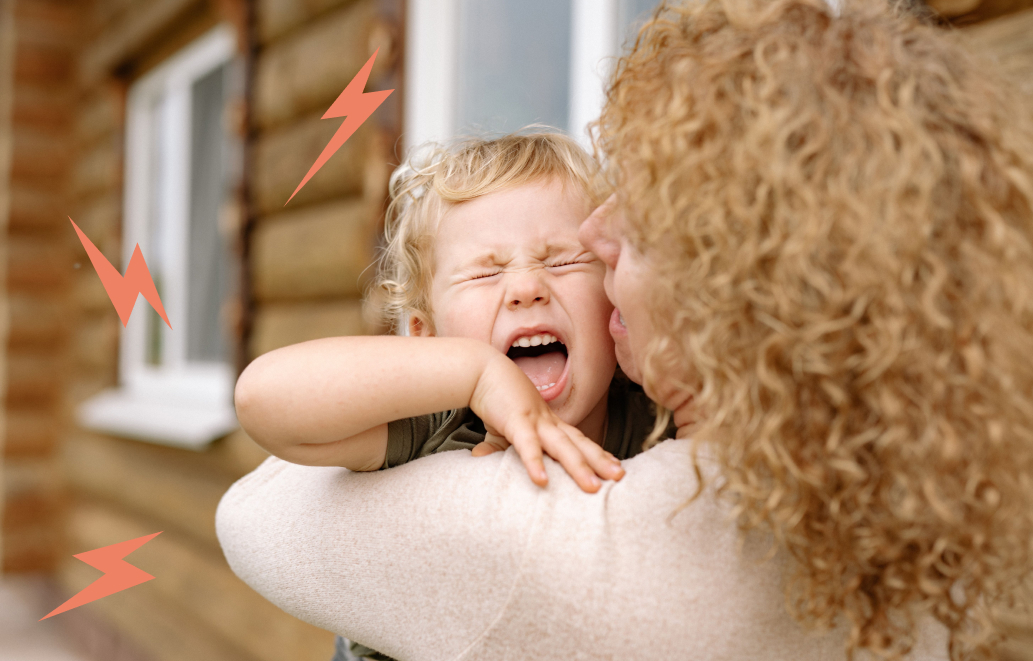
Toddlers hit because the part of the brain that stops impulses isn’t built yet — not because they’re bad or you’ve done something wrong. Hitting, biting, and hair-pulling peak around age two and fade as language and self-control grow in. You stop it not by punishing, but by calmly blocking the hit, connecting with the feeling underneath (“you’re so mad”), and teaching what to do instead once your child is calm again. Here’s why it happens, what to do in the moment, and how to help it fade faster.
Why do toddlers hit?
At Miranna, we turn the latest parenting books and the work of today’s child-development experts into short summaries — and for this one, we pulled together what several of them say about the very normal, very maddening toddler habit of hitting.
The short answer is brain development. Dr. Dan Siegel and Dr. Tina Payne Bryson, in The Whole-Brain Child, describe a child’s brain as a house with two floors. The downstairs brain runs on instinct and big feelings — fight-or-flight, anger, fear — and it’s fully operational at birth. The upstairs brain, which handles impulse control, empathy, and pausing before you act, is still under construction and won’t be finished until the mid-twenties. When a toddler is flooded with frustration, the downstairs brain takes over and the hand flies out before the barely-built upstairs brain can stop it. Their whole method is summarized in the app if you want it in one sitting.
So a hitting toddler isn’t giving you a hard time. They’re having a hard time, with a brain that can’t yet do the thing you’re asking of it.
Is hitting normal — and when does it stop?
Almost always, yes. Research on physical aggression finds that hitting rises through the second year of life, peaks around age two to two-and-a-half, and then declines steadily as language and self-regulation come online. Toddlers are, per capita, the most physically aggressive humans there are — more than teenagers, more than adults. They simply grow out of it as the upstairs brain matures and words start to replace fists.
That’s the reassuring part: for most kids, the goal isn’t to eliminate an impossible impulse overnight, but to keep everyone safe and slowly teach the skills that let it fade on schedule.
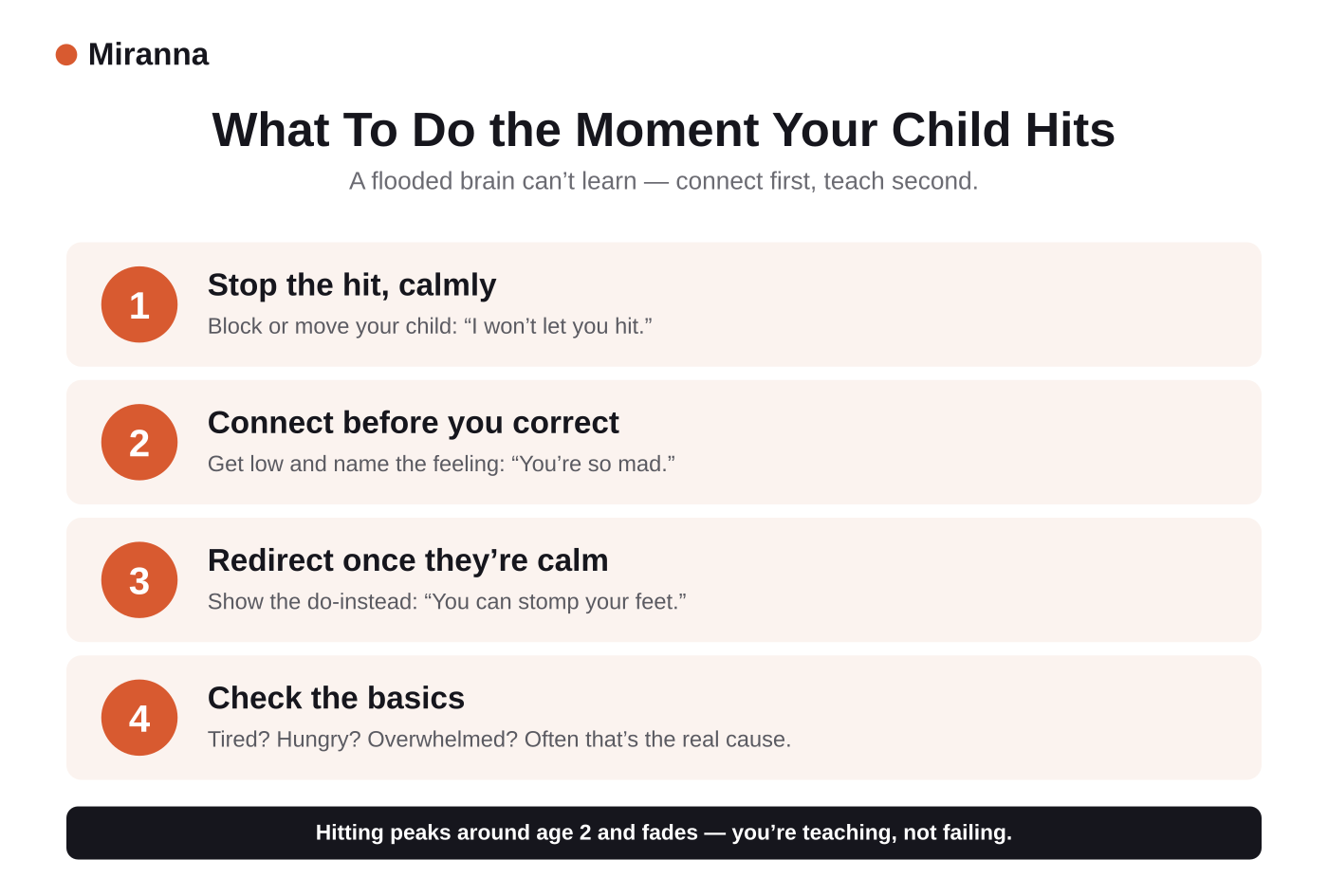
What to do the moment your child hits
In the heat of it, follow the order the brain actually needs — connect first, teach second.
- Stop the hit, calmly. Block the hand or move your child, and name the limit as something you do: “I won’t let you hit.” Firm and quiet beats loud every time.
- Connect before you correct. A flooded downstairs brain can’t hear a lecture. Get low, and name the feeling — The Whole-Brain Child calls this “name it to tame it.” “You’re so mad your tower fell. That’s really frustrating.” Naming the emotion helps calm it.
- Redirect once they’re calm. Only now can the upstairs brain learn. Show the do-instead: “When you’re that mad, you can stomp your feet or come find me.” Keep it short. Getting a small child to take in an instruction at all has its own rules — why your toddler won’t listen covers them.
- Check the basics. In Raising Mentally Strong Kids, Dr. Daniel Amen makes the point that a tired, hungry, or overstimulated child looks exactly like an aggressive one. A lot of hitting is really a nap or a snack in disguise — his brain-first approach is summarized in the app too.
- Catch the gentle moments. Notice out loud when your child uses words or soft hands: “You asked for a turn instead of grabbing — that was so hard and you did it.” Kids grow whatever gets attention.
How to prevent hitting before it starts
You can’t childproof frustration, but you can lower how often the downstairs brain floods:
- Give the words. Teach and rehearse simple scripts — “my turn,” “stop,” “help” — when everyone’s calm, so they’re available when they’re not.
- Watch the pattern. Most hitting clusters around predictable triggers: hunger, tiredness, transitions, or too many kids and too few toys. Adjust the setup before the meltdown.
- Model the calm you want. Your regulated voice is the upstairs brain your toddler borrows until theirs works. Yelling at a hitter teaches hitting-with-words.
- Fill the connection cup. A few minutes of undivided, one-on-one time each day lowers the background stress that fuels a lot of lashing out.
What makes hitting worse
A few common, well-meaning reactions tend to backfire:
- Hitting or spanking back. It models the exact behavior you’re trying to stop, and the research links physical punishment to more aggression, not less. Our guide to positive discipline without yelling or time-outs covers what to do instead.
- A big, dramatic reaction. Yelling, gasping, or a long lecture can accidentally make hitting the most interesting thing your child did all day. Keep your response small and calm.
- Shaming. “Bad boy” or “why are you so mean?” teaches a child that they are the problem, which fuels more dysregulation, not less.
- Reasoning mid-meltdown. The upstairs brain is offline while your child is flooded. Save the teaching for after they’re calm — in the moment, less talking is more, exactly as in a full-blown tantrum.
{{Article Banner}}
What about biting, spitting, and hair-pulling?
Same brain, same plan. Biting, spitting, pinching, and hair-pulling come from the identical downstairs-brain impulse and respond to the identical sequence: stop it calmly, name the feeling, then teach the alternative when your child is regulated. Biting often has an extra cause worth checking — teething, sensory-seeking, or simple exploration in the youngest kids — but the response stays the same: keep it matter-of-fact, and skip the big dramatic reaction that can accidentally make it more interesting.
When to get extra support
Most hitting fades on the developmental timetable above. It’s worth a conversation with your pediatrician or a child psychologist if the aggression is intense and frequent across every setting, isn’t declining at all by age four or five, comes with a language delay or a sudden change, or is aimed at seriously hurting. Getting help early isn’t a sign you’ve failed — it’s how you find the need hiding underneath.
FAQ
Why does my toddler hit me, their favorite person?
Because you’re their safest place. Kids let their biggest, messiest feelings out with the person they trust most — the hitting is often a sign of security, not rejection.
Is it normal for toddlers to hit?
Yes. Physical aggression peaks around age two and declines as language and self-control develop. It’s so common in toddlers it’s nearly a milestone; what matters is that it trends downward over the next couple of years.
Should I hit back or spank so they “know how it feels”?
No. Hitting a child to teach them not to hit models the exact behavior you’re trying to stop, and the research links physical punishment to more aggression, not less.
At what age do kids stop hitting?
For most children it drops off sharply between ages three and five as words replace impulses. Aggression that hasn’t declined by school age is the kind worth checking with a professional.
Why does my toddler hit when they’re happy or excited?
Big positive feelings can flood the downstairs brain just like big negative ones. The impulse-control system that would soften an excited swat simply isn’t online yet — name it and redirect the same way.
Hitting isn’t a character flaw — it’s a half-built brain doing its best under big feelings. Keep everyone safe, connect before you correct, and give it time. The words are coming, and the hitting is on its way out.

When you're ready to talk to someone
When you're ready to talk to someone
Sometimes the next step is having one good conversation. Miranna's coaches work with women navigating burnout, hormonal shifts, relationships, and the in-between moments — at your pace, when you're ready.
Browse who you'd want to talk to and book a session right in the app.
.jpeg)

People ❤️ Miranna