Join our newsletters and be the first to receive app updates, exclusive content, and connect with a supportive network of accomplished women. Sign up today to unlock your journey to success with Miranna

Mindful Parenting: What It Is and How to Actually Do It


Mindful parenting means bringing full, non-judgmental attention to your child and to yourself in the moment — noticing what’s happening before you react to it. It isn’t a personality type, a discipline method, or a promise to stay calm; it’s a practice of paying attention on purpose, which is exactly why any parent can do it and no parent does it perfectly. The research links it to lower parental stress, less knee-jerk reactivity, and warmer, more responsive relationships over time. Here’s what mindful parenting actually is, the five parts it’s built from, and how to practice it without adding one more impossible standard to your day.
What is mindful parenting?
At Miranna, we turn the latest books and the work of today’s doctors and researchers into short summaries — and for this piece, we gathered what several of them agree on about the quiet skill underneath all the parenting advice: paying attention.
The term comes from Jon and Myla Kabat-Zinn, who took mindfulness — Jon Kabat-Zinn’s now-classic definition is the awareness that arises from paying attention, on purpose, in the present moment, and without judgment — and pointed it at the parent-child relationship. In practice, that means catching yourself on autopilot (reacting from yesterday’s stress, your own childhood, the to-do list in your head) and choosing, instead, to actually see the child in front of you and the feeling rising in yourself.
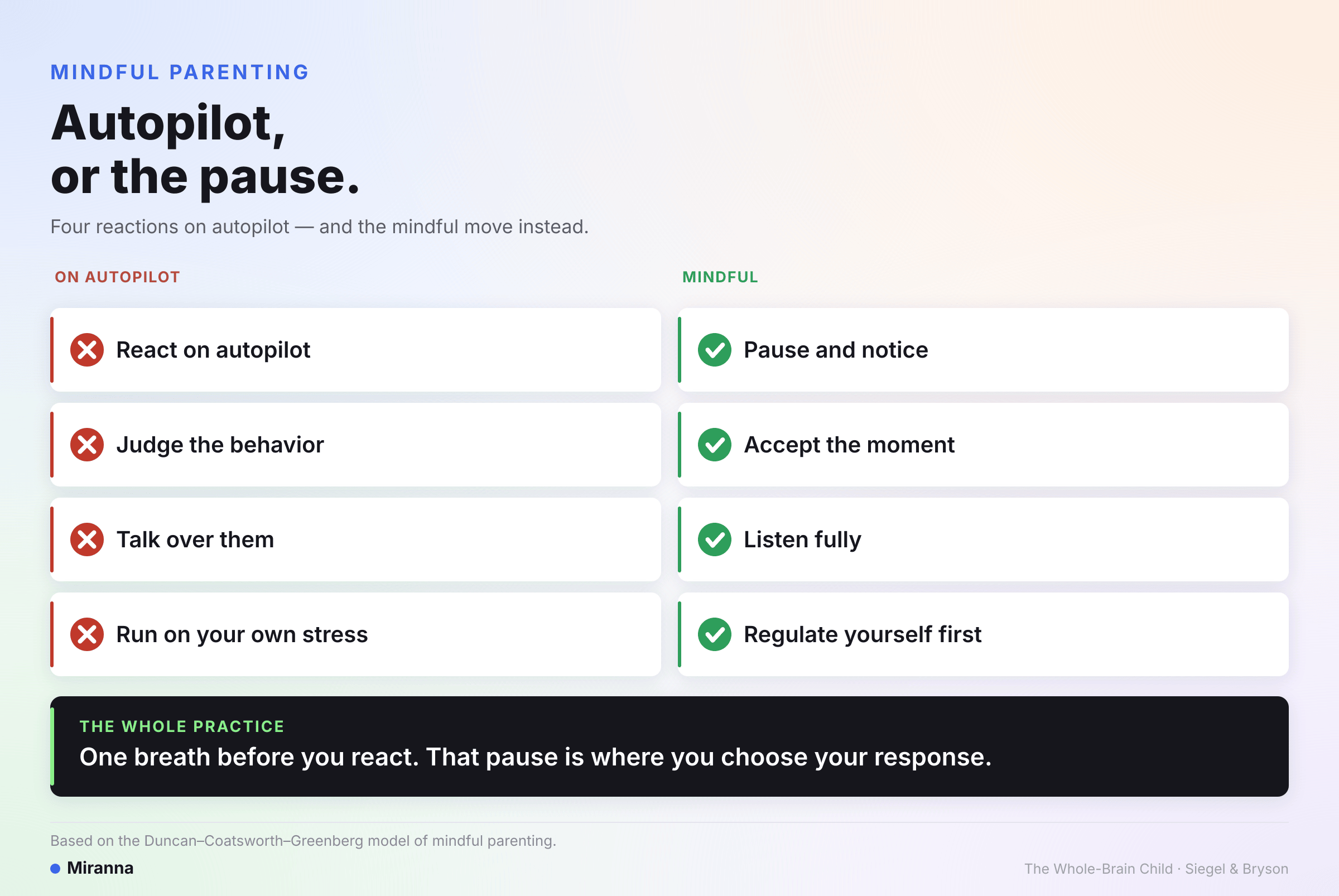
What it isn’t matters just as much. Mindful parenting isn’t permissiveness, it isn’t staying serene while chaos reigns, and it definitely isn’t never losing your temper. It’s the pause between what happens and what you do next — the small gap where you get to choose your response instead of firing off a reaction. Much of that response lives in the brain’s calmer “upstairs” floor, which goes offline when you’re flooded; the mechanics of staying connected to it are summarized in the app in The Whole-Brain Child, if you want the neuroscience in one sitting.
The five parts of mindful parenting
The most-used research model, developed by psychologists Larissa Duncan, Douglas Coatsworth, and Mark Greenberg, breaks mindful parenting into five skills you can actually practice — not a mood you either have or don’t.
- Listening with full attention. Really hearing your child — putting the phone down, getting to their eye level, noticing tone and body language, not just words. Most kids don’t need you to fix the thing; they need to feel heard while they have the feeling.
- Nonjudgmental acceptance — of them and of yourself. Meeting the moment as it is, without the running commentary (“he’s being difficult,” “I’m terrible at this”). Acceptance isn’t approval of the behavior; it’s dropping the judgment long enough to see clearly.
- Emotional awareness — of them and of yourself. Noticing what your child is feeling under the behavior, and noticing your own rising heat before it takes the wheel. You can’t manage a reaction you haven’t noticed yet.
- Self-regulation in the relationship. The pause. Feeling the surge and choosing your response instead of being run by it — the single skill most parents most want, and the one everything else rests on.
- Compassion — for your child and for yourself. Assuming the good — a struggling child, not a bad one — and extending the same kindness inward on the days you get it wrong. Self-blame doesn’t make you a better parent; it just empties the tank faster.
Why does mindful parenting work?
The mechanism is refreshingly unmysterious. A child in a big feeling can’t reach for calm they don’t have — they borrow it from you. When you regulate yourself first, you become the steady nervous system they co-regulate against; when you react from your own flooded state, you pour fuel on theirs. Mindful parenting simply widens the gap where that choice gets made.
Over time, the research finds, it changes the weather of the whole relationship. Reviews of the mindful-parenting literature link the practice to parenting more calmly and consistently, greater emotion regulation, and parent-child relationships that grow warmer, more supportive, and marked by less conflict and negativity. It also tends to lower parental stress — which matters, because a less depleted parent has more of the pause to spend. This is the same logic behind positive discipline: regulate yourself first, then teach.
{{Article Banner}}
How to practice mindful parenting (without meditating for an hour)
You don’t need a cushion or a free half-hour you’ll never find. Mindful parenting is built from small reps, in the moments you’re already in.
- Take the one-breath pause. Before you respond to the spilled milk or the sassy tone, take a single slow breath. That breath is the whole practice in miniature — it’s the difference between reacting and choosing.
- Name what you notice — silently or out loud. “I’m getting angry.” “She’s exhausted, not defiant.” Naming a feeling turns down its volume, in you and in them. If limits keep dissolving into power struggles, connecting before correcting is exactly the move in why your toddler won’t listen.
- Pick one daily moment to be fully present. Not the whole day — one. Bath time, the walk to school, the first two minutes of pickup. Phone away, agenda off, just there. Presence is a muscle, and one honest rep a day builds it.
- Practice the repair. Mindful parenting includes noticing when you’ve slipped and coming back: “I was short with you — that was about my day, not you.” The repair is where the learning is, for both of you.
- Turn the compassion inward, too. The goal is a kinder inner coach, not a harsher one. “That was hard, and I’ll try again” keeps you in the game far longer than a night of self-recrimination.
Mindful parenting isn’t about being calm all the time
This is the part worth saying plainly, because the phrase can sound like one more bar to clear. Mindful parenting is not a state of permanent serenity, and treating it that way turns a helpful practice into another stick to beat yourself with. You will lose the pause. You will react. Some days the tank is empty and the best you can manage is noticing that it is — and on the days the anger or exhaustion takes over, this is the piece for you.
That’s not failure — that’s the practice. The whole point of paying attention “nonjudgmentally” is that it includes the moments you’re not proud of, met with curiosity instead of contempt. And in the seasons when parenting has quietly rewired who you are — a shift the science of Matrescence lays out in about seven minutes — the most mindful thing you can do is extend yourself the same patience you’re trying to give your child.
FAQ
What is mindful parenting in simple terms?
It’s paying full, non-judgmental attention to your child and yourself in the moment, so you can respond thoughtfully instead of reacting on autopilot. It’s a practice of noticing — not a requirement to be calm or perfect.
What are the five components of mindful parenting?
In the widely used research model: listening with full attention, nonjudgmental acceptance of self and child, emotional awareness of self and child, self-regulation in the relationship, and compassion for self and child.
Does mindful parenting really work?
Research links it to lower parental stress and reactivity and to warmer, more consistent, less conflict-filled parent-child relationships over time. The core mechanism is that a regulated parent helps a child regulate.
How do I start practicing mindful parenting?
Start tiny: one slow breath before you respond, silently naming what you and your child are feeling, and choosing one daily moment to be fully present. Small reps beat grand resolutions.
Is mindful parenting the same as gentle parenting?
They overlap but aren’t identical. Gentle parenting is an approach to discipline and connection; mindful parenting is the underlying skill of present, non-judgmental awareness that makes any warm, firm approach easier to actually do.
Mindful parenting isn’t one more thing to be good at — it’s permission to do less on autopilot and more on purpose. One breath, one honest moment of attention, one repair after you slip. You won’t get it right every time, and that was never the goal. The goal is simply to keep coming back to the present, and to the child who’s only in this version of themselves once.

When you're ready to talk to someone
When you're ready to talk to someone
Sometimes the next step is having one good conversation. Miranna's coaches work with women navigating burnout, hormonal shifts, relationships, and the in-between moments — at your pace, when you're ready.
Browse who you'd want to talk to and book a session right in the app.
.jpeg)


People ❤️ Miranna