Join our newsletters and be the first to receive app updates, exclusive content, and connect with a supportive network of accomplished women. Sign up today to unlock your journey to success with Miranna

How to Stop Procrastinating: What Actually Works


Procrastination is an emotion-regulation problem, not a time-management one. You delay because starting produces an unpleasant feeling — boredom, anxiety, self-doubt — and avoiding it brings immediate relief. The fix is to make starting emotionally cheaper: name the feeling, shrink the first step to two minutes, and remove one decision.
The reason "just do it" has never worked on you is that it's aimed at the wrong problem.
You already know what to do. You know the deadline. You have a list, possibly three. What you're avoiding isn't the task — it's how the task makes you feel when you look at it.
Once you see that, the useful advice changes completely.
Why do we procrastinate?
The research is unusually clear on this. Sirois and Pychyl's work on short-term mood regulation describes procrastination as prioritising how you feel right now over what your future self needs — you avoid the task, the bad feeling stops, and the relief reinforces the avoidance.
Which means procrastination is a coping strategy that works brilliantly in the short term and terribly over a week.
Two consequences follow, and both are counterintuitive:
Discipline isn't the lever. You can't out-discipline a feeling you haven't identified. That's why planners, apps and 5 a.m. starts fail — they organise the task, not the emotion.
Shame makes it worse. The unpleasant feeling around the task grows every time you fail to start, which raises the cost of starting tomorrow. Self-criticism isn't a motivator here; it's fuel.
What kind of procrastination is this?
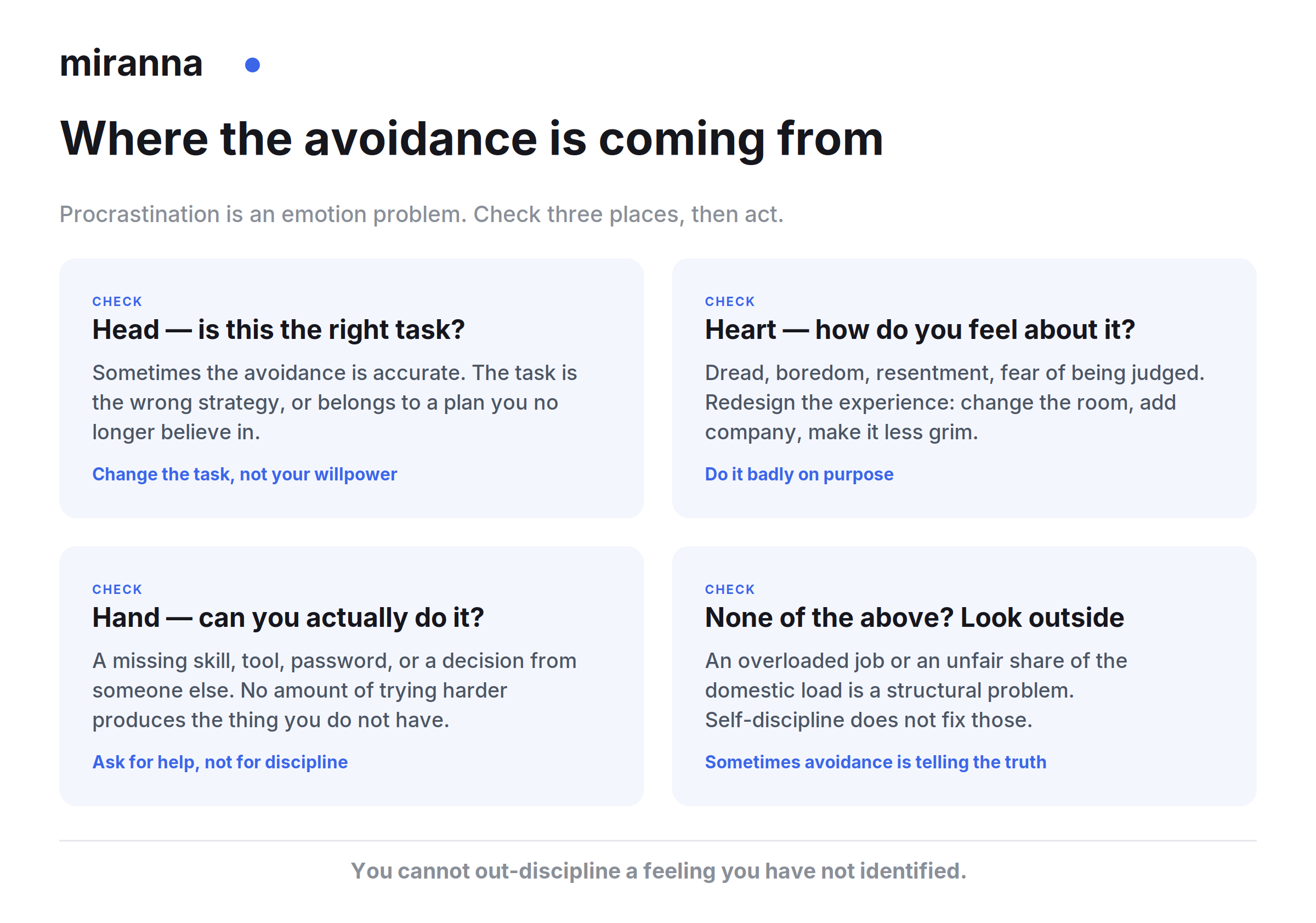
Anne-Laure Le Cunff's framing is the most useful diagnostic I've come across: when you catch yourself avoiding something, check three places.
Head — is this the right task at all? Sometimes avoidance is accurate. The task is the wrong strategy, or it belongs to a plan you no longer believe in. The fix isn't more willpower, it's changing the task.
Heart — how do you actually feel about it? Dread, boredom, resentment, fear of being judged. The fix is redesigning the experience: change where you do it, pair it with something you like, add company, make it less grim.
Hand — can you actually do it? Missing a skill, a tool, a password, a decision from someone else. The fix is asking for help, not trying harder.
When all three line up, starting is easy. When one is missing, you burn willpower on a fight you can't win — which is exactly what the last three Tuesdays felt like.
Her full argument, including why procrastination is worth listening to rather than crushing, is summarized in about seven minutes.
What actually works
Everything below is aimed at making the first thirty seconds emotionally cheaper.
1. Name the feeling out loud. "I'm avoiding this because I'll probably do it badly." Naming it reduces its charge, and it usually points at which of head, heart or hand is missing.
2. Shrink the first step until it's absurd. Not "write the report" — "open the document and write one bad sentence." The two-minute version isn't about doing less; it's about getting past the part where you're not started.
3. Decide when and where, in advance. I'll do it at 2 p.m. at the kitchen table. Deciding the specifics ahead of time removes the negotiation, and the negotiation is where you lose.
4. Work for a fixed short block. Twenty-five minutes with a timer, permission to stop afterwards. A container makes an unbounded task finite.
5. Do it badly on purpose. A deliberately rough first version disarms perfectionism, which is the most common engine of avoidance in people who describe themselves as lazy.
6. Remove one decision. Same time, same place, same first action. Every choice you make before starting is a chance to not start.
7. Change the room. Physical relocation resets the association. The task you can't face at your desk is sometimes fine in a café.
8. Borrow a witness. Working alongside someone, in person or on a call, is one of the most reliable interventions there is — no pressure required, just presence.
{{Article Banner}}
What doesn't work
Guilt. The evidence points the other way. Following 119 students across two sets of midterms, Wohl, Pychyl and Bennett found that those who forgave themselves for putting off the first exam procrastinated less before the second — and the effect ran through reduced negative emotion. Being harder on yourself raises the emotional cost of the task.
A better system. New app, new planner, new colour-coded method. It feels productive and it's a sophisticated form of avoidance.
Waiting to feel motivated. Motivation follows action far more reliably than it precedes it.
Blocking out four hours. A large empty block is intimidating and easy to sacrifice. Twenty-five minutes is harder to argue with.
Piling on more accountability. Sometimes helpful. Often it just adds shame to a task that already has too much attached to it.
Procrastination and ADHD
Worth separating out, because the advice diverges.
If routines evaporate, if you can only start under deadline pressure, and if this has been the pattern since school rather than since your current job — that's a different mechanism. ADHD brains often struggle with task initiation regardless of how much someone cares about the outcome, and the standard fixes work less well.
What tends to help more: external structure, body-doubling, novelty, urgency created deliberately, and much shorter blocks. Dr. Andrew Huberman's practical focus tools are summarized in four minutes, and our guide to everyday strategies for adults with ADHD goes further.
This isn't diagnostic and no article can assess you. If the pattern is lifelong and costly, a proper assessment is worth asking for rather than another productivity system.
When it isn't procrastination
Some avoidance is information rather than a fault. Worth checking honestly:
- You're exhausted. Depleted isn't the same as avoidant, and the fix is rest, not a timer.
- The system is the problem. An overloaded job, an unfair share of the domestic load, a process that doesn't work. No amount of self-discipline fixes a structural problem, and treating it as personal failure keeps it invisible.
- You've lost interest in everything, not just this. That belongs with a professional rather than a planner.
- You genuinely don't want to do it. Sometimes the honest move is to drop the task, not to trick yourself into it.
There's also a useful signal hiding in what you do instead. If you consistently avoid work by cooking, reading about houses, or writing something unrelated, that's worth noticing — the distraction is often pointing at something you'd rather be doing.
FAQ
Why do I procrastinate even on things I want to do?
Because the discomfort is usually about how the task makes you feel — fear of doing it badly, or of it mattering — rather than about wanting the outcome. Wanting something and dreading starting it are entirely compatible.
What is the 2-minute rule for procrastination?
Shrink the first step to something you could do in under two minutes. It works because the hardest part is beginning, not continuing.
Is procrastination laziness?
No. Lazy people don't feel bad about not doing things. Procrastination is usually accompanied by considerable distress, which is what distinguishes it.
What are the types of procrastination?
A useful split is by cause: the task is wrong for you, the task feels bad, or you lack a skill or tool. Each has a different fix — change the plan, redesign the experience, or get help.
How do I stop procrastinating with ADHD?
Standard advice works less well. External structure, working alongside someone, deliberate novelty and much shorter blocks tend to help more, and a proper assessment is worth pursuing.
Does punishing myself help me stop procrastinating?
The opposite. In one study of 119 students, self-forgiveness after procrastinating on one exam predicted less procrastination before the next, because it lowered the negative emotion attached to the task.
Make starting cheaper
You're not going to think your way out of this, and you're not going to shame your way out either — shame is part of the mechanism.
What works is smaller: notice what you're feeling, work out whether it's the task, the feeling or the missing tool, and then make the first thirty seconds so cheap that avoiding it takes more effort than beginning.
One bad sentence. Twenty-five minutes. The kitchen table at two o'clock.
For the underlying mechanics, our guide to building habits that survive a real week and our productivity tips for a fragmented day go further.
Miranna turns the best books on habits, focus and motivation into short audio summaries — for the twenty minutes you actually have. Try Miranna free.

When it's been on the list for months
Some things stay on the list for a reason. Miranna's coaches work with women on the hard, specific stuff — the task you have moved forward eleven times, the conversation attached to it, working out whether it was ever yours to do — at your pace, when you're ready. Browse who you'd want to talk to right in the app.
When you're ready to talk to someone
Sometimes the next step is having one good conversation. Miranna's coaches work with women navigating burnout, hormonal shifts, relationships, and the in-between moments — at your pace, when you're ready.
Browse who you'd want to talk to and book a session right in the app.
%2520(1).jpeg)


People ❤️ Miranna