Join our newsletters and be the first to receive app updates, exclusive content, and connect with a supportive network of accomplished women. Sign up today to unlock your journey to success with Miranna

The Night Routine That Actually Improves Your Sleep

A night routine works by lowering arousal and giving your body the same signals at the same time each evening. The parts that matter are cutoffs — caffeine about ten hours before bed, food and alcohol about three, screens and work in the last hour — plus a consistent wake time. Candles are optional.
Search "night routine" and you'll mostly find aesthetics: silk pillowcases, ten-step skincare, a herbal tea photographed at a flattering angle.
None of that is the mechanism. The mechanism is unglamorous — you're trying to lower your body temperature, reduce stimulation, and give your nervous system a predictable sequence it can recognise. That's it.
Here's the version that survives a real evening.
What is a night routine actually for?
Sleep isn't a switch you flip. It's a descent, and it starts well before you get into bed.
Three things have to happen. Your core temperature needs to drop. Your nervous system needs to move out of alert mode. And your brain needs a signal that the day is closed — which is why unfinished mental business is the single most common reason people lie awake.
A good routine does those three things reliably, in the same order, most nights. The repetition is the point: the sequence itself becomes a cue, and eventually the first step starts making you sleepy on its own.
When should a night routine start?
Earlier than most people think. Sleep specialist Dr. Michael Breus uses a countdown that's easy to remember:
- Three hours before bed: stop eating and drinking alcohol
- Two hours before bed: stop working
- One hour before bed: stop looking at screens
- Zero: the number of times you hit snooze in the morning
You will not hit all four on a Tuesday. That's fine — the framework tells you which one to fix first, and for most people the biggest win is the three-hour cutoff, not the one-hour one.
His full set of tools — the wind-down, what to do with a 3 a.m. waking, why alcohol is worse for sleep than people assume — is summarized in about eight minutes.
The four cutoffs that do most of the work
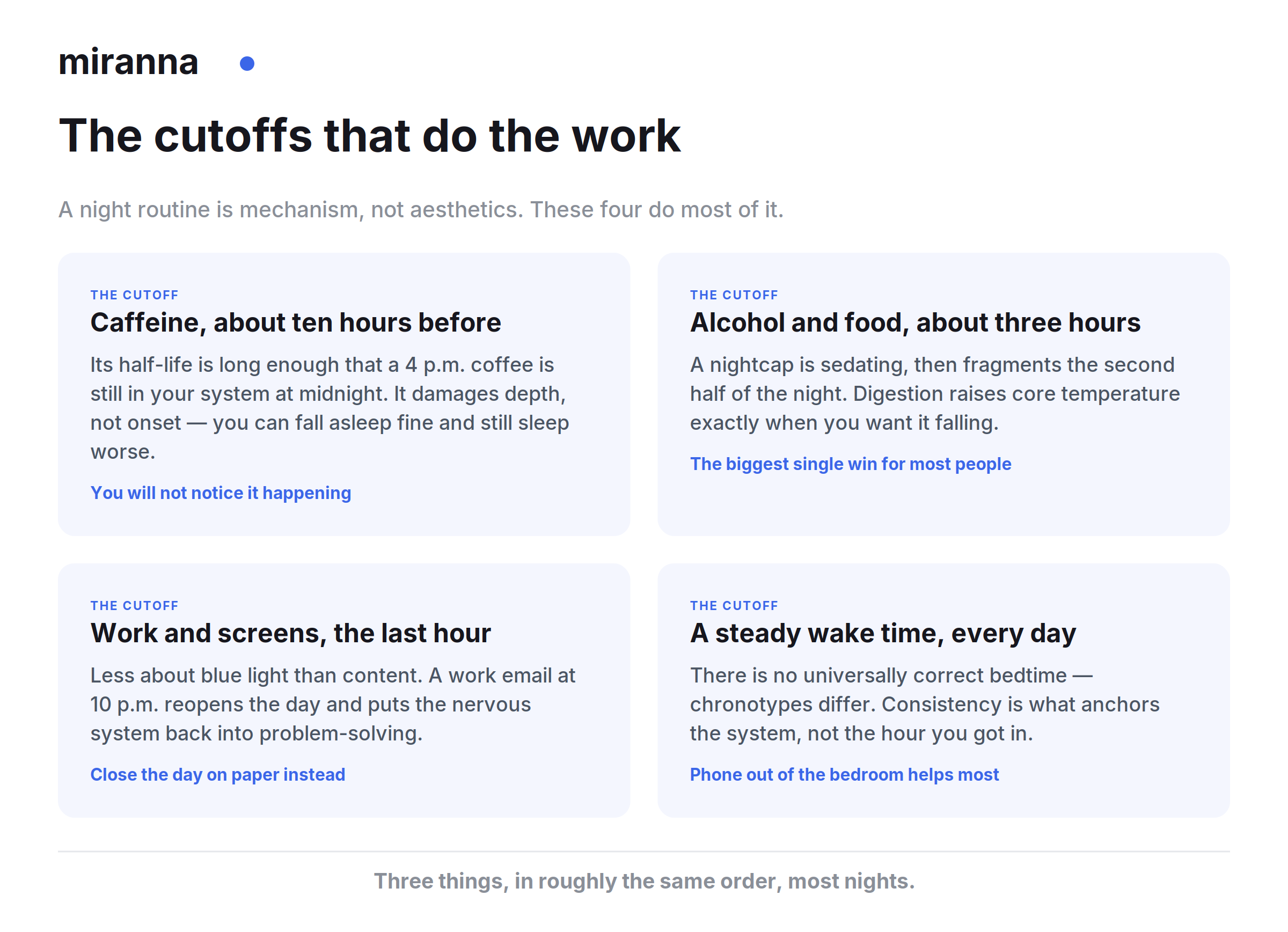
Caffeine, about ten hours before bed. Its half-life is around five hours, so a 4 p.m. coffee is still measurably in your system at midnight. In a controlled trial, 400 mg of caffeine taken six hours before bed cut objectively measured sleep by over an hour — and participants did not notice it had happened. You may fall asleep fine and still get worse sleep; the damage is to depth, not to onset.
Alcohol, about three hours before bed. A glass of wine is sedating, which is why it feels like it helps. It then fragments the second half of the night as it metabolises, which is exactly the half that's already lightest.
Food, about three hours before bed. Digestion raises core temperature at the point you want it falling.
Work and screens, in the last hour. The problem is less blue light than content — a work email at 10 p.m. reopens the day's unfinished business and puts your nervous system straight back into problem-solving mode.
A night routine you can actually keep
Aim for thirty minutes. If that's unrealistic, ten will do more than a perfect routine you abandon in a fortnight.
- Set a wind-down alarm, not a bedtime alarm. The alarm that matters is the one telling you to start, not the one telling you you've failed.
- Close the day on paper. Two minutes writing tomorrow's one priority and anything nagging at you. This is the step people skip and the one that most reliably stops 2 a.m. rumination.
- Lower the light. Overhead lights off, lamps on. Dimming the room does more than any app that tints your screen orange.
- Cool the room. A drop in core temperature is what initiates sleep. A cooler bedroom does half the work for you.
- Do one slow thing. Reading, stretching, a shower, tidying one surface. What it is matters far less than that it's the same thing most nights.
- Slow the exhale. Longer out-breaths than in-breaths — the 4-7-8 pattern is the popular version — shift you toward the calming branch of the nervous system in about a minute.
- Phone out of the bedroom. The single highest-return change on this list, and the one most people negotiate hardest against.
{{Article Banner}}
What about chronotypes?
This is where most night-routine advice quietly fails people.
Breus sorts sleepers into four chronotypes — Lion, Bear, Wolf and Dolphin — and the practical consequence is that there is no universally correct bedtime. Lions fade early and wake naturally at five. Wolves don't get useful until late morning and are genuinely alert at 11 p.m. Forcing a Wolf into a 10 p.m. bedtime produces an hour of lying awake and a conviction that she's broken.
What's actually non-negotiable is consistency, not the hour. A steady wake time anchors the whole system, and it matters more than what time you got in — which is why it is also the first thing in our guide to building a morning routine you'll actually keep.
So: work out roughly which type you are, set a realistic window, and stop trying to become a Lion because a productivity book told you to.
When you don't control your evening
Most night-routine content assumes a quiet flat and a free hour. Plenty of women have neither.
- Anchor to an event, not a clock. "After the last child is in bed" is a cue that fires. "At 9:30" often isn't.
- Have a two-minute version. Phone out of the room and lights down. That's the whole routine on the bad night, and it still counts — the same minimum-version logic that makes any habit survive.
- Negotiate the bedroom, not the evening. If you can't control when the evening ends, you can often still control the room's light, temperature, and whether a phone is in it.
- Different bedtimes are allowed. Partners with different chronotypes trying to sync usually means one of them lying awake. Separate schedules — sometimes separate rooms — is a practical fix, not a relationship verdict.
Entrepreneur Bryan Johnson's approach — treating sleep as a trainable performance skill, with resting heart rate as the feedback signal — is summarized in about eight minutes if you like a measurable version.
What to skip
The twelve-step aesthetic routine. It photographs well and lasts nine days. Three consistent things beat twelve occasional ones.
Melatonin as a nightly sleeping pill. It's a timing signal, not a sedative, and most over-the-counter doses are far higher than anything used in research. Worth a conversation with a pharmacist or doctor rather than a habit you drift into.
A nightcap. Covered above, and it's the most common self-prescribed sleep aid there is.
Blue-light glasses as the whole solution. Dimming the room and putting the phone elsewhere does more, and costs nothing.
Optimising the routine while ignoring the schedule. If you're going to bed at 1 a.m. because that's the only quiet hour you get, no wind-down fixes that. The problem is the shape of the day.
When it isn't the routine
Some things a night routine can't solve, and it's worth naming them rather than adding a fourth candle:
- You wake at 3 a.m. most nights and can't get back. That's a distinct pattern with its own fixes — we've written about why sleep breaks and what actually works.
- You snore, gasp, or your partner notices you stop breathing. Worth raising with a doctor; sleep apnea is badly underdiagnosed in women.
- You're anxious rather than wired. A wind-down helps at the margin, but the underlying thing is the thing to treat.
- You've been sleeping badly for months. Chronic insomnia has an evidence-based treatment — CBT-I — and it isn't a routine.
FAQ
What should a night routine include?
A wind-down that starts about an hour before bed, dimmed light, a cooler room, one slow repeated activity, a two-minute brain dump, and the phone out of the bedroom.
How long before bed should a night routine start?
Roughly three hours for food and alcohol, two for work, one for screens. Most people get the biggest gain from the three-hour cutoff rather than the one-hour one.
What time should I go to bed?
There's no single right answer — it depends on your chronotype. Consistency matters more than the hour, and a steady wake time anchors the system better than a fixed bedtime.
Does a night routine actually help you sleep?
Yes, through mechanism rather than magic: lower light and temperature, less stimulation, and a repeated sequence your nervous system learns to read as a cue.
What's the difference between a night routine and an evening routine?
In practice, none — both describe the wind-down before sleep. What matters is where it starts, not what you call it.
What if I only have ten minutes?
Lights down, phone out of the room, and two minutes writing tomorrow's one priority. That's a real routine, and it survives the nights a longer one wouldn't.
Three things, most nights
The best night routine isn't the most impressive one. It's three things you do in roughly the same order, most nights, in a room that's dark and slightly too cool.
Get the cutoffs approximately right, keep your wake time steady, and put the phone somewhere else. Everything after that is decoration — pleasant, but not what's doing the work.
Miranna turns the best books and podcasts on sleep into short audio summaries — short enough to listen to during the wind-down itself. Try Miranna free.

When the day won't close
Some evenings need more than a wind-down. Miranna's coaches work with women on the hard, specific stuff — a mind that starts listing things at 11 p.m., the only quiet hour being the one you should be sleeping in, working out what to put down before bed — at your pace, when you're ready. Browse who you'd want to talk to right in the app.
When you're ready to talk to someone
Sometimes the next step is having one good conversation. Miranna's coaches work with women navigating burnout, hormonal shifts, relationships, and the in-between moments — at your pace, when you're ready.
Browse who you'd want to talk to and book a session right in the app.



People ❤️ Miranna