Join our newsletters and be the first to receive app updates, exclusive content, and connect with a supportive network of accomplished women. Sign up today to unlock your journey to success with Miranna

How to Build a Habit That Survives a Real Week


To build a habit, make it small enough to do on your worst day, attach it to something that already happens reliably, and remove one step of friction before you start. Then plan what you'll do the first time you miss it — because you will, and that moment decides whether the habit survives.
Most habit advice assumes the problem is that you don't want it enough.
It usually isn't. It's that the habit was built for an imaginary week — one where nothing runs late, nobody needs anything, and you have energy at the same time every day. That week doesn't arrive, so the habit collapses, and you file it under personal failure.
Here's how to build one that holds up in the week you actually have.
Why habits don't stick
Four reasons, and only one of them is about motivation.
It was too big to start. Thirty minutes of anything is a decision you have to make daily. Two minutes isn't.
The cue was unreliable. "Every morning" is not a trigger, it's a hope. Habits attach to specific events, not to intentions.
There was too much friction. Every step between you and the behaviour is a place to stop — finding the shoes, charging the thing, clearing the table.
Missing once turned into missing forever. The first missed day is normal. What follows it is usually a quiet decision that the whole thing has failed, and that's what actually ends it.
Notice that none of those are fixed by wanting it more.
Start absurdly small
Smaller than you think is worth doing. That's not a motivational trick — it's the mechanism.
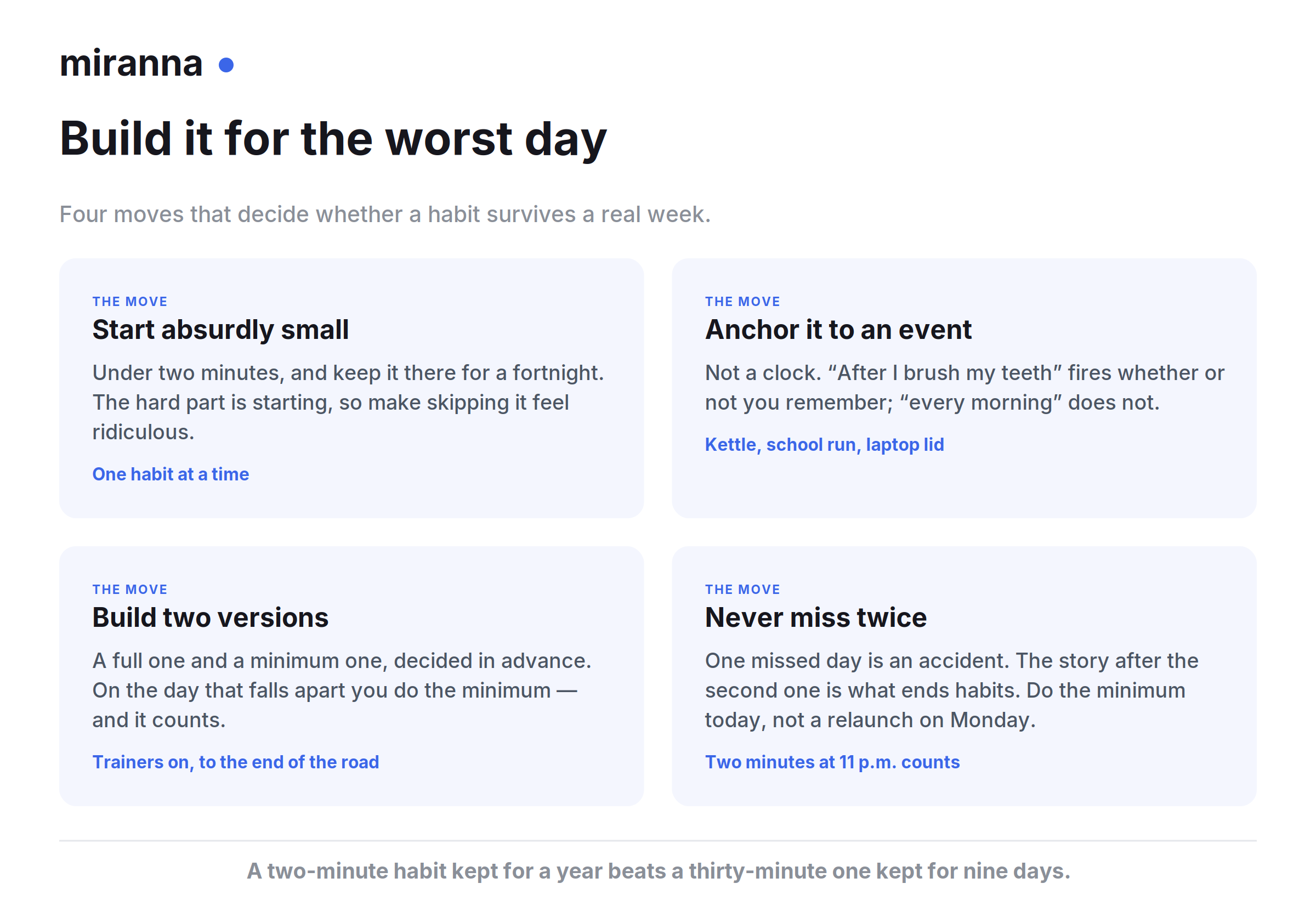
The hardest part of any habit is starting, and a version small enough that skipping it feels ridiculous gets you past that part every time. One page. Two minutes of stretching. Opening the document. Filling the water bottle.
Two rules make this work:
- Keep it small for longer than feels necessary. A fortnight at the small version, minimum. Most people scale up in week one and lose it in week two.
- Do one habit at a time. The most common failure is enthusiasm — four new routines starting Monday, none of them alive by Friday.
James Clear's whole framework for this is summarized in about nineteen minutes, and we've broken down the core ideas of Atomic Habits separately.
Anchor it to something that already happens
New habits need a cue that fires whether or not you remember them. The most reliable cue is an existing action, not a time.
Compare: "I'll stretch in the mornings" versus "after I brush my teeth, I'll stretch for two minutes." The first depends on you noticing. The second happens because your teeth do.
Good anchors are things you do without deciding: the kettle, the school run, closing the laptop, the shower, feeding the cat. Bad anchors are things that move — "after lunch" when lunch is anywhere between noon and four.
Write it as one sentence and say it out loud once: after [thing that always happens], I will [tiny habit].
Build two versions, not one
This is the part most advice skips, and it's the difference between a habit that lasts three weeks and one that lasts.
Design a full version and a minimum version at the same time.
- Full: twenty minutes of exercise. Minimum: put the trainers on and walk to the end of the road.
- Full: write for an hour. Minimum: open the file and write one sentence.
- Full: proper evening wind-down. Minimum: phone out of the bedroom.
On a good day you do the full one. On the bad day — the one with the sick child and the late meeting — you do the minimum, and crucially, the minimum still counts. You haven't broken anything. The chain holds.
Habits die on the days that go wrong. Deciding in advance what the bad-day version looks like is what carries them through.
{{Article Banner}}
Remove friction before adding motivation
Motivation is the least reliable input you have. Convenience is the most.
Before starting, spend ten minutes removing one obstacle:
- Put the thing where you'll trip over it, not where it belongs
- Prepare the night before — clothes out, bag packed, water filled
- Delete the app, or move it off the first screen
- Reduce the decision: same workout, same time, same order, no choosing
And do the inverse for anything you want less of. Add steps, add distance, add one small annoyance. Most habits you'd like to break aren't decisions — they're the path of least resistance.
What to do when you miss a day
You will miss. Plan for it now, while you're calm.
The rule that matters: never miss twice. One missed day is an accident. Two is a new pattern, and the story you tell yourself after the second one — "I've fallen off, I'll restart Monday" — is what kills more habits than any amount of busyness.
So the recovery move is not a fresh start. It's the minimum version, today, however late and however token. Two minutes at 11 p.m. keeps the identity intact in a way that a grand Monday relaunch does not.
Also worth dropping: streak counting past a certain point. A 40-day streak becomes a thing you can lose, and losing it feels like a verdict. Consistency over months matters; the number does not.
How to build habits when your week is unpredictable
Standard habit advice assumes broadly identical days. Plenty of women don't have those — shift work, small children, caring responsibilities, a calendar set by other people.
What works instead:
- Anchor to events, not clocks. Your day may not have a stable 7 a.m., but it has a first coffee and a moment the door closes behind everyone.
- Aim for a weekly count, not a daily streak. Four times a week is a real target. Every single day, at a fixed hour, is a setup for failure.
- Expect energy to vary — including with your cycle. The routine that works in week two can be genuinely unusable in week four. That's not inconsistency, and building the minimum version is how you account for it.
- Attach it to a place if the time won't hold. Some habits anchor better to a location than a moment: the walk starts at the school gate, the reading happens in that chair.
If a rigid goal itself keeps being the problem, Anne-Laure Le Cunff's case for running small experiments rather than committing to outcomes is summarized in seven minutes.
When it isn't a habit problem
Sometimes the system is fine and something else is in the way. Worth checking honestly:
- You're not sleeping. Broken sleep undoes almost everything else, and no habit design compensates for it.
- Your plate is genuinely full. If every hour is spoken for, the answer is subtraction, not a better routine. Something has to come off before anything goes on.
- Much of your load isn't habit-shaped. Remembering, coordinating and anticipating for other people can't be redesigned with a cue. That one is a conversation about who does what.
- The skill is missing, not the habit. Sometimes what blocks you is that you haven't learned the underlying skill yet, and that has its own method — see how to learn faster.
- Your brain doesn't build automaticity easily. ADHD brains often don't get the effortless version other people describe. Different strategies work better — our guide to everyday approaches for adults with ADHD is a better starting point than more discipline.
- You've lost interest in most things, not just this one. That's worth raising with a professional rather than solving with a tracker.
FAQ
How do I start a new habit?
Pick one, shrink it to under two minutes, attach it to something you already do reliably, and remove one step of friction before day one.
Why can't I stick to habits?
Usually because the habit was too big, the cue was a time rather than an event, there was too much friction, or one missed day turned into stopping altogether.
How many habits should I start at once?
One. Starting several at once is the most common reason none of them survive the month.
What should I do if I miss a day?
Do the minimum version today rather than restarting on Monday. The rule that protects habits is never missing twice in a row.
How do I build a habit with an unpredictable schedule?
Anchor to events rather than clock times, aim for a weekly count instead of a daily streak, and design a minimum version for the days that fall apart.
Do habit trackers help?
For many people, yes — visible progress is a form of immediate reward. They stop helping when the streak itself becomes the thing you're afraid to lose.
The version that survives Thursday
The habit you keep is rarely the impressive one. It's the small, slightly embarrassing version that still happens on the day everything goes wrong.
That's not settling. A two-minute habit performed for a year beats a thirty-minute one performed for nine days, and the second one is what most people are actually choosing when they aim high.
Start smaller than you want to. Decide now what the bad-day version looks like. And when you miss — not if — do the minimum today rather than the relaunch on Monday.
Miranna turns the best books on habits and behaviour into short audio summaries — Clear, Le Cunff, and more — for the twenty minutes you actually have. Try Miranna free.

When starting isn't the hard part
Some habits need more than a better plan. Miranna's coaches work with women on the hard, specific stuff — the routine that never makes it past week three, a week you don't fully control, deciding what comes off the list before anything goes on — at your pace, when you're ready. Browse who you'd want to talk to right in the app.
When you're ready to talk to someone
Sometimes the next step is having one good conversation. Miranna's coaches work with women navigating burnout, hormonal shifts, relationships, and the in-between moments — at your pace, when you're ready.
Browse who you'd want to talk to and book a session right in the app.



People ❤️ Miranna