Join our newsletters and be the first to receive app updates, exclusive content, and connect with a supportive network of accomplished women. Sign up today to unlock your journey to success with Miranna

Atomic Habits Summary: The Core Ideas in 10 Minutes


James Clear’s argument in Atomic Habits is that behaviour follows systems rather than intentions. Habits form through a four-part loop, and you change them by redesigning cues and environment instead of relying on willpower. The practical core: make the habit obvious, attractive, easy and satisfying — and start smaller than feels worthwhile.
The book has sold well over twenty million copies, which usually means the ideas have been flattened into infographics that miss the point.
So here is what actually matters in it, what to do with it this week, and — the part nobody writes about — where it stops being enough.
What is Atomic Habits about?
One idea, argued carefully: you do not get results from setting better goals. You get them from the systems that produce your daily behaviour.
Goals and systems point in different directions. A goal is a destination, and it is the same one your competitors have; a system is the process that gets you there and keeps you there afterwards. Goal-focused thinking also builds in a trap — you are unhappy until you arrive, and once you do, nothing keeps the behaviour going.
The shift is from what do I want to achieve to what kind of person does this automatically, and what would make that easier.
The nineteen-minute summary in the app covers the full argument, and there is a shorter conversation between Clear and Mel Robbins if twelve minutes is what you have.
The four laws of behaviour change
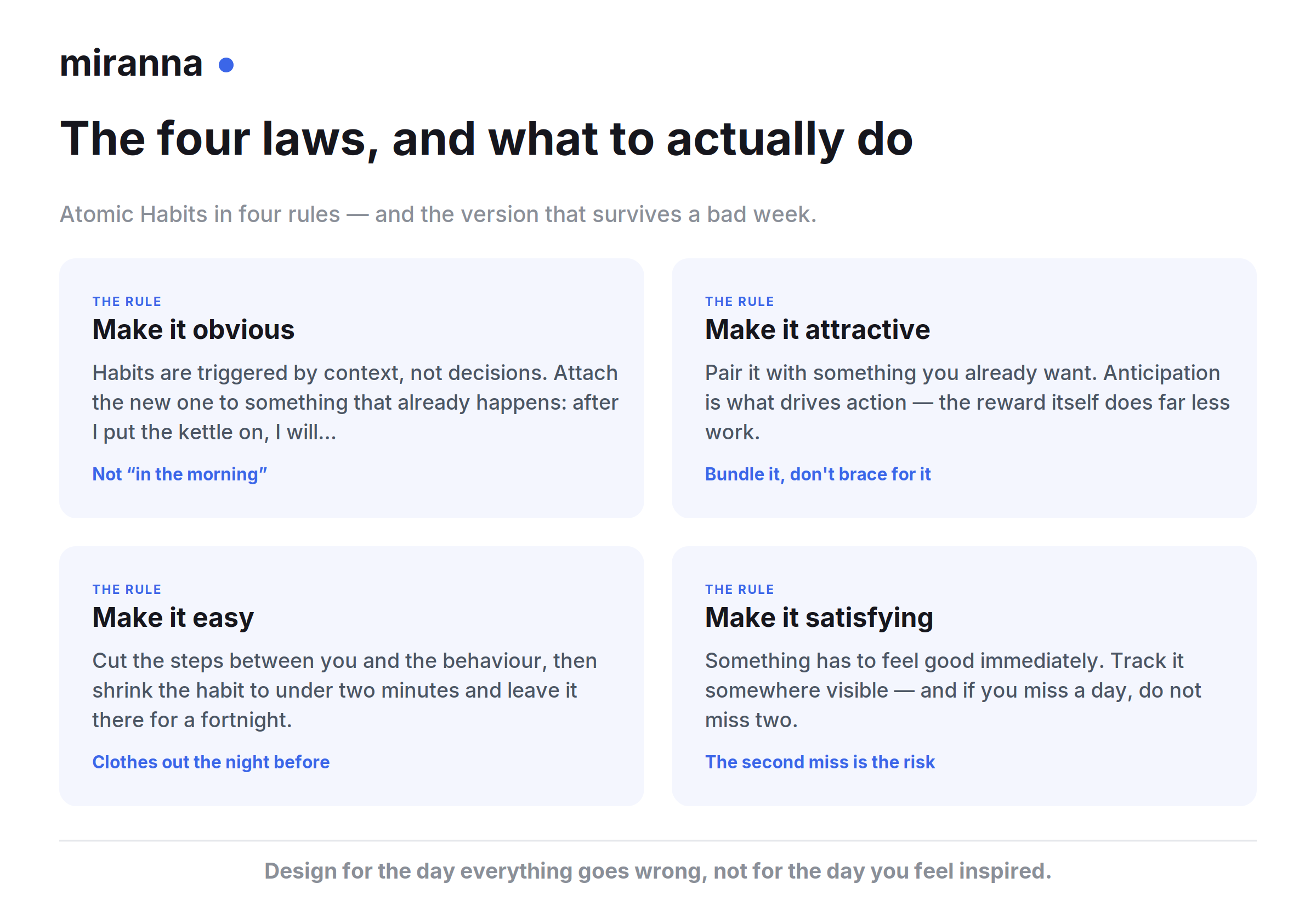
Clear frames habit formation as a loop — a cue triggers a craving, which prompts a response, which delivers a reward — and builds four practical rules on top of it.
- Make it obvious. Most habits are triggered by context, not decisions. Put the thing where you will see it, and be specific about when and where it happens.
- Make it attractive. Pair the habit with something you already want. Anticipation is what drives action, not the reward itself.
- Make it easy. Reduce the number of steps between you and the behaviour. Convenience beats motivation almost every time.
- Make it satisfying. Something has to feel good immediately, because delayed rewards do not reinforce anything in the moment.
To break a habit, you invert all four: make it invisible, unattractive, difficult and unsatisfying. Most people try only the last one, in the form of guilt, which is why it rarely works.
Why identity matters more than outcomes
This is the part of the book that does the real work, and it is the part most summaries skip.
Clear describes three layers at which change can happen: outcomes (what you get), processes (what you do), and identity (what you believe about yourself). Most people start at the outer layer and work inwards. The lasting version runs the other way.
Behaviour that conflicts with your self-image does not last. If you believe you are disorganised, systems designed for an organised person will feel like a costume you are wearing until someone notices.
So the direction of change runs the other way round: each small action is evidence about who you are. Ten minutes of writing is not progress toward a book — it is a vote for being someone who writes. Enough votes and the identity shifts, and once it does the behaviour stops requiring negotiation.
Practically: decide the type of person first, then ask what that person does daily, and make the smallest version of it unavoidable.
Habit stacking, explained
The easiest way to make a new habit obvious is to attach it to something already automatic.
The formula is simple: after [existing habit], I will [new habit]. After I pour my coffee, I will write three lines. After I close my laptop, I will set out tomorrow’s clothes.
It works because you are borrowing a cue that already fires reliably, rather than hoping to remember. The common mistake is stacking onto something vague — “in the morning” is not a cue, but “after I put the kettle on” is.
The close cousin is an implementation intention: I will [behaviour] at [time] in [place]. Deciding the when and where in advance removes the moment of negotiation, which is where most habits are actually lost.
Two smaller tools worth stealing
Temptation bundling. Pair something you should do with something you want to do, and only allow the second alongside the first. The podcast you love, but only on the walk. The show you are hooked on, but only while folding laundry. It borrows motivation from the thing that already has it.
Pointing and calling. Japanese train operators point at each signal and say aloud what they see, and error rates fall sharply. Spoken out loud, an automatic action stops being automatic. Naming what you are about to do — I am about to open the app instead of writing — is often enough to make the choice conscious again.
The two-minute rule
Start with a version of the habit that takes under two minutes.
Not as a trick to get you doing more, though that often happens. The point is that the hardest part is showing up at all, and a version small enough to be undeniable gets you to the starting line on the days when nothing else would.
Read one page. Put on the trainers. Open the document. If two minutes is genuinely all you do, that still counts as a vote for the identity — and on most days it turns into more.
{{Article Banner}}
Why progress feels invisible at first
Clear’s most consoling idea is that results lag behind effort in a way that feels like failure.
Habits compound, which means the visible payoff arrives long after the work does. There is a stretch — sometimes months — where you are doing everything right and nothing appears to be happening. Most people quit precisely there, in the flat part of the curve, one step before the change becomes visible.
Knowing the shape of the curve is what gets you through it. The unglamorous middle is not evidence that it is not working; it is what working looks like from the inside.
What Atomic Habits does not cover
The book is excellent and it has blind spots. Worth naming them, because if you follow it perfectly and it still does not stick, the problem might not be you.
It assumes your days are broadly similar. Habit stacking needs a stable cue. If your week is set by other people’s schedules, small children, or shift work, the anchor keeps moving.
It does not account for fluctuating energy. The system that works in week two of your cycle can be unusable in week four, and the same applies through perimenopause. Designing for your best day guarantees a system you will abandon.
Environment design assumes control over your environment. Easy if you live alone. Harder in a shared kitchen where four other people put things back wherever.
It is quiet on invisible labour. Much of what fills a day is not habit-shaped at all — it is remembering, coordinating and anticipating for other people. No cue redesign touches that; the fix is redistribution, and that is a conversation, not a system.
Not all brains form habits the same way. ADHD brains, in particular, often do not get the automaticity that the model depends on. If routines evaporate the moment novelty does, that is worth knowing rather than treating as a discipline failure — our guide to everyday strategies for adults with ADHD is more useful there.
If the goal-shaped approach itself is what keeps failing you, Anne-Laure Le Cunff’s argument for running small experiments instead of committing to outcomes is summarized in seven minutes and is a genuinely different model.
How to use this next week
- Pick one habit. Not four. The failure mode of this book is enthusiastic over-application.
- Shrink it until it is almost embarrassing. Two minutes. Then keep it there for a fortnight.
- Attach it to a cue that actually fires — an existing action, not a time of day.
- Remove one step of friction. Clothes out the night before, app deleted, bag by the door.
- Track it somewhere visible, and if you miss a day, do not miss two. The second miss is where habits die.
- Say the identity out loud. “I am someone who moves in the mornings” does more than a streak counter.
FAQ
What is the main idea of Atomic Habits?
That your results come from your systems rather than your goals — so lasting change comes from redesigning cues, environment and identity rather than from summoning more willpower.
What are the four laws of behaviour change?
Make it obvious, make it attractive, make it easy, and make it satisfying. To break a habit you invert each one.
What is habit stacking?
Attaching a new habit to one that already happens automatically, using the form “after [existing habit], I will [new habit].” It borrows a reliable cue instead of relying on memory.
What is the two-minute rule?
Starting with a version of the habit that takes under two minutes, because the hard part is beginning. It gets you to the starting line on the days you would otherwise skip.
Does Atomic Habits actually work?
The mechanisms — cue design, friction, immediate reward — are well supported. It works less well when your days are unpredictable, your energy fluctuates, or your brain does not build automaticity easily.
How long does it take for a habit to form?
Longer than the popular twenty-one-day figure, and it varies enormously between people and behaviours. The more useful measure is consistency rather than a number of days.
The smallest version, on the worst day
If you take one thing from the book, take this: design for the day when everything goes wrong, not for the day you are inspired.
A system that only works when you are rested, undisturbed and motivated is not a system. It is a mood. The version that survives a bad week is the one that eventually changes something.
For more on where this fits alongside other approaches, see our guide to the best productivity books.
Miranna turns books like this into short audio summaries — so you can get the argument on a walk and spend your evening actually doing the two minutes. Try Miranna free.

When the system keeps falling apart
Some habits need more than a better system. Miranna's coaches work with women on the hard, specific stuff — the routine that fell apart in week three, a week set by other people's schedules, working out what to stop doing before adding anything — at your pace, when you're ready. Browse who you'd want to talk to right in the app.
When you're ready to talk to someone
Sometimes the next step is having one good conversation. Miranna's coaches work with women navigating burnout, hormonal shifts, relationships, and the in-between moments — at your pace, when you're ready.
Browse who you'd want to talk to and book a session right in the app.



People ❤️ Miranna