Join our newsletters and be the first to receive app updates, exclusive content, and connect with a supportive network of accomplished women. Sign up today to unlock your journey to success with Miranna

Productivity Tips That Work in a Fragmented Day

The most useful productivity tips aren't about doing more in the same hours. They're about protecting attention, matching work to your energy, and cutting the number of decisions you make. Start with the three that pay off fastest: one priority a day, phone out of reach, and hard limits on when work ends.
Most productivity advice was written for a day that arrives in large, uninterrupted blocks.
That isn't the day most women get. The calendar belongs partly to other people, the interruptions are legitimate, and the invisible admin — remembering, coordinating, anticipating — never appears on anyone's task list but eats the same hours.
So these are tips built for the day you actually have.
What actually makes you more productive?
Three things, and hours worked isn't one of them.
Attention. Not time. An uninterrupted twenty minutes beats a distracted ninety, and every switch costs you a slice of focus that doesn't come back immediately.
Energy. The same task takes fifteen minutes or an hour depending on where in the day — and where in your cycle — you attempt it.
Decisions. Every choice about what to do next costs something. The most productive people aren't the most disciplined; they've just removed most of the decisions.
Judge every tip below by whether it protects one of those three.
Tips for a day you don't fully control
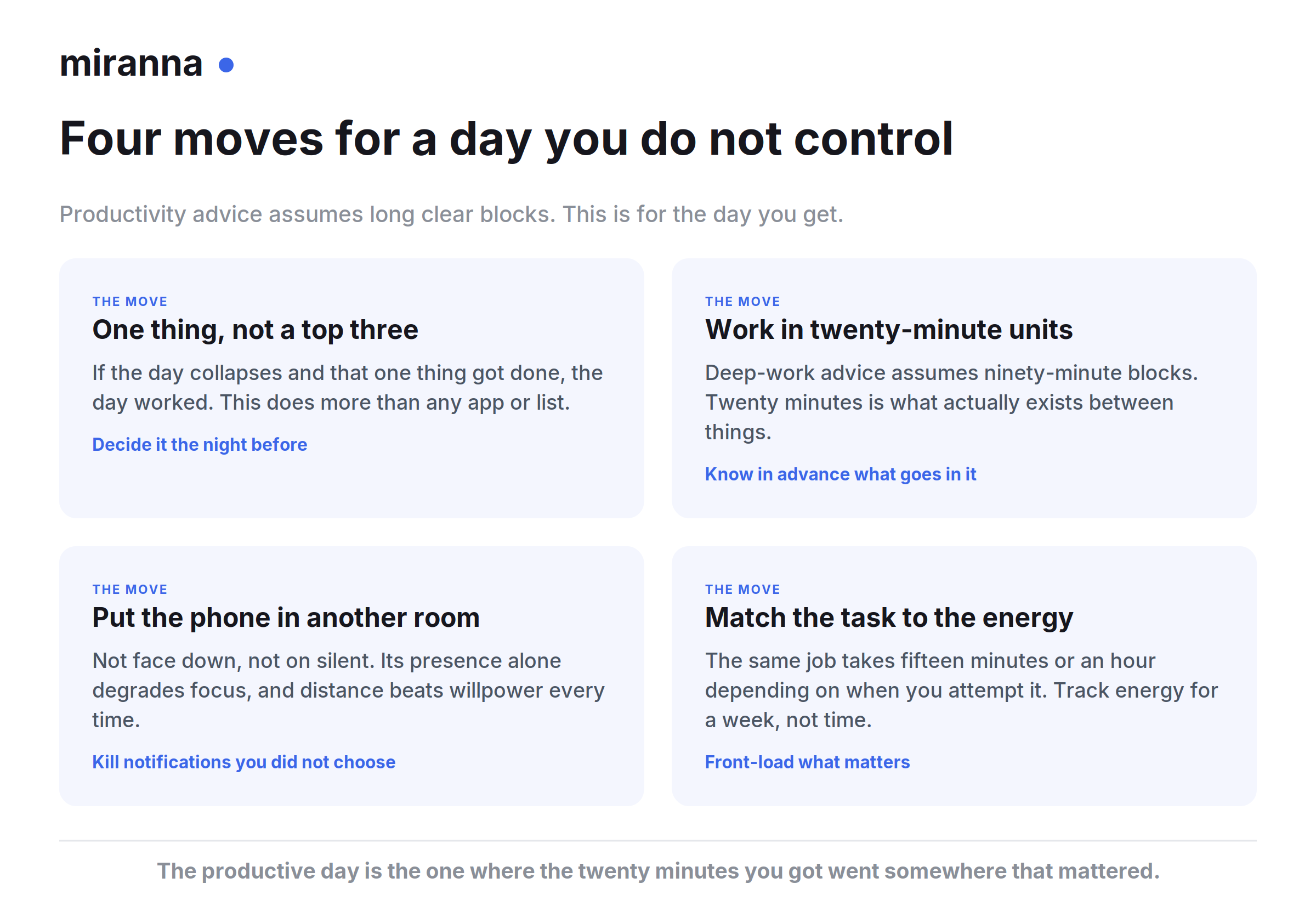
1. Choose one thing that must happen today. Not a top-three, not a prioritised list of nine. One. If the day collapses and that one thing got done, the day worked. This single habit does more than any app.
2. Work in twenty-minute units. Most advice assumes ninety-minute deep-work blocks. Twenty minutes is what actually exists between things, and a surprising amount fits in it if you know in advance what you're doing.
3. Decide the night before. Five minutes at the end of the day deciding tomorrow's one thing removes the morning's worst tax: figuring out where to start while you're still half-awake.
4. Batch the small stuff into one ugly hour. Email, forms, replies, admin — put them in a single block you don't feel good about, rather than letting them punctuate everything.
5. Leave a visible breadcrumb. Stop mid-task with a note about the next step. Picking up a thread is far cheaper than rediscovering it, and interrupted work is the normal case, not the exception.
Tips for protecting your attention
6. Put the phone in another room. Not face down. Not on silent. Another room. In the study that named this effect, nearly 800 people did worse on working-memory and reasoning tasks when their phone was on the desk than when it was in another room — face down and switched off made no difference. Distance is the only version that works.
7. Turn off notifications you didn't choose. Almost every default alert exists to serve someone else's engagement metrics. Keep messages from real people; kill the rest.
8. Give a task a container. "Write the report" is unbounded and easy to avoid. "Write the report badly for twenty-five minutes" is a thing you can start.
9. Single-task on purpose. Multitasking is task-switching with better branding, and it's most expensive precisely when your attention is already fragmented.
Dr. Andrew Huberman's practical focus tools — including why stillness helps and why fidgeting isn't the enemy — are summarized in four minutes and are the fastest payoff on this page.
{{Article Banner}}
Tips for working with your energy
10. Front-load what matters. Most people have more capacity before noon than they'll admit to using well. Move the important thing there and stop scheduling anything demanding at 4 p.m.
11. Track your energy for a week, not your time. Note when you felt sharp and when you felt like wading. Two weeks of that tells you more than any time-tracking app, and it's the input the next tip needs.
12. Work with your chronotype, not against it. Sleep specialist Dr. Michael Breus sorts people into four types — Lion, Bear, Wolf, Dolphin — and the practical point is that peak hours are not the same for everyone. The advice to do your hardest work at 6 a.m. is written by and for one of those types. Also worth knowing: he recommends waiting about ninety minutes after waking before caffeine, because your own cortisol is doing that job first.
13. Expect it to vary — including with your cycle. The week that suits hard thinking and the week that doesn't aren't random, and planning as though every week is identical is why so many systems fail. Schedule demanding work where it fits, not where the calendar looks tidy.
14. Fix sleep before optimising anything. Nothing on this page survives four broken nights. Sleep specialist Dr. Michael Breus's practical rules are summarized in eight minutes and will do more than any planner.
How do you stop wasting time?
The honest answer is that most "wasted" time isn't the problem people think it is.
Scrolling at 9 p.m. after a full day is usually depletion, not indiscipline — and the fix is rest you actually planned, rather than the scroll you fell into. What quietly costs more is different:
- Decision drag. Ten minutes deciding what to do, several times a day.
- Re-reading the same email because you opened it when you couldn't act on it.
- Half-work. Work with a phone in your hand, which delivers neither output nor rest.
- Meetings and messages that could have been three sentences.
- Redoing the mental logistics for things nobody wrote down.
Fix those and you'll find more hours than any morning routine will give you.
What to stop doing
Subtraction beats optimisation, and this is the part most productivity content leaves out because there's nothing to sell.
Stop starting new systems. A new app is a way of feeling productive without being productive. Use the plain one you already have.
Stop managing other people's reactions. Mel Robbins's argument is that a huge share of daily capacity goes into controlling how others behave and feel about us — and reclaiming it frees more hours than any calendar trick. Her case is summarized in twenty minutes.
Stop treating rest as a reward. Rest is an input. Scheduled properly it produces output; taken only after collapse it produces resentment.
Stop optimising when you're already at the edge. If you're running on empty, more systems won't help — the fix is removal. Our six-minute summary on burnout is the more useful thing to listen to at that point.
What about productive hobbies?
A common piece of advice is to make your downtime productive — learn a language, monetise the knitting.
Be careful with it. Turning every interest into an output stream is how people end up with no genuine rest at all, and the hobbies that restore you are usually the useless ones: the walk with no step target, the reading with no notes, the thing you're mediocre at.
If a hobby genuinely energises you, it's productive by the only measure that matters. Just don't let it acquire a KPI.
FAQ
What are the best productivity tips?
Pick one priority a day, work in twenty-minute units, put your phone in another room, and front-load demanding work into your best hours. Those four cover most of the value.
How can I be more productive at work?
Protect attention rather than adding hours: batch small tasks into one block, turn off notifications you didn't choose, and decide the night before what tomorrow's one thing is.
How do I stop wasting time?
Look past scrolling. Decision drag, half-work with a phone in hand, and redoing logistics nobody wrote down usually cost more hours than the obvious culprits.
How do you stay productive with an unpredictable schedule?
Assume twenty-minute units rather than long blocks, leave a note about the next step when you're interrupted, and pick one thing that must happen rather than a list.
Does time-blocking actually work?
It helps when your calendar is genuinely yours. When it isn't, tracking your energy and matching tasks to it works better than defending blocks that keep getting moved.
What if I'm exhausted rather than disorganised?
Then productivity advice is the wrong tool. Sleep, subtraction, and honest reassessment of what you're carrying come first — systems afterwards.
Protect the twenty minutes
The productive day isn't the one with four clear hours. It's the one where the twenty minutes you did get went to something that mattered, and you knew in advance what that was.
Everything else on this page is in service of that. One priority, fewer decisions, attention defended, energy respected, and a willingness to remove things rather than fit more in.
For the underlying mechanics, our guide to building a habit that survives a real week and our summary of Atomic Habits go deeper — and the best productivity books roundup has more if you want the full argument from the people who made it.
Miranna turns those books into short audio summaries — designed for the fragments of time you actually have. Try Miranna free.

When a better planner isn't the answer
Sometimes the problem isn't your system. Miranna's coaches work with women on the hard, specific stuff — a calendar that belongs to everyone else, saying a clean no to something, deciding what actually has to happen this week — at your pace, when you're ready. Browse who you'd want to talk to right in the app.
When you're ready to talk to someone
Sometimes the next step is having one good conversation. Miranna's coaches work with women navigating burnout, hormonal shifts, relationships, and the in-between moments — at your pace, when you're ready.
Browse who you'd want to talk to and book a session right in the app.



People ❤️ Miranna