Join our newsletters and be the first to receive app updates, exclusive content, and connect with a supportive network of accomplished women. Sign up today to unlock your journey to success with Miranna

Fear of Intimacy: Why Closeness Feels Unsafe


Fear of intimacy is not a fear of relationships. Most people who have it want closeness badly. What frightens them is what closeness requires — being known accurately, by someone who could then leave. So the pattern looks contradictory from the outside: you pursue, you get close, and then something in you starts backing out at exactly the moment things are going well. That timing is the tell, and it’s also the clue to what’s actually happening.
What is fear of intimacy?
Most of what follows comes from one source we summarize at Miranna — couples therapist Terry Real — plus sixty years of attachment research that arrived at a remarkably similar conclusion from a different direction.
Fear of intimacy is anxiety triggered by closeness itself rather than by any particular partner. It isn’t shyness, it isn’t introversion, and it isn’t a preference for independence. The distinguishing feature is the direction of the reaction: the closer things get, the more uncomfortable you become, and the discomfort arrives precisely when there’s nothing wrong.
It’s worth separating this from the broader category. Intimacy issues covers anything that makes closeness difficult — exhaustion, a bad year, a partner who isn’t available. Fear of intimacy is one specific cause underneath it, and it behaves differently: it doesn’t lift when circumstances improve. It tends to get worse.
What are the signs of fear of intimacy?
Rarely dramatic. Usually a pattern you can only see across several relationships, or several years of one:
- You feel relief, not disappointment, when plans get cancelled
- You find flaws in partners at the point things become serious
- You keep one foot out — a private account, an unmentioned friendship, an exit you could take
- You’re more comfortable being the one who helps than the one who needs
- Conversations about the future make you physically restless
- You’re highly self-disclosing about facts and almost never about feelings
- Someone gets close and you find yourself picking a fight over something small
That last one is the most misread. Conflict that appears from nowhere after a good weekend is rarely about the thing being argued over. It’s distance being manufactured, because distance is what feels safe.
What causes fear of intimacy?
Not a character flaw, and not usually a decision. It’s a protection that made sense once and outlived its usefulness.
A strategy learned young. Terry Real’s central observation is that each of us picked up a way of surviving conflict in childhood — going on the attack, or collapsing and appeasing. Both are fast, both feel righteous in the moment, and both put a wall exactly where intimacy would need an opening. If closeness in your early life was unpredictable, conditional or unsafe, self-protection isn’t irrational. It’s the correct answer to an old question that nobody has updated. His full case for how adults get out of that loop runs about eleven minutes in the Miranna app.
The partner you picked. Real makes an observation that lands uncomfortably: we tend to choose partners who press exactly the buttons formed in childhood. He doesn’t treat that as a mistake — it’s how the old wound becomes visible in the first place. So the person who triggers your withdrawal isn’t evidence you chose badly. More often they’re the reason you can finally see the pattern at all.
Attachment patterns. In 1987, Cindy Hazan and Phillip Shaver found that the attachment styles observed in infants show up in adult romantic relationships in roughly the same proportions — about 60% secure, 20% avoidant, 20% anxious. Avoidant attachment is the one most often mistaken for fear of intimacy, and the overlap is real: a nervous system that learned closeness leads to disappointment will shut the system down rather than risk it again. What matters more than the label is that attachment patterns are tendencies, not sentences — later relationships revise them.
Specific injuries. Betrayal, a bad ending, humiliation. One relationship where being open was used against you is enough to make openness feel expensive for a long time afterward. Psychiatrist Bessel van der Kolk describes the heavier version of this as traumatic reenactment — the unconscious pull to recreate the situations that hurt you. Not because anyone wants to be hurt again, but because the nervous system got wired around them, and the familiar can feel safer than the unknown.
Never having been shown. If nobody around you talked about their inner life, you weren’t taught something other people appear to do effortlessly. That’s a gap, not a defect.
{{Article Banner}}
Why do I pull away when things are going well?
Because that’s the moment the stakes change.
While a relationship is uncertain, you’re managing a risk you can see. Once it’s going well, the risk becomes invisible and much larger: you now have something to lose, and the part of you that learned to see closeness as dangerous starts looking for the exit while there’s still time.
It usually shows up as a story rather than a feeling. They’re not quite right for me. I need more space. Something’s off, I can’t explain it. The stories are convincing because they’re built from real details — everyone has flaws to notice if you go looking.
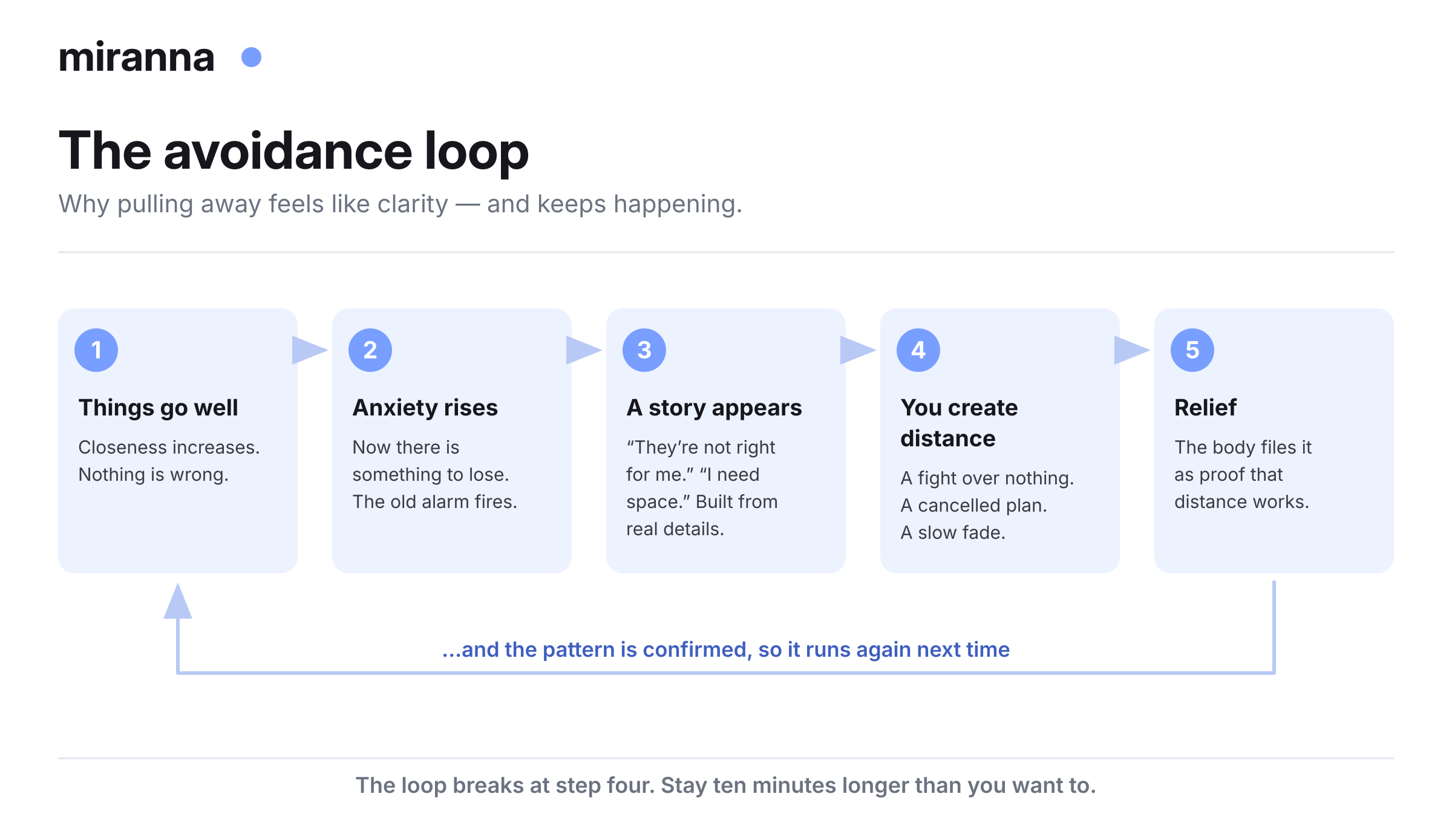
The test that cuts through it: ask what changed. If the doubts arrived after they got closer rather than after they did something, the doubts are probably about closeness. That’s not proof the relationship is right. It’s proof the timing deserves scrutiny before the conclusion does.
How to overcome fear of intimacy
- Name the pattern out loud, to yourself first. “I get uncomfortable when things go well” is a sentence that takes most of the power out of the reaction, because unnamed patterns run automatically and named ones can be questioned.
- Practice small disclosures on purpose. Not the big confession. One true thing a day that costs a little to say — what actually annoyed you, what you’re worried about, what you liked. The nervous system learns from repetition, not intensity.
- Stay ten minutes longer than you want to. The urge to leave the conversation, the room, the relationship peaks and then drops. Most people act on the peak and never find out about the drop.
- Tell your partner what’s happening, not why. You don’t need a full explanation to say “I get twitchy when things are good, it isn’t about you, don’t take the distance personally.” That single sentence prevents an enormous amount of damage.
- Notice what you do with need. People who fear intimacy are usually excellent at being needed and terrible at needing. Ask for something small and let someone do it for you.
- Get help if there’s a real injury underneath. Where the pattern traces back to trauma, abuse, or a loss that hasn’t been processed, this stops being a self-improvement project. A therapist is the right person for that work, and going is not an admission of anything.
How do you love someone who fears intimacy?
Carefully, and without making yourself smaller.
Pursuing harder is the intuitive response and the counterproductive one — pressure confirms the underlying fear, and the person withdraws further. So does the opposite extreme: going silent to give space until the space becomes the relationship.
What tends to work is steadiness. Stay consistent, keep your own life full, don’t reward withdrawal with panic or punish it with coldness. Say clearly what you need without demanding they produce it immediately. And keep the difference in view between someone who is frightened and working on it, and someone who is simply unavailable — the first is a process, the second is a fact.
There’s a limit worth naming. Waiting indefinitely for someone who won’t acknowledge the pattern isn’t patience; it’s a slow way to end up lonely inside your own relationship. Deciding how long you’re willing to wait is your right, not a betrayal.
FAQ
Is fear of intimacy the same as intimacy issues?
No. Intimacy issues is the umbrella — anything making closeness hard, including stress or circumstance. Fear of intimacy is one cause underneath it, and it’s identifiable by its timing: it flares when things are going well rather than badly.
Can fear of intimacy go away?
It softens, reliably, with practice and with a relationship where openness keeps not being punished. It rarely disappears on its own, because avoidance is self-reinforcing — every time you withdraw and feel relief, the pattern is confirmed.
Is fear of intimacy the same as avoidant attachment?
They overlap heavily but aren’t identical. Avoidant attachment is a broad relational style; fear of intimacy is the specific anxiety that closeness produces. Someone can have an avoidant style and, with a patient partner and some self-awareness, very little fear left.
Why do I sabotage relationships when they get serious?
Usually because seriousness is the point at which loss becomes possible. Ending it yourself is the only version where you control the timing — which feels like protection and functions like a repeat.
When should I see a professional about this?
When the pattern has cost you relationships you wanted, when it traces back to something frightening in your history, or when you can see it clearly and still can’t interrupt it. Coaching helps with the practice; a therapist is the right place for trauma. This article covers the psychology of the pattern, not treatment.
Fear of intimacy is a defense that once made sense and now costs more than it protects. It doesn’t come apart in one conversation — it comes apart in small disclosures that keep not going badly. Say one true thing this week and stay in the room afterward.

When you'd rather not figure it out alone
Miranna's coaches work with women on closeness, self-protection, and the patterns that are easier to see than to interrupt — one session at a time.
When you're ready to talk to someone
Sometimes the next step is having one good conversation. Miranna's coaches work with women navigating burnout, hormonal shifts, relationships, and the in-between moments — at your pace, when you're ready.
Browse who you'd want to talk to and book a session right in the app.


People ❤️ Miranna