Join our newsletters and be the first to receive app updates, exclusive content, and connect with a supportive network of accomplished women. Sign up today to unlock your journey to success with Miranna

Emotional Intimacy: How to Build It With Your Partner


Emotional intimacy is the sense that you can be fully yourself with your partner — messy thoughts, unflattering feelings, real needs — and be met rather than managed. It isn’t built in big conversations or on weekends away. It’s built in small, repeated moments when one of you reaches out and the other turns toward instead of away. Which is oddly good news: if closeness has quietly drained out of your relationship, it drained through those same small moments, and that’s exactly where it comes back.
What is emotional intimacy?
Everything below comes out of the book and podcast summaries we make at Miranna — here, mostly from couples therapist Terry Real, with a detour into Dr. Karen Gurney’s work on desire.
Emotional intimacy is mutual, felt safety: the confidence that you can show your partner something true about your inner life and have it received with interest rather than judgment, correction, or distance. It’s not the same as physical intimacy, and it’s not the same as time together. Plenty of couples share a bed, a mortgage, and a calendar and have almost no emotional intimacy, because nothing that costs anything to say ever gets said.
Three things have to be present:
- Disclosure — one person says something slightly risky.
- Responsiveness — the other turns toward it rather than away from it.
- Repetition — it happens often enough that both nervous systems learn it’s safe.
Remove any one of the three and closeness stalls, no matter how much love is in the room.
What does emotional connection actually mean?
Emotional connection is the experience of registering with someone — your inner state lands with them, and it matters to them. In practice it depends less on deep understanding than on plain attention.
Couples therapist Terry Real describes a relationship as an ecosystem rather than two people negotiating across a table. You’re never really choosing between your interests and your partner’s; you’re either feeding the thing you both live inside or draining it. That reframe changes what an argument is for — and if you want his full case on how couples keep closeness alive over decades, you can hear it summarized in about eleven minutes in the Miranna app.
The distinction worth holding: connection is a moment, intimacy is the pattern those moments add up to. You can have a genuinely connected evening and still be in a low-intimacy marriage. What builds intimacy is frequency, not intensity.
{{Article Banner}}
Why does emotional intimacy fade?
Rarely because of one event. Real’s model is that every relationship cycles through harmony, then disharmony, then repair — and the cycle is normal. Couples in trouble aren’t the ones who fall out of harmony. Everyone does. They’re the ones who stop completing the loop back to repair. Unrepaired disharmony doesn’t stay hot; it cools into politeness, then distance.
What gets in the way, in his framing, is the part of us that learned in childhood how to survive conflict — by going on the attack, or by collapsing and appeasing. It’s fast, it feels righteous, and it’s terrible at intimacy. Both moves protect you from your partner at the exact moment closeness would require the opposite.
Physical closeness usually drains at the same time. Psychosexologist Dr. Karen Gurney points to what she calls sexual currency: the ordinary, non-goal-oriented touch a couple keeps in circulation — a kiss that isn’t a question, a hand on the back, flirting with no destination. When that quietly disappears, sex stops being a continuation of daily closeness and becomes a separate, loaded negotiation. Her argument for why long-term desire behaves the way it does runs about nine minutes if you’d rather listen than read — and we unpack the mechanics of it in how desire actually works.
How do you emotionally connect with your partner?
Start smaller than you think. In John Gottman’s Love Lab research, a bid is any small attempt at contact: “look at this,” a sigh, a question about your day. You can turn toward it, turn away from it, or turn against it. Following newlywed couples for six years, Gottman found that those still together had turned toward each other’s bids around 86% of the time, while those who divorced averaged 33%.
Nothing in that is dramatic. It means connection is mostly a response rate — and a response rate is something you can change this week.
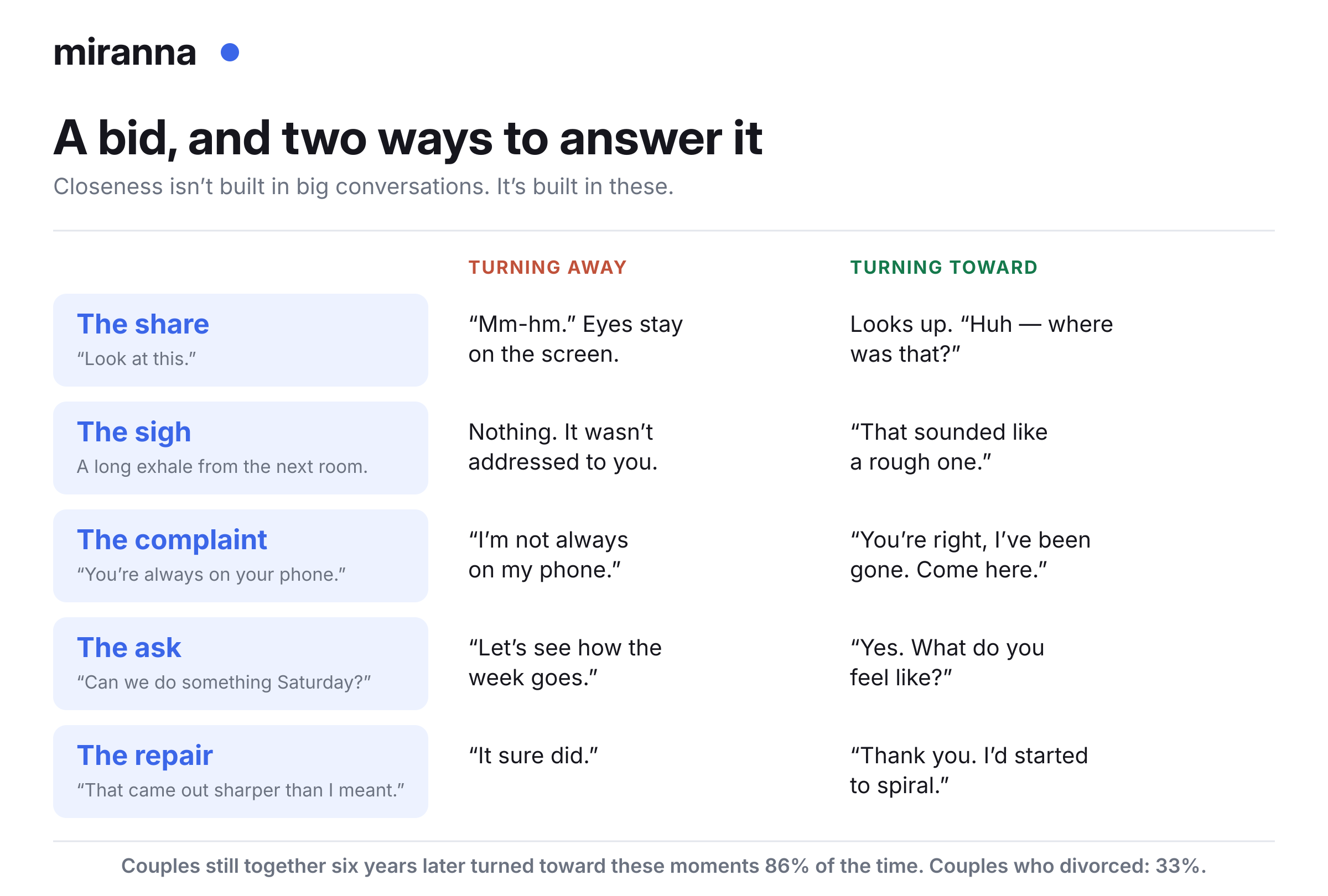
Three things that raise yours:
- Answer the bid, not the content. “Look at this bird” is never about the bird. It’s are you there? You don’t need to be interested in the bird.
- Say the thing under the complaint. “You’re always on your phone” is a bid in disguise. “I miss you” gets a different response, because it gives your partner something to move toward instead of defend against.
- Repair out loud, and small. “That came out sharper than I meant” takes four seconds and closes a loop that would otherwise sit open for days.
How to increase intimacy in a relationship
Five practices that do more than they look like they should:
- Trade the daily download for a daily check-in. Logistics aren’t connection. One question a day about the inside of their life — not the outside — changes the ratio.
- Put one conversation a week off the schedule track. No calendar, no kids, no money.
- Bring back touch that isn’t a question. Sexual currency is rebuilt in seconds, not evenings.
- Convert complaints into requests. A complaint says what’s wrong; a request says what you want. Only one of them is actionable, and only one of them is intimate.
- Repair fast rather than well. A quick, imperfect repair beats the perfect conversation you’re saving for a calmer week.
If you want structured practices to work through together, we have a fuller set in intimacy exercises for couples.
What are good deep relationship questions for couples?
Questions work because they force disclosure and responsiveness at the same time. In 1997, psychologist Arthur Aron sat pairs of strangers down with 36 questions that escalate from light to personal; 45 minutes later, many reported a level of closeness comparable to their closest relationships. The mechanism isn’t romantic — it’s structural. Gradual, reciprocal self-disclosure, in that order.
The same ramp works for couples who already know each other. Start where it’s easy, then climb:
- What have you been thinking about lately that you haven’t told me?
- When in the last month did you feel closest to me?
- What do you need more of from me that you’ve stopped asking for?
- What are you quietly afraid of right now?
- If we had one free year together, what would you want to do with it?
The rule that makes it work: whoever answers goes second, too. One-way questions are an interview, not intimacy. For a longer sequence to work through over several evenings, see our questions for couples to reconnect.
FAQ
What’s the difference between emotional intimacy and physical intimacy?
Emotional intimacy is being known; physical intimacy is being touched. They feed each other — but one doesn’t automatically produce the other, and couples commonly have plenty of one and very little of the other.
Can you have emotional intimacy without physical intimacy?
Yes, and many long-term couples do for stretches — after a birth, during illness, through a hard year. It becomes a problem when it stops being a season and no one names it.
What causes a loss of emotional connection in a relationship?
Usually accumulation, not rupture: unrepaired small conflicts, bids that stopped getting answered, and a slow shift into managing a household instead of knowing a person.
What questions deepen intimacy fastest?
The ones that ask for a feeling rather than a fact, and that you’re willing to answer yourself. “What was the hardest part of your week?” outperforms “how was your week?” almost every time.
How long does it take to rebuild emotional intimacy?
Days to feel the first shift, months for it to hold. Response rate changes quickly; trust that the change is real takes longer.
How do I connect with a partner who shuts down?
Lower the stakes and shorten the ask. Shutting down is usually overwhelm, not indifference. If the pattern is entrenched and one of you feels persistently unsafe or hopeless, that’s worth working through with a couples therapist rather than alone — this article isn’t a substitute for that. If the wall shows up around closeness itself rather than around conflict, our pieces on fear of intimacy and intimacy issues go deeper.
Emotional intimacy isn’t a trait some couples have and others don’t. It’s a response rate, a repair habit, and a willingness to say the slightly risky thing before it becomes the unsayable one. Pick the smallest of those and start there tonight.

When you'd rather not figure it out alone
Miranna's coaches work with women on closeness, conflict, and rebuilding connection — one conversation at a time.
When you're ready to talk to someone
Sometimes the next step is having one good conversation. Miranna's coaches work with women navigating burnout, hormonal shifts, relationships, and the in-between moments — at your pace, when you're ready.
Browse who you'd want to talk to and book a session right in the app.



People ❤️ Miranna