Join our newsletters and be the first to receive app updates, exclusive content, and connect with a supportive network of accomplished women. Sign up today to unlock your journey to success with Miranna

Solitude vs. Loneliness: The Difference Between Being Alone and Being Lonely

.jpeg)
You can spend a quiet Saturday entirely by yourself and end it feeling refreshed and whole. You can also spend that exact same Saturday alone and end it feeling hollow and unseen. Same circumstances, opposite experiences. The difference between them is the difference between solitude and loneliness—and learning to tell them apart is one of the most useful things you can do for your wellbeing.
We tend to treat “alone” and “lonely” as the same word wearing two outfits. They’re not. One is a state; the other is a feeling. This guide untangles them: what each one actually is, how to tell which you’re feeling, and what each one needs from you.
What’s the Difference Between Solitude and Loneliness?
The short version: solitude is being alone and feeling fine about it. Loneliness is feeling disconnected, whether or not anyone else is around.
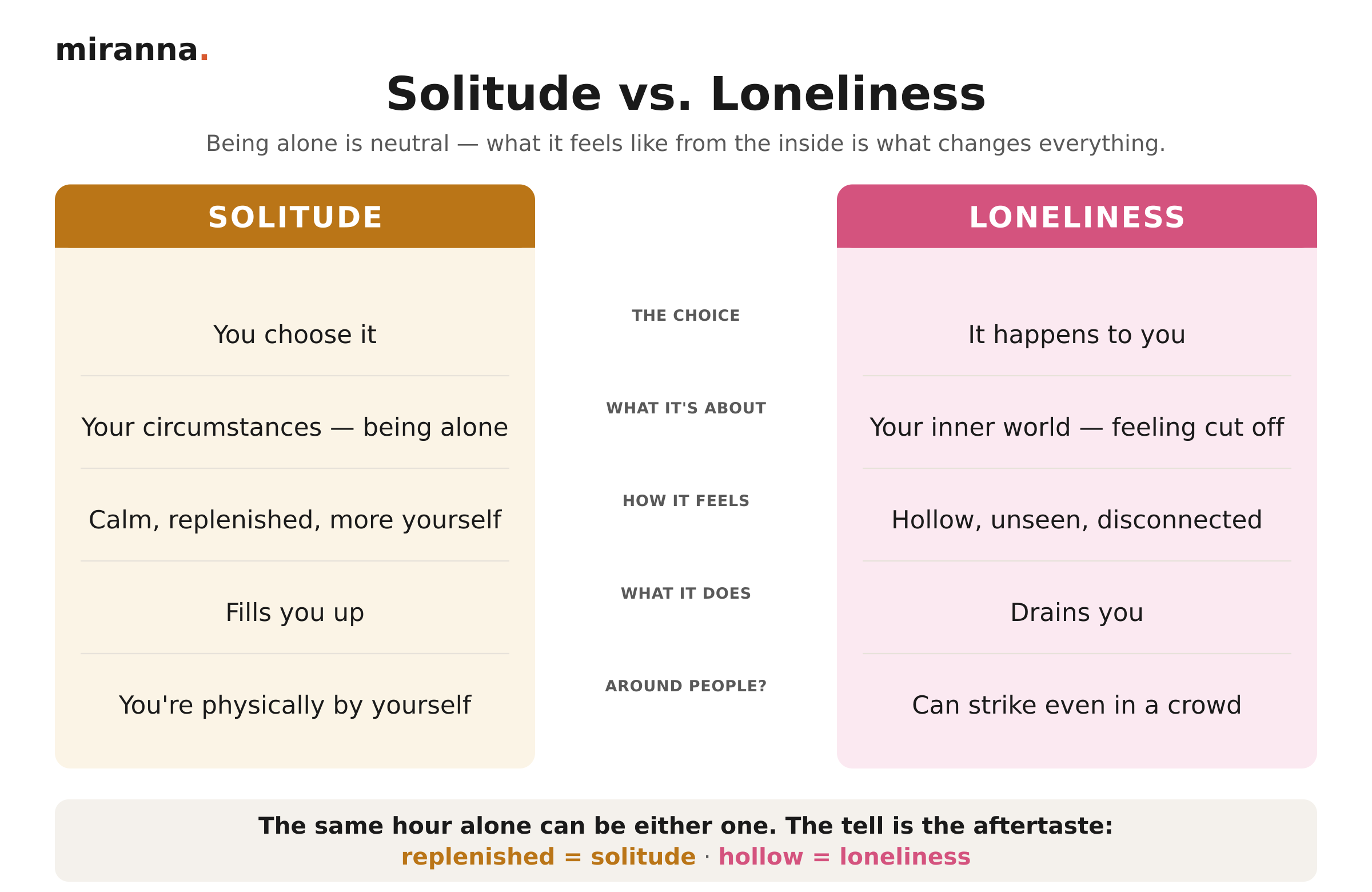
Solitude is about your circumstances—you’re physically by yourself. Loneliness is about your internal experience—a painful gap between the connection you have and the connection you want. That’s why the two come apart so easily. You can have rich solitude with no loneliness at all, and you can sit in a crowded room feeling profoundly lonely.
Put simply: solitude is something you choose and it fills you up; loneliness is something you suffer and it drains you. Being alone is neutral. What turns it into solitude or loneliness is how it feels from the inside.
What Is Solitude, Really?
Solitude is intentional, restorative time with yourself. It’s the long bath, the solo walk, the morning coffee before anyone else is awake, the project you lose hours in. You chose it, and you come out the other side steadier than you went in.
Healthy solitude does real work. It’s where you hear your own thoughts under the noise, recharge if socializing tires you, and get reacquainted with what you actually want—rather than what everyone around you wants. Far from a consolation prize for people without plans, it’s a skill, and the people who have it tend to be less dependent on others for their sense of okayness.
What Is Loneliness, Really?
Loneliness is the distressing sense that your need for connection isn’t being met. It’s not a fact about how many people you know; it’s a feeling about how seen and understood you are.
That’s why it doesn’t track with your social calendar. You can feel it after a busy day full of people, because none of those interactions touched anything real. It tends to show up as a low, flat ache, a sense of being on the outside of things, or a quiet conviction that no one really knows you. If you want to get specific about how it shows up, our guide to the signs of loneliness breaks them down—and if you’re ready to ease it, how to cope with loneliness is the full playbook.
Can You Be Alone Without Being Lonely?
Absolutely—and it’s one of the clearest signs of a healthy relationship with yourself. Plenty of people live alone, travel alone, or spend most weekends alone and feel content, even energized. For introverts especially, alone time isn’t a deficit; it’s how the tank gets refilled.
The key ingredient is choice. Alone time you’ve chosen, that leaves you feeling restored, is solitude—not loneliness. So if you’ve ever felt vaguely guilty for wanting more time to yourself, you can let that go. Wanting solitude isn’t antisocial or a sign that something’s wrong. It’s a legitimate need, and meeting it usually makes you better company when you do show up for others.
Can You Be Lonely Without Being Alone?
Yes—and this is the version that confuses people most. You can be partnered, surrounded by coworkers, in a packed group chat, and still feel deeply lonely. Connection isn’t about proximity. It’s about depth.
When the people around you only engage with you on the surface—logistics, small talk, the weather—the part of you that wants to be truly known stays hungry. “Lonely in a crowd” isn’t a contradiction; it’s just loneliness revealing what it’s actually about. More people won’t fix it. A little more honesty and depth with a few of them might.
How Do You Tell Which One You’re Feeling?
Here’s a simple gut check. After a stretch of time alone, ask yourself one question: do I feel replenished, or do I feel hollow?
- Replenished, calm, more yourself → that was solitude. You might simply need more of it.
- Hollow, restless, aching for connection → that’s loneliness. It’s a signal to reach out, not to retreat further.
The same hour by yourself can be either one. The tell isn’t the clock or the calendar—it’s the aftertaste. Learning to read that aftertaste lets you respond to what you actually need, instead of forcing yourself to socialize when you need rest, or isolating further when you actually need people.
Why Does Being Alone Feel Scary at First?
If solitude makes you anxious rather than calm, you’re not broken—you’re human. We’re wired for connection, so being alone can register, on some old instinctive level, as unsafe. On top of that, quiet removes the distractions that keep harder feelings at bay, so the first thing solitude surfaces is sometimes discomfort.
The reassuring part: this usually softens with practice. Solitude is a muscle. Start small—ten unhurried minutes with no phone—and the unease tends to give way to something that feels less like emptiness and more like spaciousness.
{{Article Banner}}
How Do You Build a Better Relationship With Being Alone?
You grow into solitude the same way you grow into anything—gently and on purpose. Start by choosing it instead of just ending up in it: plan a small ritual that’s yours alone, like a walk, a bath, or a slow coffee. Do something absorbing rather than just sitting in the silence at first. And notice how you feel afterward, so you start to associate alone time with restoration rather than dread.
This matters beyond comfort. When you can be content on your own, you stop clinging to relationships out of fear of being alone, and connection comes from a steadier, freer place. If the deeper issue is that you’d genuinely like more people in your life, that’s a different project—and our guide to making friends as an adult is where to start.
When Is It More Than Loneliness?
Most loneliness eases with connection and time, and most discomfort with solitude eases with practice. But if a heavy, lonely feeling lingers for a long stretch and comes wrapped in hopelessness or a persistent low mood—or if the urge to be alone is really a pull to withdraw from everyone—that’s worth treating as more than a passing mood.
That’s not weakness; it’s information. Talking to a therapist or your doctor is an ordinary, sensible step, the same way you’d see someone about a pain that won’t go away. You don’t need to reach any threshold of “bad enough” first.
Alone, On Your Own Terms
The goal was never to be alone less or alone more. It’s to make peace with both—to enjoy your own company when you have it, and to reach for connection when you need it. Once you can tell solitude and loneliness apart, you stop fighting the wrong battle.
If learning to enjoy your own company is the part you’d like help with, Miranna turns the best books and podcasts on solitude and connection into short audio summaries—small, kind ideas you can take in on a quiet evening and use the next day.
FAQ
What is the difference between solitude and loneliness?
Solitude is being alone by choice and feeling content—it restores you. Loneliness is the distressing feeling that you lack the connection you want, and it can happen whether you’re alone or surrounded by people. Solitude is about your circumstances; loneliness is about your inner experience.
Can you be alone and not lonely?
Yes. When alone time is chosen and leaves you feeling restored rather than empty, it’s solitude, not loneliness. Many people—introverts especially—need regular alone time to recharge and feel completely content in their own company.
Can you be lonely even when you’re not alone?
Definitely. Loneliness is about depth of connection, not the number of people around you. You can feel lonely in a marriage, on a busy team, or in a full group chat if those relationships stay on the surface and you don’t feel truly known.
Is wanting to be alone a sign of depression?
Wanting solitude is normal and healthy—it’s how many people recharge. The difference is in how it feels: chosen alone time that restores you is solitude, while a pull to withdraw from everyone, paired with a persistent low mood or hopelessness, is worth talking through with a professional.
How do I know if I’m lonely or just an introvert?
Introversion is about how you recharge; loneliness is about an unmet need for connection. The test is the aftertaste: if time alone leaves you restored and content, you’re likely a happy introvert. If it leaves you hollow and wishing for connection, that’s loneliness—and the two can absolutely coexist.

You don’t have to figure this out alone.
When you’re ready, Miranna’s coaches can help you build a kinder relationship with solitude—and ease loneliness when it’s there. Browse who you’d want to talk to, and start with one good conversation.
When you're ready to talk to someone
Sometimes the next step is having one good conversation. Miranna's coaches work with women navigating burnout, hormonal shifts, relationships, and the in-between moments — at your pace, when you're ready.
Browse who you'd want to talk to and book a session right in the app.


People ❤️ Miranna