Join our newsletters and be the first to receive app updates, exclusive content, and connect with a supportive network of accomplished women. Sign up today to unlock your journey to success with Miranna

How to Talk to Your Partner About Sex


The conversation goes wrong in predictable ways: it happens in bed, right after a refusal, and it opens with what isn’t working. Reverse all three and most of the difficulty disappears. Talk with your clothes on, at a time when nobody has just been turned down, and start with something you like rather than something you don’t. The rest is vocabulary — and most people were never given any.
Why is this so hard to talk about?
This piece draws on two summaries in the Miranna app: journalist Katherine Rowland, who spent five years interviewing women about their sex lives, and psychosexologist Dr. Karen Gurney, who works with couples on exactly this.
Three things stack up.
Nobody taught you the words. Rowland’s finding is that most women can’t describe their own physical sensations with any precision — not because they can’t feel them, but because no one ever asked them to try. You end up with “good,” “fine,” and “nice” to describe an entire category of experience. That’s not enough information for anyone to act on.
Any comment reads as a verdict. Sex is one of the few areas where feedback lands as a judgment of the person rather than the activity. “I’d like it slower” gets heard as “you’re bad at this,” which is why so many people say nothing for years.
The timing is almost always wrong. The conversation tends to happen in bed, at night, in the immediate aftermath of a rejection or a disappointment. That’s the worst possible moment, and it’s when nearly everyone tries.
When and where to have it
Gurney is unambiguous: talk with your clothes on. Not in bed. Not at bedtime. Not directly after sex, and definitely not directly after someone said no.
A walk works. A car works — side by side, no eye contact required, and a natural end point. Sunday afternoon works. What all of those have in common is that nobody is exposed, nobody has just been refused, and either person can end it without leaving a room.
Give it a shape, too. “Can we talk about sex for ten minutes sometime this week?” lets your partner arrive prepared rather than ambushed. Unannounced serious conversations put people on the defensive before a word of content has been said. Gurney’s full case for how desire behaves in long relationships runs about nine minutes in the app.
{{Article Banner}}
How do you start the conversation?
Open with something that’s working. Not as a manipulation tactic — because it’s true, it’s usually never been said, and it establishes that this is a conversation about making something good better rather than an audit.
Then one specific thing you’d like more of. Specific is the whole game here: a request that can be pictured can be granted, and a general one can only be agreed with vaguely and then forgotten.
Three openers that tend to work:
- “I’ve been thinking about our sex life and I want more of it, not less. Can we talk about it this week?”
- “There’s something I like a lot that we don’t do very often. Can I tell you what it is?”
- “I want to be better at telling you what I want. I’m not great at it yet.”
The last one is the strongest, and the most underused. It puts the difficulty on you rather than on them, which means nothing has to be defended.
What to avoid opening with: “We need to talk about our sex life.” Nobody in history has heard that sentence and felt relaxed.
How to give feedback without it landing as criticism
Terry Real’s framing applies here more than anywhere: teach rather than correct. People learn through encouragement and shut down under shame, and shame in this particular context shuts things down for a long time.
Practically, that means describing what works for you instead of what doesn’t work about them:
- “I love it when you go slower there” rather than “you go too fast”
- “It really works for me when you ask” rather than “you never ask”
- “More pressure, right there” rather than “that’s not doing anything”
Same information, entirely different reception. The first version gives your partner something to do. The second gives them something to feel bad about.
And build the vocabulary before you need it. Rowland’s exercise is to practise naming sensations with precision — warm, buzzy, heavy, pulsing, too light, stay there — in your own head first. You cannot advocate for an experience you have no words for.
How to say no without it landing as rejection
This is the part almost nobody is taught, and it does more damage than anything else on this list.
Rowland puts it simply: “not tonight” is a start, and “not that, but this” is better. The difference is that the first one closes the whole subject and the second one keeps a door open.
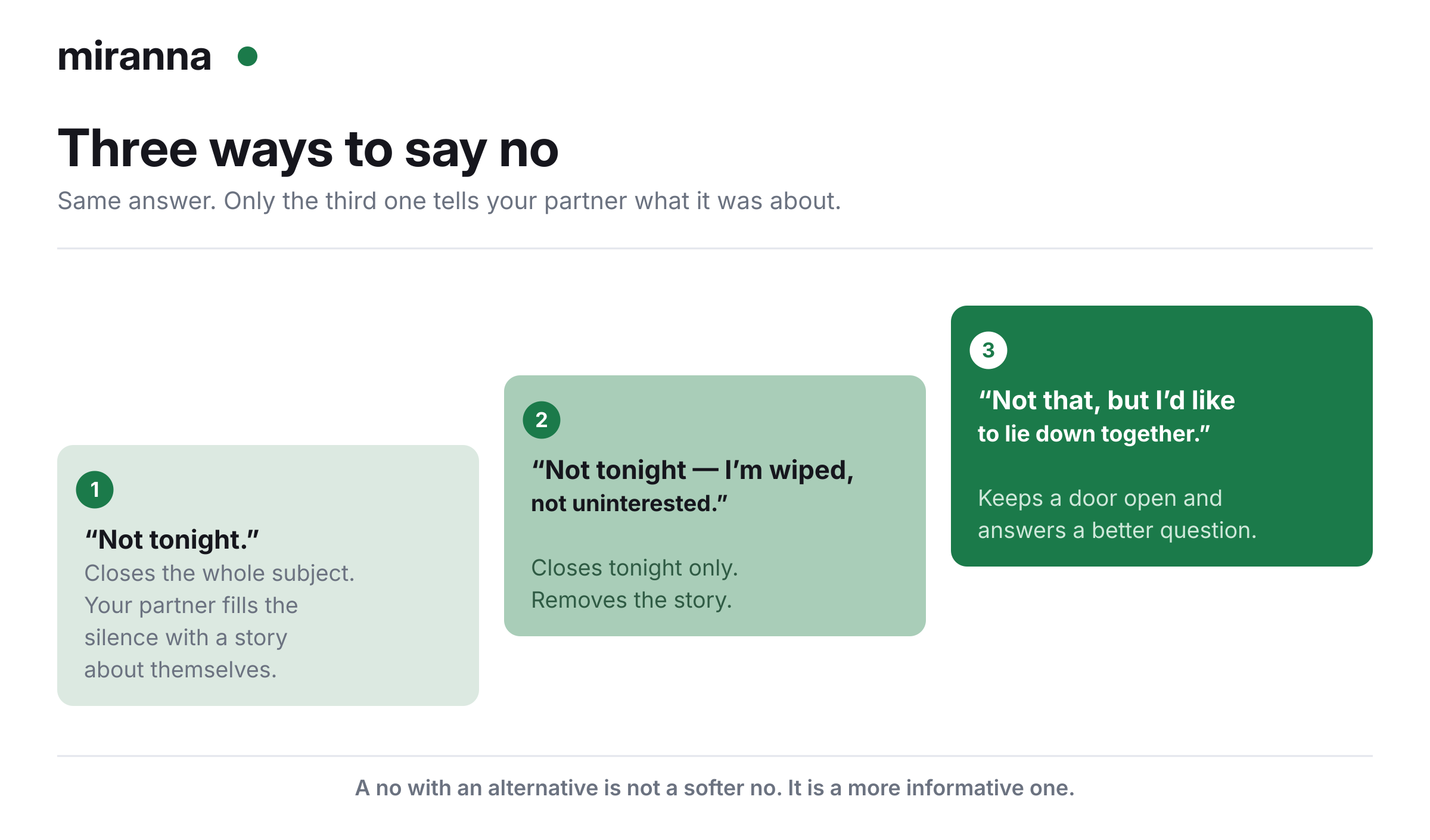
A refusal with an alternative isn’t a softer no. It’s a more informative one. It tells your partner that the answer is about tonight, or about that specific thing, rather than about them — which is what they will otherwise assume.
The higher-desire partner has work here too. Gurney’s advice is to stop keeping score: counting requests and refusals turns sex into a ledger, and nobody wants debt sex. A no that gets treated as an event will produce fewer honest yeses, not more.
What if your partner reads your body wrong?
Worth naming, because it causes a specific and common misunderstanding.
Emily Nagoski describes arousal non-concordance: the physical signs of arousal and the subjective feeling of wanting sex don’t reliably line up. A body can respond while the mind is entirely elsewhere. This works in both directions, and it means physical signals are unreliable evidence of desire in anyone. Her full explanation runs about fourteen minutes in the app.
The practical upshot: words beat inference. If your partner has been reading your body and drawing conclusions, telling them plainly that it doesn’t work that way — for anyone, not just you — takes an enormous amount of unnecessary interpretation out of your sex life.
What if it’s gone badly before?
Then the goal for the first attempt isn’t resolution. It’s establishing that the subject can be raised at all without a fight.
Keep it short and end it early, while it’s still going well. Ten good minutes that stop cleanly do more for the next conversation than forty minutes that end badly.
If it consistently goes wrong — if raising it reliably produces defensiveness, a shutdown, or an argument that lasts days — that’s a pattern rather than a wording problem, and a couples therapist or sex therapist is the right next step. Some conversations need a third person in the room the first few times.
FAQ
How do I tell my partner what I want without hurting their feelings?
Lead with what you like, ask for one specific thing, and phrase it as what works for you rather than what they get wrong. Timing matters more than wording: fully dressed, not at bedtime.
What if I don’t know what I want?
Common, and worth working out alone first — you can’t ask for what you haven’t found. How to have an orgasm covers that, and how to spice up your relationship has a structured exercise for identifying it.
How often should couples talk about sex?
Less often than you’d think, if the exchanges are good. A short check-in every few weeks beats one annual summit. What matters is that the subject stays raiseable.
My partner shuts down whenever I bring it up. What now?
Shorten the ask and lower the stakes — one sentence, one specific request, at a neutral moment. If that pattern holds regardless, it’s worth taking to a professional. Our piece on communication exercises for couples covers the groundwork that makes these conversations possible.
Is it normal to feel embarrassed talking about this?
Yes, and it doesn’t fully go away — it just stops being a reason not to. Even the couples with genuinely good sex lives report that these conversations take deliberate effort.
Clothes on, no recent refusal in the air, start with what you like, ask for one thing. That’s the whole method, and it works far better than the version most people attempt at midnight.

When you'd rather not figure it out alone
Miranna's coaches work with women on saying what they want, setting limits, and the conversations that keep getting postponed — one session at a time.
When you're ready to talk to someone
Sometimes the next step is having one good conversation. Miranna's coaches work with women navigating burnout, hormonal shifts, relationships, and the in-between moments — at your pace, when you're ready.
Browse who you'd want to talk to and book a session right in the app.



People ❤️ Miranna