Join our newsletters and be the first to receive app updates, exclusive content, and connect with a supportive network of accomplished women. Sign up today to unlock your journey to success with Miranna

Menopause and Anger Toward Your Husband: Why It Happens


Anger toward a partner during menopause is extremely common. Falling progesterone weakens the brain’s calming system while poor sleep lowers your threshold — so irritation that used to pass now surfaces. But the anger usually lands on real things: unequal load, unnoticed effort, and years of accommodation you no longer have the capacity to keep up.
You are furious at the way he breathes. At the question about where the scissors are. At the fact that he asked what is for dinner in a tone that was, objectively, neutral.
And underneath it, a thought you have not said out loud: I am not sure I like him anymore.
That thought is frightening enough that most women do not google it until 11 p.m., alone. So let us take it seriously rather than reassuringly.
Why does menopause make you angry at your husband specifically?
Because he is the safest target, and because he is the closest one.
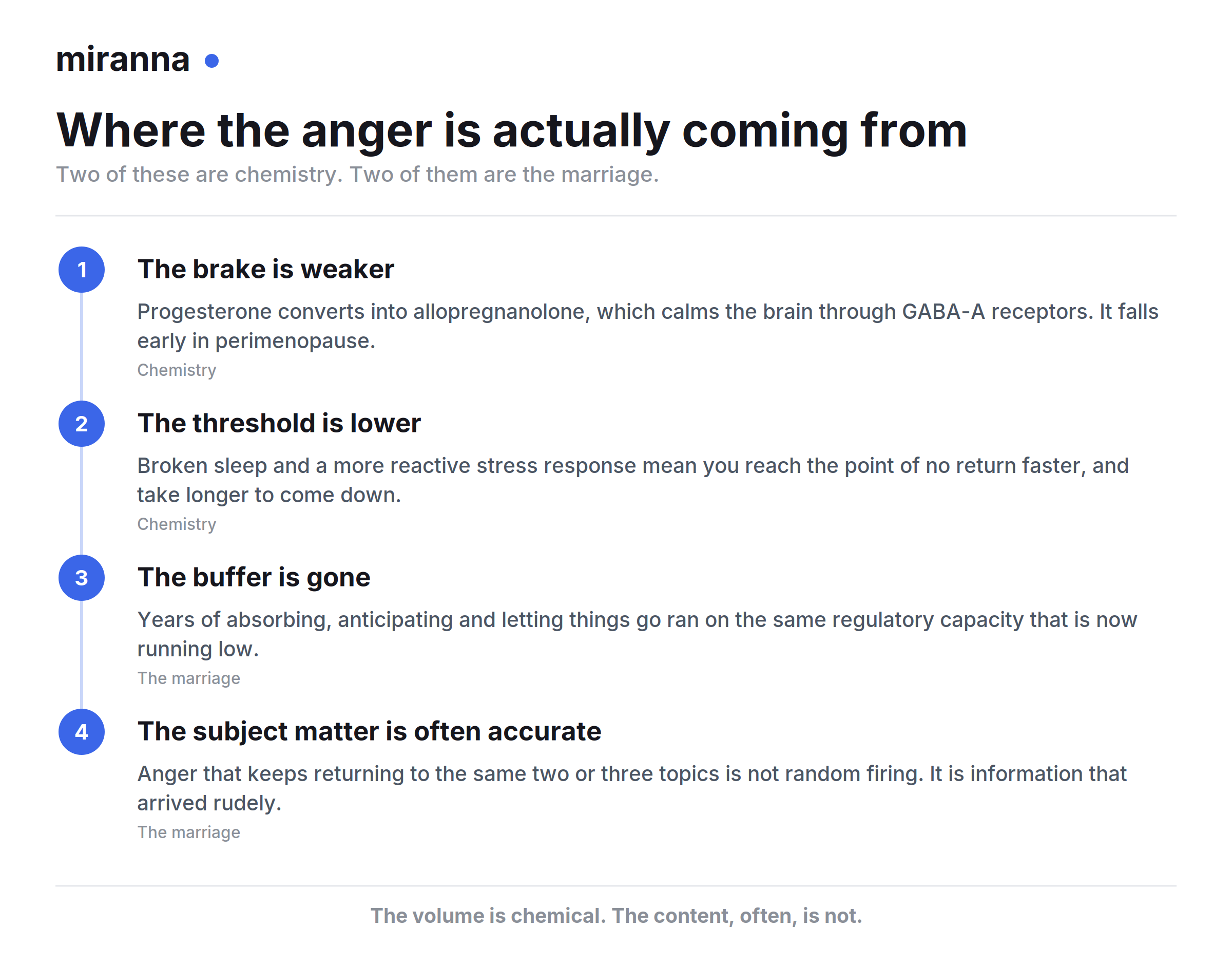
The mechanism is real: progesterone converts into allopregnanolone, which acts on the brain’s main calming system, and it starts falling early in perimenopause. Add broken sleep and a more reactive stress response, and you reach threshold faster and take longer to come down. We have written about the physiology of perimenopausal rage in detail.
But “it is your hormones” is only half an explanation, and women can feel that it is incomplete.
The other half: for years, a lot of what kept the peace was your effort. Absorbing, anticipating, letting things go, being easy to live with. That work is invisible precisely because it is done well. And it costs regulatory capacity — the same capacity that is now running low.
So it is not that menopause invented the irritation. It is that menopause removed the buffer that was quietly holding it.
Is it him, or is it the hormones?
Both, and the split matters.
A useful test: is the reaction disproportionate, or is the subject matter wrong?
If you exploded over a coffee cup, the reaction was disproportionate — that is the nervous system. If you exploded over the fourth time this month you handled the school admin alone, the reaction was disproportionate and the subject matter was accurate. Those need different responses.
The mistake is treating all of it as symptom. Anger that keeps returning to the same three topics is not random firing. It is information that arrived rudely.
It is worth writing down what you are actually angry about when you are calm. Most women find two or three genuine, longstanding items — and a lot of noise attached to them.
Why do I feel emotionally detached from my husband?
This is the part that frightens women most, and it deserves a plain answer.
Feeling flat toward a partner during this stage is common and is not, by itself, a verdict on the relationship. Several things are happening at once: exhaustion leaves nothing for connection, low mood dampens warmth generally, and desire often changes in ways that get misread as “I do not love him.”
Distance also compounds. You withdraw a little because you have nothing left; he reads it as rejection and withdraws too; the space between you fills with unspoken conclusions. Neither of you did anything cruel, and yet six months later you are roommates.
The intimacy side of this has its own dynamics — we have covered how a marriage goes quietly sexless separately, because the pattern usually starts long before menopause and is more fixable than it feels.
Can menopause ruin a marriage?
Honestly: it can put real strain on one, and it can also end marriages that were already unravelling. Divorce in midlife is common enough that “menopause ruined my marriage” is a phrase thousands of women type each month.
But two things are worth separating.
Menopause is a stress test, not a cause. It removes the capacity that was compensating — for a partner who was already unavailable, for a division of labour that was already unfair, for conversations that were already overdue. Couples who come through it usually describe the transition as the thing that forced a renegotiation they had been avoiding.
The women who struggle most are rarely those with the worst symptoms. They are the ones going through it alone in the same house as someone who has not been told what is happening.
{{Article Banner}}
How do you explain menopause to your husband?
Most men are not refusing to help. They genuinely do not know, and the vague version — “it is my hormones” — gives them nothing to do.
What works is specific, short, and unemotional, delivered at a calm moment rather than mid-argument:
- Name the mechanism, not the mood. “My progesterone is dropping, which affects the part of the brain that regulates emotion. My reactions are bigger than the situations right now, and that is physiological.”
- Separate the two kinds of anger. “Some of what I snap about is chemistry, and I will apologise for it. Some of it is genuinely about how we split things, and I want to talk about that properly.”
- Say what it is like from inside. “I am waking at 3 a.m. most nights. I am running on about a third of my usual energy. It is not about you, and it is not permanent.”
- Ask for something concrete. Not “be more supportive” — that is unmeasurable. “Take over the school run on Wednesdays.” “Do not ask me questions in the first hour of the day.” “If I snap, give me twenty minutes and come back.”
- Tell him what not to do. Do not say “is it your hormones” in an argument. It ends the conversation and it makes the next one less likely.
Couples therapist Terry Real’s whole argument is that relationships survive on repair rather than on never rupturing — his eleven-minute summary is genuinely worth listening to together, which is easier than handing someone a book.
What husbands actually need to know
If he reads one thing, make it this:
- This is not a mood she is choosing. The brain’s calming system is running with less of the compound that regulates it.
- It is temporary. Difficult years, not a new personality.
- Sleep is the biggest variable. Protecting her sleep does more than any conversation.
- Do not diagnose her in an argument. “Is it your hormones” is the single most reliable way to make it worse.
- Some of the anger is accurate. Ask which parts, when things are calm, and listen to the answer.
- Withdrawing is not rejection. It is depletion. Stay close anyway.
- Ask what would actually help this week. Then do that specific thing.
When it is not menopause
Some things do not get explained by hormones, and it is a disservice to file them there.
If he dismisses what you tell him, mocks it, or uses it against you. If contempt has entered the way you speak to each other. If you feel unsafe, controlled, or diminished. If the imbalance in the household was intolerable before any of this started.
Those are relationship problems that a menopause explainer cannot solve, and they deserve proper support — couples therapy, individual therapy, or in the case of any fear for your safety, specialist help rather than a conversation over dinner.
Naming that honestly matters. Not every hard marriage is a hormonal misunderstanding.
FAQ
Why am I so angry at my husband during menopause?
Falling progesterone weakens the brain's calming system and poor sleep lowers your threshold, so reactions get bigger. It also removes the capacity that was absorbing longstanding irritations, which is why the anger often lands on real, specific things.
Is it normal to feel like you hate your husband in perimenopause?
Feeling flat, irritated, or detached is very common during the transition and usually eases as hormones stabilize. It is worth taking seriously as information without treating it as a final verdict.
How do I explain menopause to my husband?
Keep it specific and calm: name the mechanism, say what it is like from inside, and ask for one or two concrete things rather than general support. Doing it outside an argument matters more than the wording.
Can menopause cause divorce?
It can strain a marriage and can be the point at which an already struggling one ends. It is more accurate to see it as a stress test that forces overdue conversations than as a cause on its own.
Does menopause anger go away?
For most women it eases as the transition ends and hormone levels become steadier. The relationship patterns built during those years, however, tend to need repairing deliberately.
What if my husband is unsupportive?
Start by telling him specifically what you need, since many partners simply do not know. If he is dismissive or contemptuous after being told clearly, that is a relationship issue rather than a menopause one, and couples support is a reasonable next step.
The anger is loud, but it is also specific
The cruelest thing about this stage is that it makes women doubt their own judgement at exactly the moment their judgement gets sharper. Everything feels like an overreaction, so nothing gets taken seriously — including the parts that were true all along.
Both things can be right. The volume is chemical. The content often is not.
Most couples who name that out loud come through it, frequently with a fairer arrangement than they had before. The ones who struggle are usually the ones where nobody said anything at all.
Miranna turns the best books on relationships and the female brain into short audio summaries — short enough that you could both listen on the same drive. Try Miranna free.
This article is for information only and is not medical advice. If your relationship or your mood is affecting your daily life, please speak with a qualified professional.

When you'd rather not raise it alone
Some conversations in perimenopause need more than an article. Miranna's menopause coaches work with women on the hard, specific stuff — the thing you said at dinner, the flatness that scares you more than the shouting, working out how to explain any of it to him — at your pace, when you're ready. Browse who you'd want to talk to right in the app.
When you're ready to talk to someone
Sometimes the next step is having one good conversation. Miranna's coaches work with women navigating burnout, hormonal shifts, relationships, and the in-between moments — at your pace, when you're ready.
Browse who you'd want to talk to and book a session right in the app.



People ❤️ Miranna