Join our newsletters and be the first to receive app updates, exclusive content, and connect with a supportive network of accomplished women. Sign up today to unlock your journey to success with Miranna

How to Handle Temper Tantrums: What the Research Actually Says


A tantrum isn’t manipulation and it isn’t a discipline problem — it’s a small nervous system overwhelmed past the point where reasoning is available. The research says something most parenting advice gets wrong: anger and sadness happen at the same time during a meltdown, not in stages, and the fastest way through is to get past the anger peaks without feeding them. That means fewer words, no questions, and staying nearby until the sadness surfaces — because a sad child reaches for comfort, while an angry one can’t. Here’s what’s happening and what to do.
Why do toddlers have tantrums?
At Miranna, we turn the latest books and the work of today’s doctors and parenting experts into short summaries — and for this piece, we gathered the ideas from several of them on the meltdown: the single most common behavior concern parents raise.
The mechanics are simple. A toddler has enormous feelings and almost none of the equipment for managing them. Dr. Dan Siegel and Dr. Tina Payne Bryson describe it in The Whole-Brain Child as a house with two floors: the downstairs brain — instinct, fear, rage — is fully operational at birth, while the upstairs brain that pauses, plans, and talks itself down is years from finished. A tantrum is the downstairs brain running the house alone. Add thin language, a world arranged entirely by other people, and hunger or tiredness, and the system tips. Their full method is summarized in the app if you want it in one sitting.
So a tantrum isn’t a strategy. It’s what an overwhelmed brain does when the feeling is bigger than the tools available to hold it. Researchers describe temper tantrums as one of the most common behavioral concerns reported by parents of young children — which is worth holding onto at 8 a.m. on the kitchen floor. This is the normal part.
What’s actually happening during a tantrum?
Here’s where the research gets genuinely surprising, and where it contradicts advice you’ve probably read.
For decades the accepted picture was that tantrums run in two stages: first anger, then sadness. Then a team led by Michael Potegal and James Green did something unusual — they wired toddlers’ clothing with tiny microphones and recorded real tantrums at home in high fidelity, then analyzed the sound. The two-stage picture turned out to be wrong. Anger and sadness aren’t sequential; they’re braided together. Sadness runs underneath the whole episode, with spikes of anger riding on top of it.
That reframes the job entirely. You’re not waiting out a storm that ends on its own schedule — you’re trying not to trigger fresh anger spikes, so the sadness underneath can surface. And that matters because of what the researchers found next: once a child is past the anger, what’s left is sadness, and a sad child reaches out for comfort. An angry child can’t.
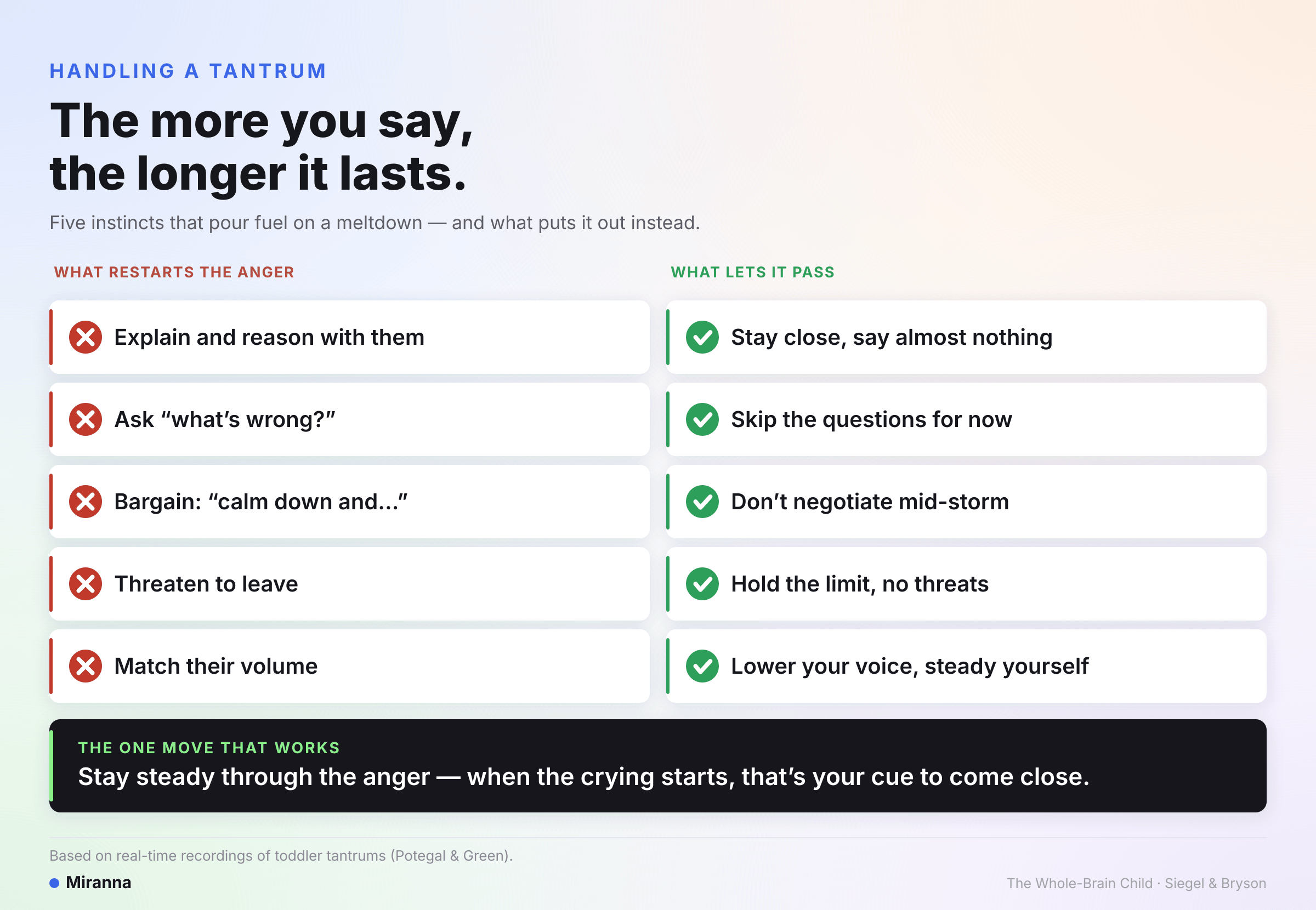
Which brings up what Potegal called the anger trap. The instinct of most loving parents — to talk, to soothe, to problem-solve, to ask what’s wrong — can restart the anger. Even a question does it: asking a flooded child to explain themselves adds a demand their brain can’t meet, and that can tip them back into rage.
The takeaway isn’t “ignore your child.” It’s fewer words, and no questions, while the anger is peaking. Stay close, stay quiet, stay unbothered. The talking part works later, and works well — just not during the screaming.
How do I handle a tantrum in the moment?
- Get yourself steady first. Your calm nervous system is what your child borrows. Two intense people escalating each other is how a five-minute meltdown becomes forty. When you’re the one running on empty, steadying yourself first is the real work.
- Make it safe, then say very little. Move breakables, move your child if they’re at risk, and then stop narrating. During the anger peaks, questions and reasoning are fuel.
- Stay nearby. Leaving the room isn’t neutral to a small child — it reads as being alone with something frightening. You can be quiet and unreactive without being gone.
- Wait for the shift. The crying-and-reaching phase is your cue. That’s the sadness surfacing, and it’s the moment comfort actually lands. Open your arms then.
- Hold the limit anyway. Comfort doesn’t mean the answer changes. This is Dr. Becky Kennedy’s core pairing — boundaries and empathy are two separate jobs, and you do both. “You were so upset we had to leave. That was hard. We still had to go.” Her framework is summarized in the app too.
- Name it, then teach — briefly. Once everyone’s regulated, put words on what happened: “You were so angry the tower fell.” Siegel and Bryson call this name it to tame it — labeling a feeling helps settle it, and it hands your child vocabulary for next time. Then one short sentence of teaching: “When you’re that mad, you can stomp or come find me.” Not a lecture. It only sticks after the storm.
One thing to skip: matching their volume. Research on how parents respond to tantrums has found that a substantial share reach for criticism, physical restraint, or harsh punishment — understandable, and it doesn’t work. It adds a second dysregulated person to a situation that already had one too many.
What about tantrums in public?
The strategy doesn’t change; your embarrassment does. That’s the actual difficulty — you’re managing a meltdown and an imagined audience at the same time, and the audience is what pushes parents into bribing or snapping.
The practical version: move somewhere less exposed if you can, get low, keep your words minimal, and let it run. Most bystanders are either sympathetic or indifferent; the ones who aren’t don’t get a vote in how you raise your child. Giving in to end it faster teaches that a big enough meltdown reopens a closed decision — the opposite of the calm consistency at the heart of positive discipline. It buys you quiet today and more tantrums this month.
{{Article Banner}}
Morning and bedtime meltdowns
If your child’s meltdowns cluster at the start and end of the day, that’s not a coincidence, and it’s usually not defiance either. Both are transitions, both run on someone else’s schedule, and both land when a child is at their lowest reserves — hungry and disoriented in the morning, depleted and overtired at night.
What tends to help is lowering the demand rather than raising the pressure: more time than you think you need, the same order of operations every day so nothing is a surprise, warnings before switches (“shoes in two minutes”), and small real choices inside the non-negotiable (“this cup or that one” — not “do you want to get dressed?”). Also worth checking honestly: an overtired child melts down more, and the fix for that is bedtime, not discipline.
If the pushback is heaviest with one particular child who fights every transition, our piece on the strong-willed child goes further into why pushing harder backfires.
When are tantrums a sign of something more?
Most tantrums are ordinary and fade as language and self-control grow in. But researchers have worked specifically on separating typical tantrums from the kind that flag a need for support, and a few patterns are worth raising with your pediatrician: meltdowns that stay frequent and intense well past the preschool years, tantrums that regularly involve hurting themselves or others, episodes so long and severe they seem to have no off-ramp, or a child who seems persistently unhappy or anxious between tantrums rather than fine.
Mentioning it to a professional isn’t an escalation. It’s the same as asking about anything you can’t assess from inside your own house.
FAQ
Are temper tantrums normal?
Yes — they’re among the most common concerns parents raise about young children. They come from a brain that feels intensely and can’t yet regulate, and they ease as language and self-control develop.
Should I ignore my child’s tantrum?
Ignore the behavior, not the child. Research suggests talking and questioning during peak anger can prolong it — but leaving isn’t the goal. Stay close and quiet, then offer comfort when the crying starts.
Why does asking “what’s wrong?” make it worse?
Because at peak anger a child can’t process a question, and being asked one adds demand to an already overloaded system. Researchers call this the anger trap. Save the conversation for after.
How long should a tantrum last?
Most are short — minutes, not hours — and they end faster when nothing restarts the anger. Regularly very long, very intense episodes are worth mentioning to your pediatrician.
Is it a tantrum or a meltdown?
People often use “tantrum” for distress tied to a want and “meltdown” for full sensory or emotional overload. The response is much the same: reduce input, stay near, stay quiet, comfort when they can take it.
Tantrums aren’t a sign you’ve done something wrong. They’re a sign your child has more feeling than machinery, which is exactly what a small child is. Fewer words, steady presence, arms open when the crying starts — and the machinery gets built.

When you're ready to talk to someone
When you're ready to talk to someone
Sometimes the next step is having one good conversation. Miranna's coaches work with women navigating burnout, hormonal shifts, relationships, and the in-between moments — at your pace, when you're ready.
Browse who you'd want to talk to and book a session right in the app.
.jpeg)


People ❤️ Miranna