Join our newsletters and be the first to receive app updates, exclusive content, and connect with a supportive network of accomplished women. Sign up today to unlock your journey to success with Miranna

Menopause Myths: 8 Things You Were Told That Aren't True

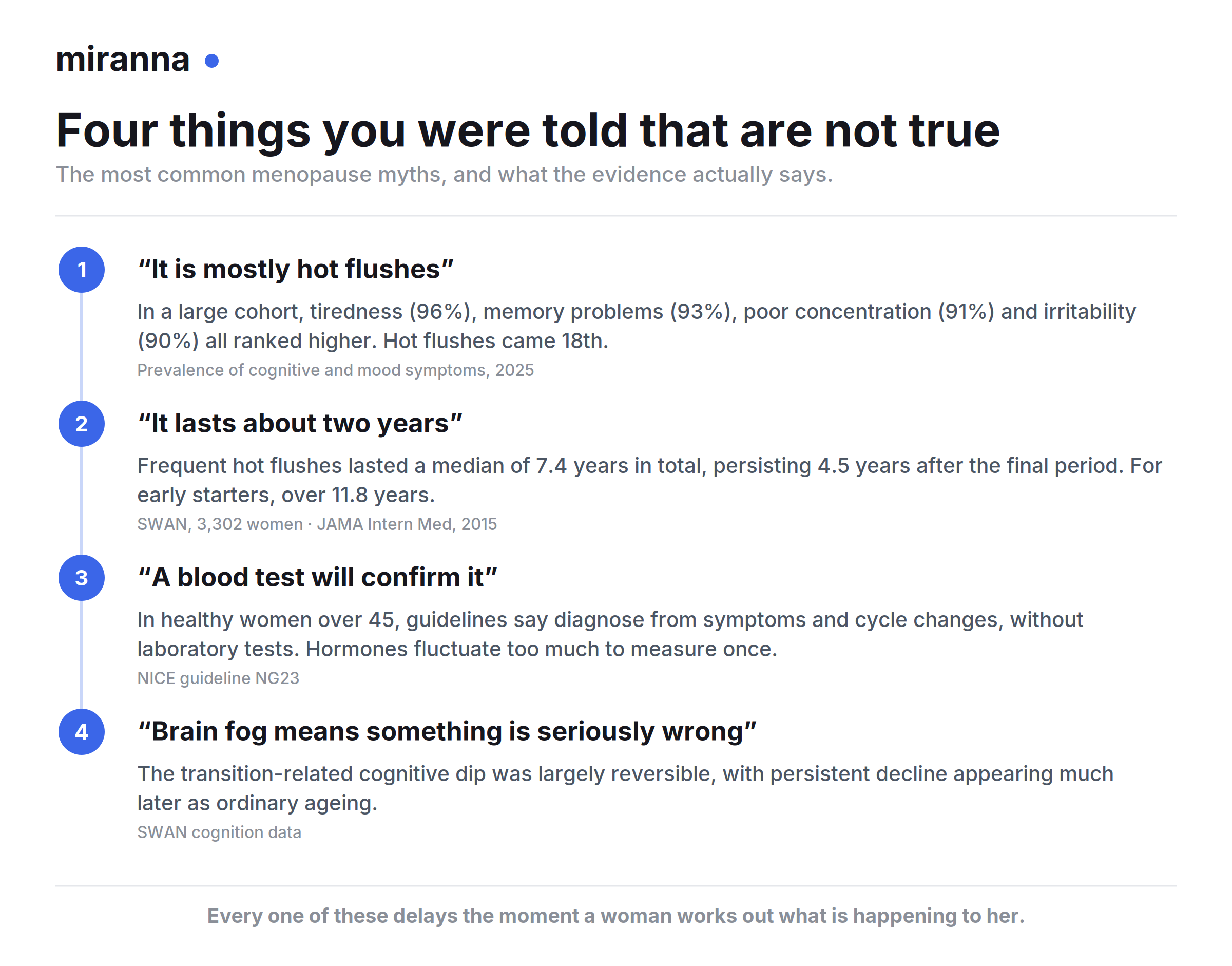
Most menopause myths come from one of two places: outdated clinical guidance that never got updated, or a wellness market with something to sell. The most consequential are that it is mostly hot flushes, that it lasts about two years, and that a blood test can confirm it. None of those hold up.
Here is the strange thing about menopause information. It is not that there is too little of it. It is that so much of what circulates is either thirty years out of date or attached to a product.
These are the eight that do the most damage — and what the evidence actually says.
Myth 1: Menopause is mostly hot flushes
This is the one that leaves women unable to recognise what is happening to them.
In a large cohort of perimenopausal and menopausal women, the five most commonly reported symptoms were tiredness (96%), memory problems (93%), difficulty concentrating (91%), irritability (90%) and feeling tense or nervous (90%). Hot flushes ranked 18th.
So the symptom that defines menopause in the public imagination is less commonly reported than five things almost nobody is warned about. Which explains why so many women spend two years assuming they have burnout, depression, or early dementia.
Myth 2: It lasts about two years
Clinical guidance long suggested six months to two years. Then SWAN followed 3,302 women for seventeen years and found that among women with frequent hot flushes, the median total duration was 7.4 years — persisting a median of 4.5 years after the final period.
For women whose symptoms started early, the median was over 11.8 years.
The two-year figure is not just wrong; it is actively harmful, because it turns a normal experience into evidence that something has gone uniquely wrong with you. Our full timeline of what lasts how long has the rest of the numbers.
Myth 3: A blood test will tell you
The NICE guideline is explicit: in otherwise healthy women over 45, perimenopause should be diagnosed from symptoms and cycle changes, without laboratory tests. The British Menopause Society and ACOG say the same.
The reason is simple. Perimenopause is defined by fluctuation, and a blood test is one frame from a very long film. A normal FSH result on Tuesday says nothing about Friday.
This myth is expensive in two directions: women pay for at-home hormone tests that cannot answer the question, and women who are told “your bloods are normal” walk away believing they have been ruled out when they have not. We have written about what a perimenopause test can and cannot tell you in detail.
Myth 4: Brain fog means something is seriously wrong
The pattern researchers observe in perimenopause is a dip, not a slope. In SWAN, the transition-related cognitive deficit was largely reversible, with persistent decline only appearing much later as ordinary cognitive ageing.
Perimenopausal fog also fluctuates — brutal weeks, then clear ones. Neurodegenerative decline does not hand you a good week.
Sudden onset, getting lost in familiar places, or steadily worsening symptoms are reasons to see a doctor. Losing the word for “colander” on a Thursday is not.
{{Article Banner}}
Myth 5: Hormone therapy causes breast cancer
This one deserves care, because it is where a headline reshaped a generation’s medical care.
The 2002 coverage of the Women’s Health Initiative led to a collapse in hormone therapy prescribing worldwide. In the years since, researchers have re-examined what those studies did and did not show — including the age of the women studied, the formulations used, and how absolute risk was reported versus relative risk.
The honest position is that this is genuinely nuanced, not that the fear was simply invented or that HRT is simply safe. Risk depends on your age, your history, the formulation and the duration, and it is a real conversation with a real clinician who knows your file.
What is not defensible is the version most women were handed: a flat no, with no discussion. If you want the argument for reassessing the evidence, Bluming and Tavris make it at length — their eight-minute summary of Estrogen Matters is a reasonable place to start before an appointment.
Myth 6: Weight gain is inevitable, and you just need to eat less
Body composition does change during this transition — that part is real. What does not follow is the prescription.
Muscle mass declines with age unless it is actively maintained, and muscle is metabolically active tissue. Eating progressively less while losing muscle is the one approach almost guaranteed to make the next decade harder, and it is the advice most women are still given.
There is also the quiet cost of the framing itself: a stage of life with genuine physical and cognitive challenges gets reduced to a body-shape problem, which is both inaccurate and exhausting.
Myth 7: Vaginal dryness and low libido are just part of getting older
Unlike hot flushes, these do not wait themselves out. Genitourinary symptoms tend to persist or progress without treatment — and they are the symptoms women are least likely to raise, which means they are the ones most often left untreated for years.
There are effective options, and they are a conversation worth having however awkward the first sentence is. If it helps: your doctor has had this conversation this week already.
Myth 8: You are too young for this
Perimenopause commonly begins in the early-to-mid forties, and starting in the late thirties is within normal variation. Symptoms often appear years before cycles become obviously irregular.
“You are too young” is not a clinical finding. It is a scheduling assumption, and it is the sentence that sends women away for another two years.
What to ask your doctor
Most of these myths survive because appointments are short and vague symptoms are easy to dismiss. Specifics change that:
- “Could this be perimenopause?” Say the word. It reframes the whole appointment.
- “What else should we rule out?” Thyroid problems, iron deficiency and anaemia overlap almost point for point, and all three are treatable.
- “Can we check thyroid function, ferritin and a full blood count?” A specific request is harder to wave away than a general one.
- “What are my options, including the medical ones?” Then ask about the risks and benefits for you, given your history.
- “Can I come back in three months with notes?” Symptoms shift. One appointment rarely settles anything.
And bring dates. “My cycle has shortened from 29 to 25 days over eight months, I have been waking at 3 a.m. since spring” carries far more weight than “I do not feel right.”
How to spot the next myth
The category will keep producing them, so a filter is more useful than a list:
- Follow the money. If the explanation arrives attached to a supplement, a protocol or a branded plan, discount it accordingly.
- Check whether a mechanism is offered. Sources that explain why something happens tend to hold up; sources that only issue instructions tend not to.
- Be wary of very long symptom lists. A list broad enough to include everything will match everyone, which is exactly why it is used to sell.
- Notice absolute versus relative risk. “Doubles your risk” means little without the starting number.
- Prefer people who say when the evidence is unclear. Certainty is the cheapest thing to manufacture.
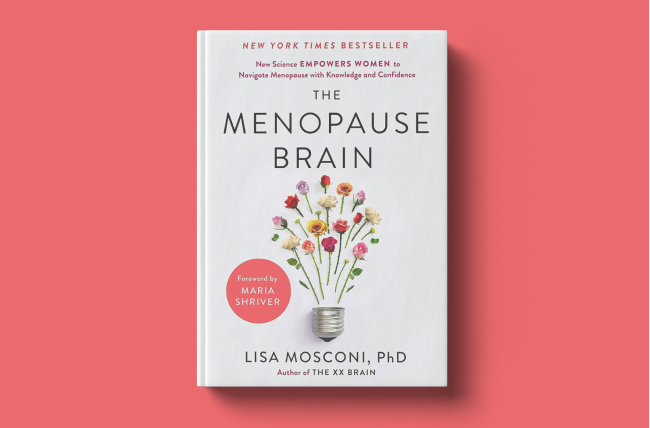
Neuroscientist Dr. Lisa Mosconi’s ten-minute summary of The Menopause Brain is a good example of the standard to hold sources to: mechanism first, honest about uncertainty.
FAQ
What is the biggest myth about menopause?
That it is mostly hot flushes. In one large cohort, tiredness, memory problems, poor concentration and irritability were all reported far more commonly, with hot flushes ranking 18th.
Is it true menopause only lasts a couple of years?
No. SWAN data found frequent hot flushes lasted a median of 7.4 years, continuing 4.5 years past the final period.
Can a blood test diagnose perimenopause?
Not reliably. Guidelines advise diagnosing on symptoms in women over 45, because hormone levels fluctuate too much for one measurement to be meaningful.
Does HRT cause breast cancer?
The risk picture is more nuanced than the 2002 headlines suggested, and depends on age, history, formulation and duration. It is a conversation for a clinician who knows your history rather than a yes-or-no answer.
Is weight gain in menopause inevitable?
Body composition changes, but the standard advice to simply eat less while losing muscle tends to make things worse. Maintaining muscle matters more than restricting further.
How do I know if menopause information is trustworthy?
Check whether it explains a mechanism, cites research you could look up, and admits uncertainty — and be sceptical when the explanation comes attached to something for sale.
The myths cost time
Every one of these has the same effect: it delays the moment a woman works out what is happening to her, and it makes the appointment she eventually books less useful than it could be.
That is the real cost. Not that women believe wrong things, but that they spend years assuming they are failing at something when they are going through something.
Miranna turns the best books on the female body and brain into short audio summaries — so the information you are working from is at least as good as the questions you are asking. Try Miranna free.
This article is for information only and is not medical advice. Decisions about hormone therapy and treatment belong with a qualified healthcare professional who knows your history.

When you'd rather not sort it out alone
Some questions about perimenopause need more than an article. Miranna's menopause coaches work with women on the hard, specific stuff — sorting good information from marketing, deciding what to raise at your next appointment, being told you are too young for this — at your pace, when you're ready. Browse who you'd want to talk to right in the app.
When you're ready to talk to someone
Sometimes the next step is having one good conversation. Miranna's coaches work with women navigating burnout, hormonal shifts, relationships, and the in-between moments — at your pace, when you're ready.
Browse who you'd want to talk to and book a session right in the app.


People ❤️ Miranna