Join our newsletters and be the first to receive app updates, exclusive content, and connect with a supportive network of accomplished women. Sign up today to unlock your journey to success with Miranna

7 Signs You Need Better Boundaries (Before Burnout Hits)

.jpeg)
You're exhausted, but you slept eight hours. You're irritated by your best friend's text, and you don't know why. You said yes to another favor this morning and felt your shoulders climb toward your ears.
When women miss the warning signs that their boundaries are eroding, the cost shows up everywhere — in mood, in relationships, and increasingly, research shows, in the body itself. This guide walks through the seven signs most often missed, the science behind why women in particular tend to ignore them, and what to do once you recognize one as your own.
Why women miss the signs in the first place
Many women are trained from childhood to read the room before reading themselves. Researchers call this self-silencing — inhibiting your own self-expression to preserve a relationship or avoid conflict. It looks virtuous from the outside. Internally, it's a slow leak.
A 2024 cross-cultural study published in the Australian Journal of Psychology found that self-silencing remains strongly tied to depression in women, and that the pressure to silence yourself is shaped less by personal temperament than by cultural norms around femininity. The signs below aren't weaknesses. They're the predictable result of being told for decades that good women are accommodating ones.
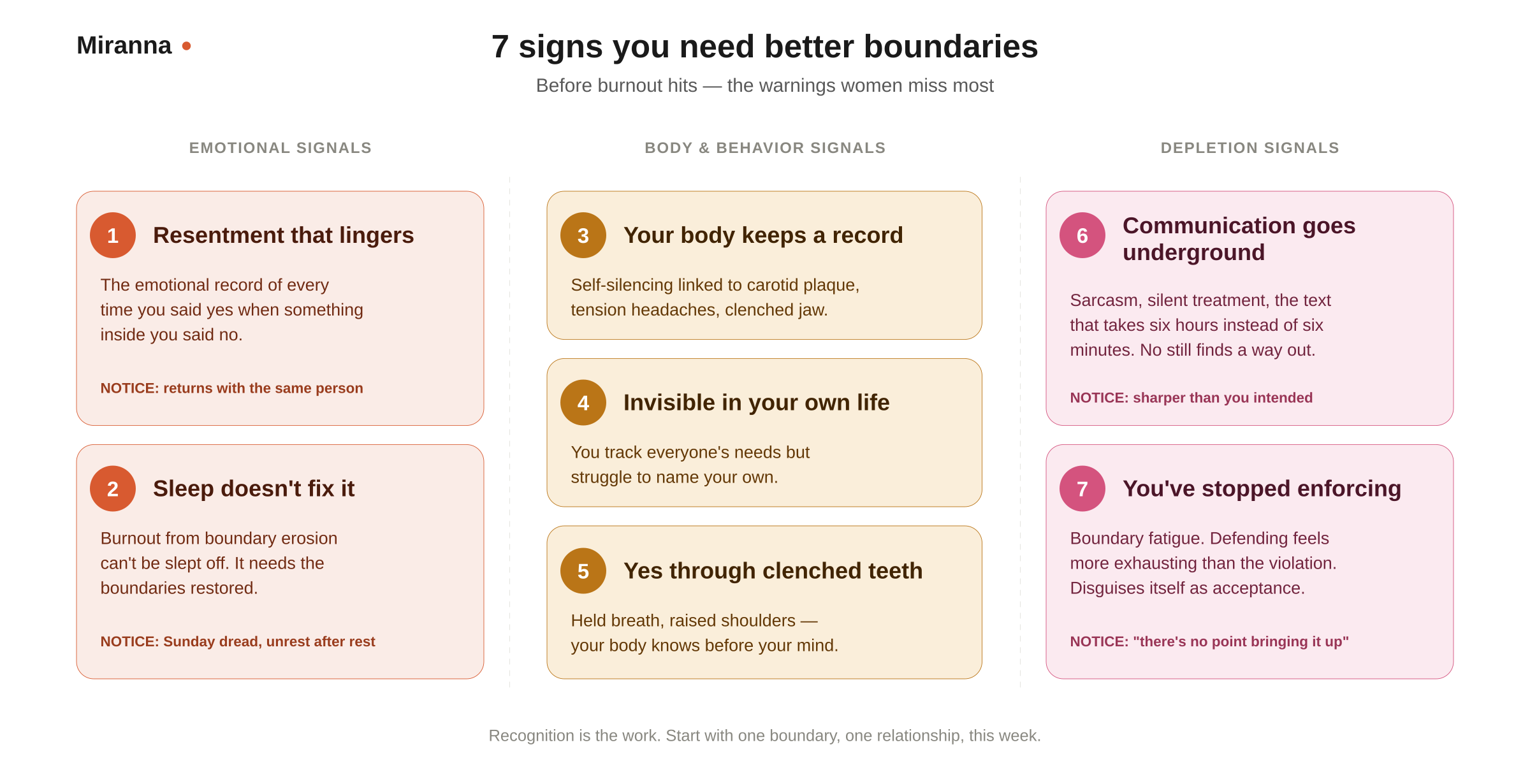
Sign 1: Resentment that won't leave you alone
The University of Rochester Medical Center identifies resentment as one of the clearest signals of poor or absent boundaries — alongside feeling taken advantage of, increased stress, depressed mood, invisibility, low self-esteem, and avoidance.
Resentment isn't pettiness. It's the emotional record of every time you said yes when something inside you said no. A 2026 analysis from Balanceology describes resentment as "a leak in the system" — chronic overfunctioning, weak boundaries, and unspoken expectations all feed it. If you find yourself bitter about helping people you genuinely love, the problem is rarely the help itself. It's the unspoken cost.
What to notice: Resentment that returns after the same kind of interaction (a specific person, a specific request, a specific time of week) is almost always a boundary needing attention.
Sign 2: You're exhausted, and sleep doesn't fix it
If you wake up tired after a full night of rest, your body may be telling you that what's draining you isn't physical workload. It's the cognitive and emotional labor of constantly managing other people's reactions.
URMC links the cluster of poor-boundary symptoms directly to burnout, citing Koutsimani and colleagues' 2019 work on how prolonged interpersonal stressors at work compound into something that looks identical to anxiety and depression. The catch: burnout caused by boundary erosion can't be slept off. It needs the boundaries restored.
What to notice: Tiredness that doesn't respond to rest, weekends that don't feel restorative, and a Sunday-night dread that has nothing to do with your specific Monday tasks.
Sign 3: Your body is keeping a record
This is the sign women miss most often, because it shows up as physical symptoms that seem unrelated to anything emotional.
A 2022 study in the Annals of Behavioral Medicine by researchers at the University of Pittsburgh — Karen Jakubowski, Karen Matthews, and Rebecca Thurston — examined 304 nonsmoking women between the ages of 40 and 60. Women who reported strong self-silencing in their intimate relationships showed measurably higher rates of carotid atherosclerosis, the vascular plaque associated with elevated heart attack risk. Translation: chronically swallowing what you actually feel may leave a physical mark on your arteries.
A 2026 piece from Newport Institute summarizes a longitudinal study of 1,493 men and 1,501 women followed over a decade: women who reported "always or usually" staying quiet during conflict had the highest premature mortality risk among the cohort.
What to notice: Tension headaches that follow specific interactions, a jaw that's permanently clenched, stomach issues that flare around particular people, a tight chest that's become your baseline.
Sign 4: You feel invisible in your own life
URMC names invisibility specifically as a boundary-erosion symptom — and women describe it in remarkably consistent language. You're the one who remembers everyone's preferences. You know which child needs which lunchbox, which colleague needs handling carefully, which family member to call on which day. And yet you struggle to name what you want for dinner tonight.
When you've spent years tracking other people's needs as your primary job, your own preferences atrophy. This isn't selflessness. It's a sign your boundaries have collapsed inward so far there's no inner self left to defend.
What to notice: Difficulty answering simple questions about your own preferences. A sense that your role in relationships is functional rather than personal. Surprise — or suspicion — when someone asks how you are doing.
Sign 5: You say yes through clenched teeth
There's a specific physical sensation that goes with violating your own limits. Your voice gets a touch higher. Your smile gets tighter. You hear yourself agreeing and feel the small internal flinch.
A 2026 article from Empowered Hearts Collective describes this pattern as one of the most reliable indicators of boundary trouble: feeling bitter about helping people, then helping anyway, then feeling more bitter. It's a closed loop that strengthens with each cycle.
What to notice: Physical tells when you're about to say yes — held breath, raised shoulders, a quick check of whether the other person is watching your face. Your body knows before your mind catches up.
Sign 6: Your communication has gone underground
When you can't say no directly, the no still finds a way out — usually sideways. Sarcasm. Silent treatment. The barbed comment dressed up as a joke. The text that takes six hours to answer when it usually takes six minutes.
Empowered Hearts Collective identifies passive aggression and emotional outbursts as two of the clearest relational signs that boundaries are being crossed without acknowledgment. The behavior gets labeled as a personality issue ("she's just moody") when it's actually a structural one — a person without permission to say no directly will say it indirectly, every time.
What to notice: Communication patterns in your closest relationships that surprise even you. Hearing yourself be sharper than you intended. Realizing you've been avoiding someone you used to enjoy.
Sign 7: You've stopped enforcing the boundaries you do have
A newer concept in the boundary literature, coined in a 2025 piece from Starting Over Today, is boundary fatigue — the state reached when your limits have been crossed so many times that defending them feels more exhausting than the violation itself. You stop pushing back. You shrug. You tell yourself it doesn't matter.
This is the most dangerous sign because it disguises itself as acceptance or maturity. It is neither. It's depletion.
What to notice: A specific resignation in how you describe certain relationships — "that's just how she is," "there's no point bringing it up," "it's not worth the fight." The phrasing of someone who has stopped trying.
What to do once you recognize a sign
Recognition is the work. Most women will read this list and identify three or four signs that describe them right now. The instinct will be to feel ashamed. Try to resist that — the signs are how you know change is needed, not evidence you've failed.
The next step isn't a sweeping life overhaul. It's one boundary, in one relationship, this week. If the resentment is loudest about a specific person, start there. If the exhaustion is heaviest around a specific obligation, start there. The Newport Institute research is bracing precisely because it shows what's at stake — but the path back is incremental.
If you're ready for the full framework on how to set and hold boundaries that stick, our pillar guide on how to set healthy boundaries walks through the three-sentence structure, what to do when someone pushes back, and how to handle the specific complications of family and romantic relationships.
You don't need to be perfect at boundaries. You need to start hearing the signs your body has already been sending.
{{Article Banner}}
Frequently asked questions
Resentment has a pattern. A bad day passes; resentment returns reliably around the same person, situation, or request. If you can predict when you'll feel it, it's pointing at a boundary, not a mood.
Yes — and that's why they're often missed. The presence of these signs doesn't mean the relationship is bad. It means the structure of that relationship is asking more of you than you're able to sustainably give. Better boundaries usually improve good relationships rather than threatening them.
Boundaries don't require the other person's cooperation to exist — they require your enforcement. You can hold a boundary about how often you visit, how long you stay on a call, or what topics you'll engage with, regardless of whether the other person agrees the boundary is reasonable.
This article is part of our series on relationships and connection. For the foundational framework, see our pillar on how to set healthy boundaries.

When you're ready to talk to someone
Sometimes the next step is having one good conversation. Miranna's coaches work with women navigating burnout, boundaries, and the in-between moments — at your pace, when you're ready. Browse who you'd want to talk to and book a session right in the app.
When you're ready to talk to someone
Sometimes the next step is having one good conversation. Miranna's coaches work with women navigating burnout, hormonal shifts, relationships, and the in-between moments — at your pace, when you're ready.
Browse who you'd want to talk to and book a session right in the app.



People ❤️ Miranna