Join our newsletters and be the first to receive app updates, exclusive content, and connect with a supportive network of accomplished women. Sign up today to unlock your journey to success with Miranna

How to Set Healthy Boundaries Without Losing People You Love


If you've ever finished a phone call wondering why you said yes to something you didn't want to do — this article is for you. Healthy boundaries aren't walls, ultimatums, or the start of a fight. They're the quiet, ongoing practice of telling the truth about what works for you and what doesn't. And for most women, learning this skill takes deliberate, often messy work. The good news: it's learnable at any age, and the research on what it does for your mental health, your relationships, and your stress levels is genuinely persuasive.
This guide walks through what healthy boundaries actually are (and aren't), why women in particular struggle to set them, what happens in your body and mind when you don't, and the specific scripts and habits that make boundary-setting feel less scary. We'll also cover the harder cases — family, work, the friend who never asks how you're doing — and what to do when someone pushes back.
What Are Healthy Boundaries, Really?
A boundary is not a punishment. It's a statement about what you will and won't accept in your own life. According to Mayo Clinic Health System, every relationship already has boundaries — the only question is whether you set them deliberately or let them form by accident. Boundaries you don't choose are usually the ones that hurt the most.
Think of boundaries as five different rooms in your life, each with its own door:
- Physical — your body, your space, your stuff. Who touches you, who borrows your car, who walks into your bedroom without knocking.
- Emotional — what you share, when, and with whom. Whether you take on other people's moods as if they were your own.
- Time — what you say yes to, and how much energy you give it. The most underrated boundary, and the one most women collapse first.
- Mental — your opinions, beliefs, and values. The freedom to disagree without justifying yourself for an hour.
- Digital — when you respond, what you share online, who has access to your phone and notifications.
A healthy boundary in any of these rooms sounds less like "you can't" and more like "I don't." You can't text me at midnight sounds controlling. I don't reply after 9pm — I'll get back to you in the morning is a fact. The first invites a fight. The second just is.
Why It's So Hard — Especially for Women
If you've struggled with this, you're not weak or broken. You're working against decades of social conditioning that started long before you noticed.
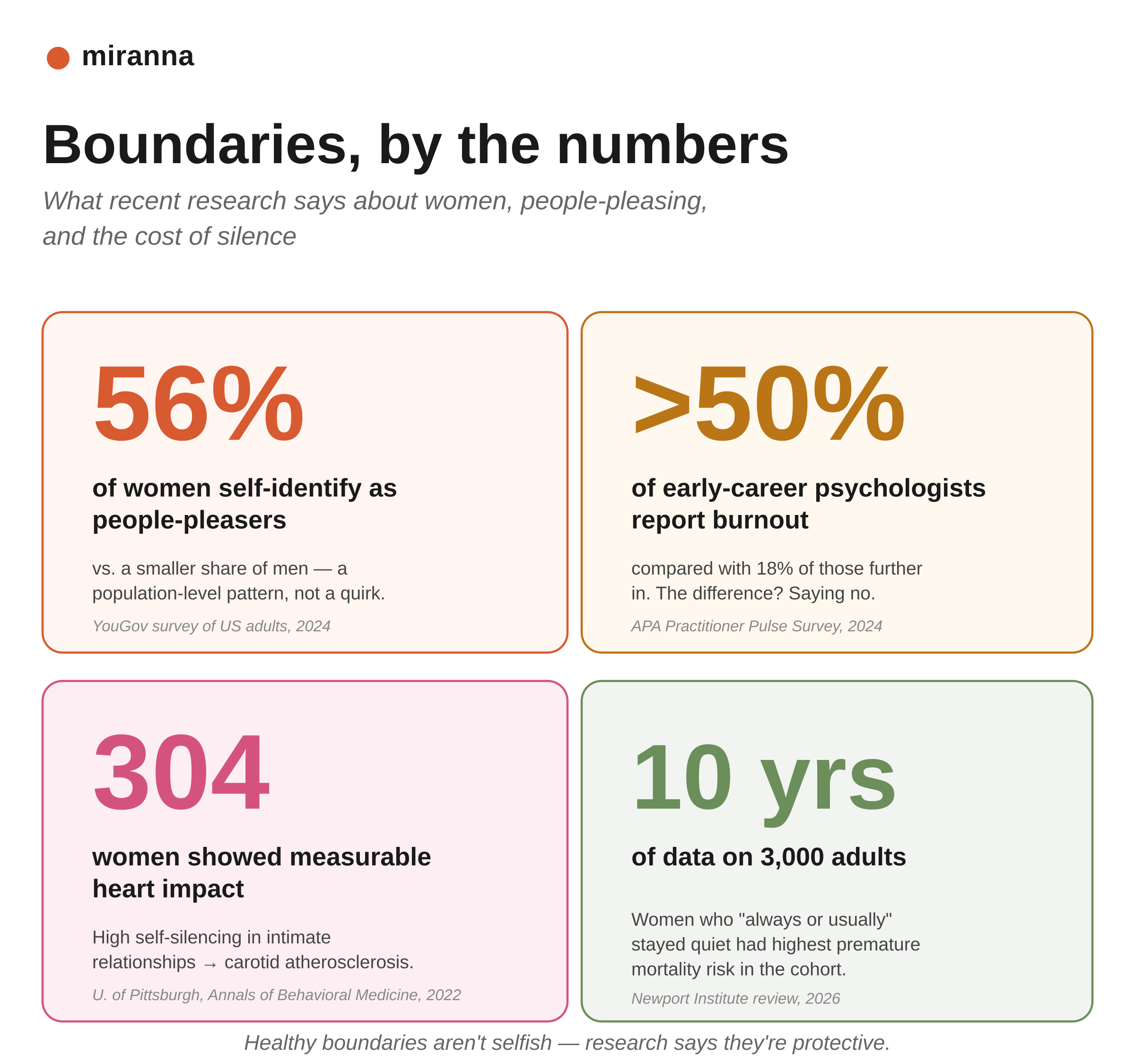
A 2025 University of Toronto study found that gender differences in people-pleasing show up in childhood — girls are more often rewarded for being agreeable, accommodating, and quiet, while boys are more likely to be praised for asserting their ideas. By adulthood, the pattern is baked in. A 2024 YouGov survey of American adults cited in recent peer-reviewed research found that 56% of women self-identify as people-pleasers, compared to a smaller share of men. That's not a personality quirk. That's a population-level pattern.
The cost is real. The same body of research links chronic people-pleasing to higher rates of disordered eating, relationship insecurity, and emotional exhaustion. Harvard psychologist Dana Jack coined the term self-silencing in the late 1980s to describe the habit of suppressing your own needs to preserve a relationship — and longitudinal studies since have linked it to higher rates of depression, cardiovascular issues, and chronic pain in women specifically.
So when you feel guilty about saying no, you're not malfunctioning. You're noticing the gap between how you were trained and what your nervous system actually needs.
What Happens When You Don't Set Them
Skipping boundaries doesn't keep the peace. It just moves the conflict inward.
Research published by the American Psychological Association shows that healthy boundaries are a primary buffer against workplace burnout — defined by the World Health Organization as chronic stress that isn't being managed. APA's 2024 Practitioner Pulse Survey found that more than 50% of early-career psychologists reported feeling burned out, compared to 18% of those in advanced career stages. The difference, the researchers note, often comes down to one skill: the ability to say no based on personal values rather than expectations.
What it looks like day-to-day when boundaries are missing:
- A low hum of resentment toward people you genuinely love
- Decision fatigue by 3pm because every yes felt obligatory
- The sense that everyone else's needs are louder than yours
- Cancelling plans last-minute because you over-committed in the first place
- Physical symptoms — tension headaches, shallow sleep, jaw clenching — that don't respond to bubble baths
These aren't personality flaws. Taken together, they're the same cluster of symptoms the APA describes as workplace burnout — energy depletion, mental distance, and a creeping sense of negativism. The thread running through them is the same: boundaries that aren't being held.
How to Set a Boundary in Three Sentences
Most boundary advice fails because it sounds like a TED talk. Here's the practical version. A healthy boundary, spoken out loud, has three parts:
- The fact — what you've noticed, without accusation
- The need — what you actually want or don't want
- The follow-through — what you'll do if it continues
Example: "When meetings run past 6pm, I can't be fully present for my family. I won't be able to attend evening syncs going forward. If something urgent comes up, I'm happy to handle it the next morning."
No apology. No 200-word preamble. No question mark at the end of a statement.
You don't need to convince the other person your boundary is reasonable. You just need to state it and live by it. The follow-through matters more than the words. A boundary you don't keep is just a wish.
Boundaries With Family — The Hardest Room
Family boundaries are where most women hit a wall. The script you used at age 12 — go along to keep the peace — is the script that's still running at 38, except now it costs you sleep.
A few specific situations and what tends to work:
- Parents who comment on your weight, your career, or how you raise your kids. You don't owe a debate. "I'm not going to discuss that right now." End of sentence. If they push, you leave the room. Not as punishment — as practice. They learn the topic costs them your presence.
- Siblings or in-laws who lean on you for emotional labour. Notice if you're the family therapist. "I love you and I can't be the person you process this with — can we find you someone qualified?" Then stop responding to 2am crisis texts.
- Holidays. You don't have to attend every gathering or stay the full weekend. "We'll come for dinner on Saturday and head home Sunday morning" is a complete sentence, not a negotiation opener.
The discomfort of setting boundaries with family doesn't go away — it gets quieter. The first time feels like a betrayal. The tenth time feels like Tuesday.
{{Article Banner}}
Boundaries at Work
Work boundaries are less about saying no to your boss and more about renegotiating the unwritten contract you signed without noticing.
Some things that actually move the needle:
- A response window, not an instant reply. "I check messages at 10, 2, and 4." Slack notifications off the rest of the day.
- A no-meeting block. Two hours of your calendar that are simply unbookable. No explanation required.
- Scope clarity at the start of a task. "To be clear, this is what I can deliver by Friday. The rest will need to wait until next sprint."
- The pause. When asked to take on something extra, say "Let me check my workload and come back to you." Not "sure!" — even if the answer ends up being yes.
Sunita Sah's 2024 book Defy: The Power of No in a World That Demands Yes — cited in APA's research on workplace burnout — makes the point that defying compliance pressure isn't rude. It's the only way to make decisions based on your actual values instead of other people's expectations.
A practical note: most workplace boundary violations don't come from a single dramatic ask. They come from a slow drift — the meeting that creeps later, the Slack response time that shrinks, the project that quietly absorbs your weekends. The drift is the danger. Catch it early, before it becomes the new baseline.
Boundaries in Romantic Relationships
This is the area most boundary articles skip, probably because it's the most uncomfortable. Romantic relationships test boundaries hardest, because the stakes feel highest — disappoint someone you love and the fear is they'll leave.
A few things worth knowing:
- Boundaries don't damage a healthy relationship. They build it. The partner who respects your no is the partner whose yes you can actually trust. Resentment, on the other hand, corrodes intimacy faster than almost anything.
- You're allowed to want time alone. Even in the best relationship. Especially in the best relationship. Wanting an evening to yourself, a friend night, or a Saturday morning that doesn't involve your partner is not a sign that something is wrong. It's a sign you're a person.
- You don't have to explain feelings to validate them. "I need quiet right now" is a complete sentence. You don't owe a five-paragraph essay on why.
- Sexual boundaries are not negotiable. No partner gets to argue you out of a no. Not with logic, guilt, or persistence. If you find yourself building a case for why your no is reasonable, that's the data — the boundary is real, the partner's response is the question.
The trickiest moments are usually around small, recurring patterns — interrupting, dismissive comments, the way one of you handles disagreement. The fix isn't a single dramatic conversation. It's the willingness to name the pattern in real time, gently and repeatedly. "That landed harder than I think you meant it to." "Can we pause and try that again?" Boundaries in a long-term relationship are less about ultimatums and more about ongoing translation.
Couples therapist Terry Real, whose work has shaped modern couples coaching, describes healthy relationships as moving through a cycle of harmony, disharmony, and repair. Boundaries are what make the repair possible. Without them, disharmony just becomes the new normal.
When Someone Pushes Back
People who benefit from your lack of boundaries are not going to applaud when you set them. Expect three reactions:
- Surprise. "That's not like you." Translation: you've been predictable. That's not a compliment; it's data.
- Guilt-tripping. "I just thought we were close." Translation: closeness has meant access to you. That definition needs an update.
- Anger. "Fine, I won't bother you again." Translation: a tantrum. Don't apologise for the boundary. Acknowledge the feeling, hold the line.
The boundary isn't validated by the other person's agreement. It's validated by your follow-through. If you wobble, the rule everyone learns is if she pushes back hard enough, the limit moves. That's the lesson you don't want to teach.
What Self-Care Actually Means Here
Self-care isn't candles. It's the boundary you set on Tuesday at 4pm that lets you sleep on Tuesday at 10pm.
A few habits worth building, in order of difficulty:
- Notice the resentment. Resentment is data. It tells you where a boundary needs to be. The friend you dread texting back, the meeting you'd cancel if you could, the favour you said yes to and now regret — each one is a flag.
- Practise no in low-stakes situations. The grocery store asking you to round up for charity. The colleague asking if you have a minute when you don't. The free trial that keeps charging. Low-stakes practice builds the muscle for the conversations that matter.
- Write the script before the conversation. You won't be eloquent in the moment. You'll be eloquent in the rehearsal. Five sentences in your notes app is enough.
- Wait 24 hours before agreeing to non-urgent requests. The pause is the boundary. Most things that feel urgent stop feeling urgent after a night's sleep. The ones that don't, deserve a real answer.
- Find one person who respects your no. Their existence proves it's possible. Build outward from there.
- Track what you said no to this week. Not as guilt-keeping. As evidence. The list grows faster than you'd think, and seeing it on paper changes how you feel about it.
FAQ
What's the difference between a boundary and an ultimatum?
A boundary is about you — what you will or won't do. An ultimatum is about controlling someone else — do this or else. "I won't stay if there's yelling" is a boundary. "Stop yelling or I'll leave you" is an ultimatum. Same situation, very different energy.
How do I set boundaries without feeling guilty?
Guilt is usually the last symptom to fade — it's a sign of how deep the conditioning runs, not a sign you did something wrong. The fastest way through is repetition. The hundredth no feels different from the first. In the meantime, sit with the guilt without acting on it.
What if the person I need boundaries with is a family member I love?
Love and boundaries aren't opposites. The clearest boundaries usually exist inside the closest relationships, because both people trust the connection to survive honesty. The version of love that requires you to disappear isn't sustainable for either of you.
Are boundaries selfish?
Selfish would be expecting someone else to manage your emotions for you. Boundaries do the opposite — they take responsibility for what's yours so other people don't have to. Mayo Clinic's research is clear that healthy boundaries reduce stress for both parties, not just the person setting them.
How long does it take to feel normal setting boundaries?
Most people report a noticeable shift within 4–8 weeks of consistent practice. The discomfort doesn't disappear, but the second-guessing does. You stop replaying the conversation in your head at midnight.
One Last Thing
Setting boundaries isn't about becoming someone harder. It's about becoming someone clearer. The women I admire most aren't the ones who said yes to everything. They're the ones who could tell you exactly what they wanted and didn't want, kindly and without apology.
You don't have to do this perfectly. You just have to start.

When you're ready to talk to someone
Sometimes the next step is having one good conversation. Miranna's coaches work with women navigating loneliness, friendships, and the kind of conversations that don't fit anywhere else — at your pace, when you're ready. Browse who you'd want to talk to and book a session right in the app.
When you're ready to talk to someone
Sometimes the next step is having one good conversation. Miranna's coaches work with women navigating burnout, hormonal shifts, relationships, and the in-between moments — at your pace, when you're ready.
Browse who you'd want to talk to and book a session right in the app.



People ❤️ Miranna