Join our newsletters and be the first to receive app updates, exclusive content, and connect with a supportive network of accomplished women. Sign up today to unlock your journey to success with Miranna

Imposter Syndrome in Women: Why It Happens and What Helps


You got the promotion, the degree, the offer, the praise — and a quiet voice still says you fooled everyone and it’s only a matter of time before they find out. That feeling has a name: imposter syndrome. It’s the gap between what you’ve actually done and what you believe you deserve, and it shows up most often in capable women who are doing just fine. The good news is that it’s common, it’s well studied, and it loosens its grip once you understand what’s really going on. This guide covers what imposter syndrome is, why it lands so hard on women, and the practical moves that help.
What is imposter syndrome, really?
Imposter syndrome is the persistent belief that your success comes from luck, timing, or charm rather than your own ability — paired with a fear of being exposed as a fraud. Psychologists Pauline Clance and Suzanne Imes first described it in a 1978 paper, and they studied it in high-achieving women who were convinced they’d somehow tricked everyone around them, even with stacks of evidence saying otherwise.
A few things matter here. First, it’s a pattern of thinking, not a medical diagnosis — you won’t find “imposter syndrome” in the diagnostic manual. Second, it tends to target the competent. The people most likely to feel like frauds are usually the ones quietly overdelivering. And third, it’s sneaky: the better you do, the higher the stakes feel, and the louder the voice gets.
It also wears different outfits. Researchers and clinicians often describe a handful of recurring patterns:
- The Perfectionist sets impossible standards and reads any small miss as proof of fraudulence.
- The Expert never feels she knows enough, so she keeps collecting certifications before she’ll call herself qualified.
- The Soloist believes asking for help would expose her, so she struggles in silence.
- The Natural Genius feels like a fake the moment something is hard, because “real” talent should be effortless.
- The Superwoman measures her worth by how many roles she can juggle at once, then burns out proving it.
You might see yourself in one of these. You might see yourself in three. That’s normal — and recognizing the pattern is the first thing that takes some of its power away.
It also helps to clear up what imposter syndrome is not, because the myths keep it alive:
- Myth: only insecure or low-achieving people get it. Reality: it targets high achievers most — the more you accomplish, the louder it can get.
- Myth: it means you’re actually underqualified. Reality: feeling like a fraud and being one are unrelated; competence and confidence run on separate tracks.
- Myth: confident people don’t feel it. Reality: many senior, visible people feel it intensely — they’ve just stopped letting it decide things.
- Myth: you’ll grow out of it once you “make it.” Reality: it often intensifies at higher levels, as the stakes and the audience grow.
- Myth: it’s a personal flaw to fix. Reality: it’s frequently a response to environment — being the only one, being doubted, lacking models.
How do you know if you have it?
There’s no blood test for feeling like a fraud, but the signs are consistent enough that most women recognize themselves quickly. You discount your wins (“anyone could have done that”). You credit luck or other people for outcomes you earned. You over-prepare, then call the result luck anyway. You dread being “found out.” And praise, instead of landing, makes you anxious — because now there’s more to live up to.
A quick gut check: when something goes well, where does your mind go first? If it reaches for the reason it doesn’t count, that’s the imposter pattern talking. A short self-assessment can show you which patterns run strongest for you — just remember it’s a mirror, not a diagnosis.
Why does imposter syndrome hit women so hard?
Here’s where it gets interesting, because the honest answer is more layered than the headlines suggest.
The phenomenon was named while studying women, and a 2024 meta-analytic review of 108 studies covering more than 40,000 people found that, on average, women report higher impostor feelings than men. At the same time, a 2024 Korn Ferry workplace survey reported in Fortune found the opposite at work — 62% of men said they feel like imposters on the job, compared with 46% of women. One likely explanation: women talk about it more openly, while men carry it silently, so the “women have it worse” story is partly a story about who’s willing to say it out loud.
So it’s not that women are uniquely fragile. It’s that the experience is shaped by the world around it. A few forces stack up:
Representation. When you rarely see someone like you in the room — or you’re the only woman at the table — your brain reads “different” as “doesn’t belong.” There’s nothing wrong with you; there’s a shortage of mirrors.
The confidence-evidence gap. Women are more likely to wait until they’re sure before stepping forward. An often-cited internal Hewlett-Packard finding, popularized by Harvard Business Review, suggested men tend to apply for roles when they meet around 60% of the requirements, while women wait until they meet nearly all of them. More qualification, less certainty.
External second-guessing. Imposter feelings don’t only come from inside. When your competence gets questioned more often, the doubt has help.
The likeability tightrope. Many women are raised to be modest and accommodating, and at work that turns into a real bind: act confident and risk being called arrogant, stay humble and get overlooked. Downplaying your wins can feel safer socially — until you’ve done it so long that you start to believe the smaller version.
The point isn’t to decide who suffers more. It’s to notice that these feelings are a sane response to specific pressures — which means they’re workable, not a fixed feature of who you are.
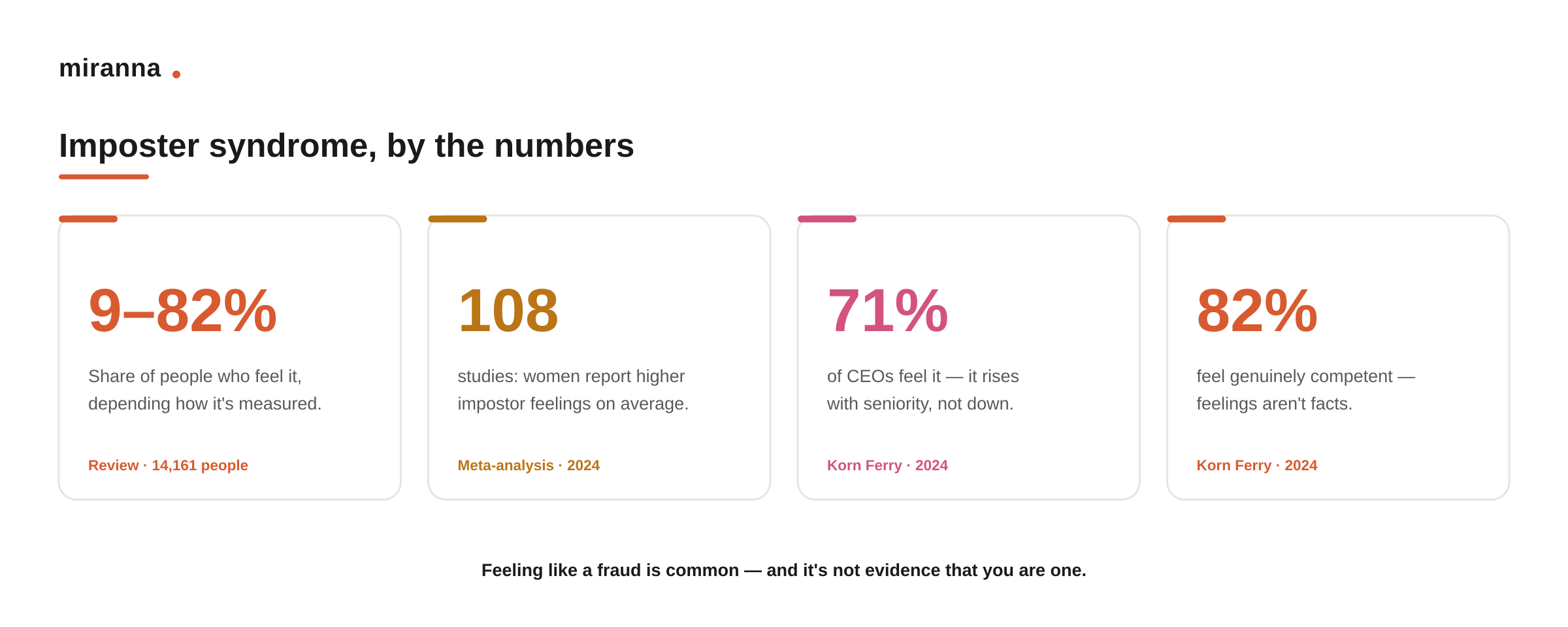
A few numbers worth holding onto: in a systematic review of 62 studies and 14,161 people, prevalence ranged anywhere from 9% to 82% depending on how it was measured — meaning almost everyone brushes up against it. That same review tied imposter feelings to burnout, anxiety, and lower job satisfaction. And the Korn Ferry data found something telling: imposter feelings rose with seniority — about 71% of CEOs reported them — even though 82% of employees said they were genuinely competent at their jobs. Feeling like a fraud and being one are clearly two different things.
What does imposter syndrome look like at work?
This is where it costs the most, because it quietly edits your career.
It sounds like staying quiet in the meeting because your idea “probably isn’t ready.” It looks like not applying for the role you’re 80% qualified for. It’s the over-preparing that eats your weekends, the apology that opens every email, the promotion you talk yourself out of asking for. None of it is dramatic. That’s the problem — it’s a slow tax on ambition.
Picture a specific Tuesday. You’re in a meeting, you have the sharpest take in the room, and you sit on it — until a colleague says almost the same thing ten minutes later and gets the nod. You feel the sting, then immediately tell yourself your version wasn’t as good anyway. That single moment, repeated across a career, is how brilliant women end up underpaid and under-promoted while doing the strongest work.
It also feeds a loop. You doubt your competence, so you overwork to prove yourself, you succeed, you credit the overwork instead of yourself, and the bar resets higher. Left alone, that loop is a fast track to burnout — exactly the link the research keeps finding.
How do you overcome imposter syndrome?
You don’t “cure” imposter syndrome the way you’d clear an infection. You get better at not letting it drive. Here’s what actually moves the needle.
{{Article Banner}}
Separate the feeling from the fact
The feeling says fraud. The facts say you were hired, promoted, chosen, paid. Both can be true at once. When the voice starts up, try naming it plainly: “I’m having the thought that I don’t belong here.” That small bit of distance — thought, not truth — is the whole game.
Name it and say it out loud
Imposter feelings thrive in secrecy — the Soloist pattern especially. The first time you say “I feel like I’m faking it” to a trusted colleague or friend, two things happen: it shrinks, and you usually find out they feel it too. You’re not confessing a flaw. You’re describing a near-universal experience.
Keep the receipts
Memory is biased toward your misses. So build a record that isn’t. Keep a running note — call it a brag file if that’s less cringe — of wins, solved problems, and unprompted thank-yous. When the doubt spikes, you read evidence instead of arguing with a feeling. This is one of the simplest, most reliable tools, and almost nobody does it.
Find your mirrors
Part of why representation matters is that you calibrate against what you see. If everyone around you seems certain and senior, your own normal self-doubt looks like proof you don’t belong. So pick a few people who’ll reflect reality back to you — a mentor a step ahead, a peer who’ll be honest, a friend in a different field who sees your work clearly. They normalize the wobble and catch the moments you’re about to discount a real win. You don’t need a big network. You need two or three honest mirrors.
Let them think what they think
A lot of imposter dread is really fear of judgment — what they’ll think when they “realize.” But you can’t control what other people conclude about you, and trying to is exhausting. The freedom comes from dropping the project entirely: let them assume, doubt, or misjudge. Your job is the work and your own read of it, not managing everyone’s opinion of you.
Redefine what “good enough” means
A lot of imposter pressure comes from a quiet, impossible definition of competence: that you should know everything, never struggle, and produce perfect work on the first try. No one operates that way — not the people you admire, not the ones who seem effortless. Competence is the ability to figure things out, ask good questions, and recover from misses, not a permanent state of knowing everything in advance. When “good enough” means capable and learning instead of flawless, most of the fraud feeling has nowhere to stand.
Stop waiting to feel ready
This is the big one. Most women wait for confidence before they act. It runs the other way. You do the scary thing while still scared, it goes fine (or fine-ish), and that builds the confidence — not the other way around. Apply at 70%. Pitch the half-formed idea. Take the role before you feel fully qualified, the way the people around you already do.
One honest caveat: if the feeling tips into constant anxiety, low mood, or distress that follows you home, that’s worth talking through with a therapist or doctor. Imposter feelings often travel with anxiety, and there’s no prize for white-knuckling it alone.

What’s the opposite of imposter syndrome?
The cartoon opposite is overconfidence — the person who’s sure they’re brilliant with little to back it up, sometimes called the Dunning-Kruger effect. But that’s not the goal, and swapping one distortion for another won’t help you.
The real opposite is something quieter: grounded self-trust. It’s being able to hold “I’m good at this” and “I still have things to learn” in the same hand without panic. It’s taking a compliment with a simple thank-you instead of a rebuttal. You don’t need to feel like the smartest person in the room. You just need to stop assuming you’re the fraud in it.
FAQ
What is imposter syndrome?
It’s the persistent feeling that your achievements aren’t deserved and that you’ll be exposed as a fraud, despite real evidence of your competence. It’s a thinking pattern, not a clinical diagnosis.
What causes imposter syndrome in women?
A mix of internal and external factors: perfectionist standards, being underrepresented or the “only one” in a space, waiting for certainty before acting, and having competence questioned more often. A 2024 meta-analysis found women report higher impostor feelings on average, though workplace surveys show men experience it too — they just discuss it less.
How do I get over imposter syndrome at work?
Separate the feeling from the facts, say it out loud to someone you trust, keep a record of your actual wins, and act before you feel fully ready — confidence tends to follow action, not precede it.
Is imposter syndrome a mental illness?
No. It’s a common psychological experience, not a diagnosable disorder. That said, it often overlaps with anxiety, and if the distress is persistent, a mental health professional can help.
What’s the opposite of imposter syndrome?
Grounded self-trust — accepting your competence without needing to feel like the best in the room, and being able to learn without reading every gap as proof you don’t belong.
You’re not faking it
Here’s the part worth sitting with: the fact that you worry about being good enough is itself a sign you care, you have standards, and you’re paying attention — the opposite of an actual fraud. The feeling will probably visit again before your next big thing. Let it. You don’t have to believe it.
Want the ideas behind this without reading a stack of books? Miranna turns the best books and podcasts on confidence, mindset, and women’s wellbeing into short audio summaries you can listen to on your commute. Try Miranna free.

When you're ready to talk to someone
Sometimes the next step is having one good conversation. Miranna’s coaches work with women navigating career pivots, leadership doubts, and the moments between roles — at your pace, when you’re ready. Browse who you’d want to talk to and book a session right in the app.
When you're ready to talk to someone
Sometimes the next step is having one good conversation. Miranna's coaches work with women navigating burnout, hormonal shifts, relationships, and the in-between moments — at your pace, when you're ready.
Browse who you'd want to talk to and book a session right in the app.



People ❤️ Miranna